10 Game-Changing Active Learning Strategies for Students
Feb 4, 2026
Let's be real: rereading notes and highlighting your textbook until it glows is a total vibe... for 2004. It’s a passive, time-sucking grind that leads to late-night panic crams and knowledge that ghosts you the second you walk out of an exam. You’re juggling classes, a job, and maybe even a social life; you literally don't have time for study methods that don't hit. If you feel like you're putting in the hours but not seeing the grades, you're not alone, and it's not a skill issue. The problem isn't your effort—it's your outdated strategy.
The answer isn't to study harder, it's to study smarter. This is your official playbook for mastering the most effective, science-backed active learning strategies for students. Forget the generic advice. We're diving deep into ten legit techniques proven to help you learn faster, understand more deeply, and actually remember stuff long-term.
Inside, you'll get the full breakdown of each strategy:
What it is: The no-fluff explanation.
Why it works: The science behind the method, but make it interesting.
How to do it: Actionable, step-by-step instructions for any subject.
We'll also show you how to level up these methods with smart AI tools. For example, a tool like Vivora can instantly turn your messy lecture slides and chaotic notes into focused flashcards, practice quizzes, and study guides, automating the most boring parts of active learning. This guide is your one-stop shop for ditching passive cramming and adopting a system that actually gets you the grades you want without the burnout. Ready to upgrade your study game? Let's get into it.
1. Spaced Repetition
Cramming for a final feels like a rite of passage, but it’s basically the junk food of studying—a quick fix that leaves you with nothing. Spaced repetition is the anti-cram, a scientifically-backed method that makes info stick in your long-term memory. It’s one of the most powerful active learning strategies for students because it works with your brain's natural tendency to forget, not against it.
Instead of hitting a topic 20 times in one night, you review it at increasing intervals. You see the material right as you’re about to forget it, which sends a signal to your brain that this info is a keeper.
How to Implement Spaced Repetition
This is clutch for foundational concepts, vocab, formulas, and key dates—anything that needs to be memorized before you can tackle the bigger picture.
For Your Solo Grind:
Manual Method: After learning something, plan to review it 1 day later, then 3 days, then a week, then two weeks. Set calendar reminders so you don't flake.
Time-Saving Method: Let's be honest, manually making and scheduling flashcards is a huge time sink. Instead, upload your lecture notes or readings to an AI tool like Vivora. It instantly generates flashcards and quizzes that are automatically scheduled for you. It tracks what you know and what you're struggling with, so you're always studying the right thing at the right time.
In the Classroom:
Professors can start each class with a low-stakes "retrieval practice" quiz covering material from yesterday, last week, and last month. This forces everyone to keep up with older material.
Quick Tips for Success
Start Early: Don't wait until midterms. Begin using spaced repetition from the first week of class.
Keep Reviews Quick: These should be fast, like 5-15 minutes. The goal is just to recall, not re-learn from scratch.
Mix It Up: Combine this with other strategies. Use the concepts you've memorized to solve practice problems or explain the idea to a friend.
Focus on Weak Spots: Pay attention to the flashcards you keep missing. Those need shorter review intervals.
2. Interleaving
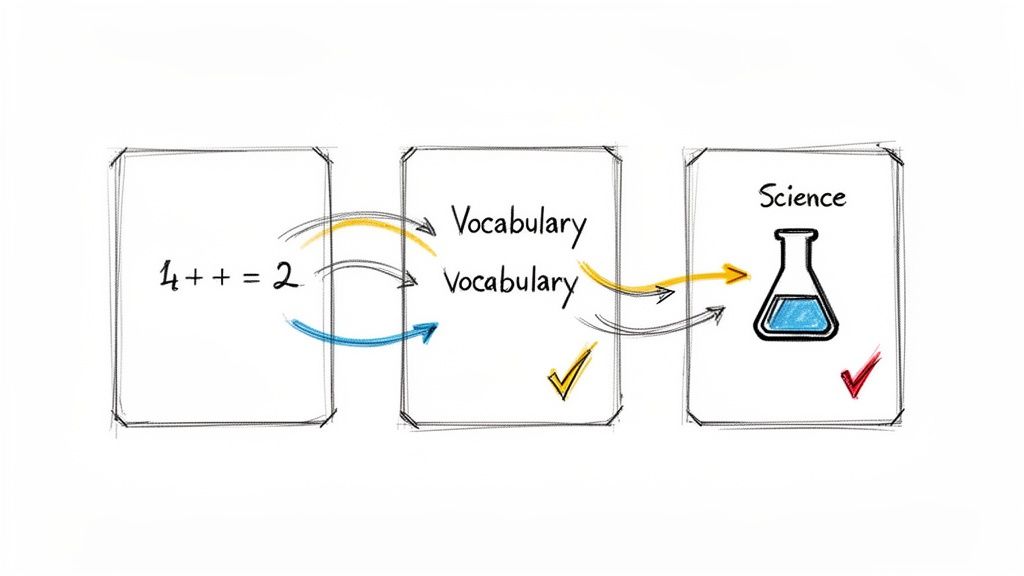
If you’ve ever studied by mastering Chapter 1 completely before even looking at Chapter 2, you’ve used a technique called "blocking." It feels super productive, but it can trick you into thinking you know more than you do. Interleaving flips this by mixing up different topics or problem types in one study session. It’s one of the best active learning strategies for students because it trains your brain to figure out which strategy to use, not just how to use one.
Instead of doing 20 algebra problems then 20 geometry problems, you’d mix them all together. This constant switching forces your brain to work harder to tell concepts apart and find the right solution for each problem. It’s tougher in the moment, but leads to way deeper knowledge that you can actually use on an exam.
How to Implement Interleaving
Interleaving is a game-changer for subjects like math, physics, chemistry, or even grammar rules in a language class. It preps you for exams where questions from different chapters are all mixed up.
For Your Solo Grind:
Manual Method: Studying for a history final? Don't just review chronologically. Make flashcards for events from different eras and shuffle them. For math, grab a few problems from Chapter 2, a few from Chapter 4, and a few from Chapter 5, and do them in a mixed set.
Time-Saving Method: Creating mixed problem sets by hand is tedious. A faster way is to upload all your relevant lecture notes to Vivora. It can generate a quiz that pulls questions from different topics, creating a perfectly interleaved practice session for you in seconds.
In the Classroom:
Professors can assign problem sets where questions aren't grouped by type. Instead of having a section for "Type A" and "Type B," the problems are mixed, making students figure out the problem type first.
Quick Tips for Success
Start with Similar Concepts: Interleaving works best when you mix related topics. For example, mix different types of chemical reactions, not chemistry and medieval history.
Don't Go Too Hard at First: Interleaving can feel like a lot. Start by studying a concept in a block for a bit, then immediately practice it in an interleaved set with stuff you already know.
Embrace the Struggle: It will feel harder than blocking. That feeling of difficulty is a sign that you're actually learning more deeply. Trust the process.
Use for Cumulative Reviews: This is your secret weapon for midterms and finals. Use your study tool to generate practice quizzes that cover everything to date.
3. Elaborative Interrogation
Just memorizing a fact doesn't mean you get it. Elaborative interrogation is a powerful technique that forces you to go beyond surface-level learning by constantly asking "Why?" and "How?". It's about questioning the material to build connections between new concepts and what you already know.
This method turns you from a passive listener into an active detective. By explaining why a fact is true or how a process works, you build deeper, more lasting memories. This is one of the most effective active learning strategies for students because it shifts you from just knowing what something is to understanding why it matters.
How to Implement Elaborative Interrogation
This strategy is perfect for complex subjects where understanding connections is everything, like history, biology, or literature. Use it to grasp the big ideas behind the facts.
For Your Solo Grind:
Manual Method: As you read your textbook, pause after each key concept and ask yourself a "why" or "how" question. For history, you might ask, "How did specific economic conditions lead to this war?" For biology, "Why do cells need mitochondria, and how does that actually work?" Write down your answer before checking the text.
Time-Saving Method: Coming up with good questions is half the battle. Instead, use Vivora's AI chat. After uploading your lecture notes, you can ask it targeted questions like, "Generate five 'why' questions about the Krebs cycle from my lecture" or "Explain how the author's childhood influenced the themes in this book." It gives you expert-level prompts to guide your learning.
In the Classroom:
Instructors can use think-pair-share activities where students first answer a "why" question on their own, then discuss and refine their answers with a partner before sharing with the class.
Quick Tips for Success
Start with Prompts: If you're new to this, begin with questions from your professor before you start making your own.
Say It Out Loud: Don't just answer in your head. Actually saying or writing down your explanation forces you to be precise and reveals any gaps in your understanding.
Connect to Your Life: Try to link the new material to other classes or real-world experiences. For example, "How does this economic theory explain the pricing at Starbucks?"
Compare Notes: In a study group, compare your "why" answers. Hearing how other people explain something can unlock a new level of understanding for you.
4. Retrieval Practice (The Testing Effect)
If you've ever spent hours re-reading your textbook only to blank out on the exam, you've hit the wall of passive review. Retrieval practice, also known as the testing effect, flips the script. It’s the powerful idea that actively pulling information out of your brain is way more effective for long-term memory than just putting it back in by re-reading.
This isn’t about the stress of a big exam. It’s about using low-stakes quizzing as a learning tool. Every time you force yourself to recall a concept, you strengthen its neural pathway, making it easier to find later. This is one of the most proven active learning strategies for students, turning testing into your most effective study session.
How to Implement Retrieval Practice
Retrieval practice is a must for any class that requires you to remember and apply info, from biology to history.
For Your Solo Grind:
Manual Method: After a lecture, put your notes away and write down everything you remember. This "brain dump" forces you to retrieve key ideas. Then, check your notes to fill in the gaps.
Time-Saving Method: Instead of just re-reading, upload your lecture slides or notes to an AI tool like Vivora. It can instantly generate a practice quiz on the material. Taking these quick quizzes after each class is a seamless way to build retrieval practice into your routine without any extra effort.
In the Classroom:
Professors can use "exit tickets," asking students to answer a question or two about the day's lesson before they leave. It’s quick retrieval practice that also gives the professor feedback.
Quick Tips for Success
Quiz Yourself Often: Don't wait for the midterm. Make frequent, low-stakes quizzing a regular part of your study cycle.
Mistakes are a W: Getting a question wrong is a good thing. It pinpoints exactly what you don't know, showing you where to focus your energy.
Explain, Don't Just Recall: Try to explain concepts out loud to yourself or a friend without looking at your notes. This is next-level retrieval.
Combine with Other Tools: Retrieval practice works perfectly with flashcards. To get better at them, check out how to create effective flashcards for your retrieval sessions.
5. Concept Mapping and Visual Organization
Just reading your notes is passive. To really understand complex subjects, you need to see how all the pieces fit together. Concept mapping is a visual strategy that forces you to organize information, draw connections between ideas, and build a mental blueprint of a topic. It's one of the most effective active learning strategies for students because it moves you beyond memorizing random facts and into actually synthesizing the material.
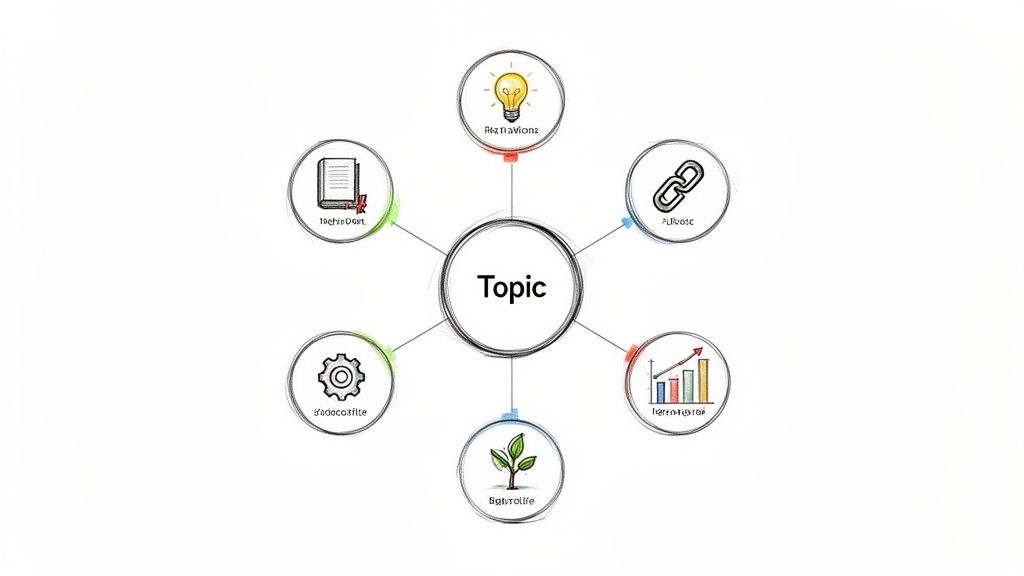
Instead of a linear list, you create a diagram or flowchart. This process shows you the hierarchy of information, reveals cause-and-effect relationships, and instantly highlights any gaps in your understanding. You’re not just consuming information; you’re building it.
How to Implement Concept Mapping
Concept mapping is a lifesaver for subjects with interconnected systems like biology, history, or psychology. Use it to visualize everything from cellular processes to historical timelines.
For Your Solo Grind:
Manual Method: Start with a central topic in the middle of a blank page. Branch out with main ideas, then connect related sub-topics. Use lines and short phrases (like "leads to" or "is a type of") to explain the relationships.
Time-Saving Method: Starting from a blank page is tough. An easier way is to upload your lecture materials to Vivora. Its AI-generated notes are already organized for you, giving you a perfect outline. Use this structure as a guide to build your visual map, ensuring you don't miss key concepts.
In the Classroom:
Professors can have students work in small groups on a shared digital whiteboard to map out a complex unit, then present their map to the class to explain their thinking.
Quick Tips for Success
Start with a Foundation: Use an organized source, like Vivora’s AI notes, to identify the main topics and sub-topics you need to include in your map.
Explain the Links: Don’t just draw lines. Write a short phrase on each connecting line to define the relationship between the two concepts.
Revise It: Create a draft of your map as you're learning. After a few days, try to recreate it from memory and then compare it to your original to fill in gaps.
Collaborate: Share your map with a study group. Seeing how others connect ideas can give you new insights and correct your misunderstandings.
6. Peer Teaching and Collaborative Learning
Ever tried to explain something to a friend only to realize you don't understand it as well as you thought? That's the magic of peer teaching. Explaining an idea to someone else is one of the best ways to find gaps in your own knowledge and lock in your understanding. It forces you to organize your thoughts and say them clearly.
This is one of the most effective active learning strategies for students because it turns studying from a solo mission into a social, dynamic process. When you teach, you learn twice. You get to hear different perspectives and reinforce concepts through discussion, making tough material way less intimidating.
How to Implement Peer Teaching
Peer teaching is perfect for tackling complex theories, working through multi-step problems, and reviewing big topics before an exam. It turns passive review into an active conversation where everyone wins.
For Your Solo Grind:
Structured Study Groups: Get a small group together (3-4 people) and assign a different topic to each person. During your meeting, each person "teaches" their section to the others.
Time-Saving Method: To keep everyone on the same page, create a shared study space with a tool like Vivora. Everyone can upload their lecture notes, and the AI will generate one unified study guide. Use this shared resource as the foundation for your group discussions on Discord or Slack, so you're all working from the same core material.
In the Classroom:
Professors can use the "Think-Pair-Share" method. Pose a tough question, give students a minute to think, have them discuss their answer with a partner, and then share the paired conclusion with the class.
Quick Tips for Success
Assign Roles: To keep study groups from turning into a hangout, rotate roles like "discussion leader," "note-taker," or "quizmaster."
Use Shared Resources: Have your group use an AI-generated study guide from Vivora as your "single source of truth" to avoid confusion.
Quiz Each Other: Use AI-generated quizzes from your course materials to test each other. It gamifies the review and instantly shows where the group is weak.
Explain "Why": The "teacher" should always explain why something works. The learners should always ask "why" if the explanation is unclear.
7. Metacognitive Monitoring and Self-Assessment
Ever finished a study session feeling like a genius, only to blank on the exam? That’s the "illusion of fluency" at work. Metacognitive monitoring is the skill of accurately judging your own learning—basically, “thinking about your thinking.” It’s one of the most crucial active learning strategies for students because it forces you to be honest about what you actually know versus what you just feel like you know.
By actively checking your understanding, you can find your weak spots and adjust your study plan. Instead of wasting time re-reading chapters you already get, you can focus your energy where it will actually boost your grade.
How to Implement Metacognitive Monitoring
This strategy is a game-changer for exam prep. It makes sure your study time is efficient and targeted.
For Your Solo Grind:
Confidence vs. Competence Check: Before reviewing a topic, rate your confidence from 1-10. Then, take a practice quiz on it. Compare your score to your initial rating. The gap is where you need to focus.
Time-Saving Method: The easiest way to do this is with an AI study tool. After you upload your materials to get AI-generated notes, Vivora's dashboard tracks your quiz performance topic by topic. It gives you hard data on your strengths and weaknesses, so there's no guesswork. You can see exactly which concepts are tripping you up.
In the Classroom:
Professors can use "exam wrappers," which are short reflection worksheets students fill out after an exam is graded. Students analyze the types of mistakes they made and plan new study strategies for the next test.
Quick Tips for Success
Quiz First, Review Second: Always try to answer practice questions before looking at the answers. This is a true test of your knowledge.
Keep a "Struggle" List: After each study session, jot down the top 2-3 concepts you struggled with. This becomes your priority list for the next session.
Explain It Out Loud: Try to explain a tough concept to an imaginary person. If you stumble or can't explain it simply, you don't know it well enough yet.
Use the AI Chatbot: If a quiz reveals a weak spot, ask Vivora’s AI chatbot to explain the concept in a different way or provide more examples until it finally clicks.
8. Problem-Based Learning (PBL) and Case Studies
Memorizing facts feels pointless if you don't know how to apply them. Problem-based learning (PBL) and case studies flip the script: you start with a complex, real-world problem and learn the content you need to solve it. It’s one of the most effective active learning strategies for students because it directly connects knowledge to application, which makes you more motivated and helps you understand things better.
This approach forces you to think like a professional. You’re not just answering questions; you’re a doctor diagnosing a patient or a consultant advising a company. You actively find your knowledge gaps, do the research, and work with others to propose a solution.
How to Implement PBL and Case Studies
PBL and case studies are amazing for courses that require critical thinking, like medicine, law, business, and engineering.
For Your Solo Grind:
Deconstruct the Problem: Start by breaking down the case. What do you know? What do you need to find out? What are the core questions you need to answer?
Time-Saving Method: When tackling a complex case, it's easy to get lost in a sea of browser tabs. Use an AI tool like Vivora to create a dedicated workspace. You can upload the case study, lecture notes, and articles all in one place. Use the AI chat to clarify complex concepts or explore different solutions without getting sidetracked.
In the Classroom:
Professors can give the class a real-world case study and break students into small groups. Each group works through the problem and presents their solution at the end of the unit.
Quick Tips for Success
Embrace the Unknown: The point of PBL is to not know all the answers at the start. Focus on asking the right questions to guide your learning.
Connect Theory to Practice: As you learn new things in lectures, constantly ask, "How does this apply to my case study?"
Collaborate Effectively: In a group, assign roles. Who's doing the research? Who's putting the presentation together?
Test Your Understanding: After researching a case, use your notes on Vivora to generate a quiz on the key concepts. This ensures you’ve truly mastered the material.
9. Dual Coding and Multimedia Learning
Ever notice how it’s easier to remember something from a YouTube video than a boring textbook chapter? That’s dual coding. This theory says our brains process words and visuals through separate channels. When you combine both, you create two memory pathways, making the info much easier to recall.
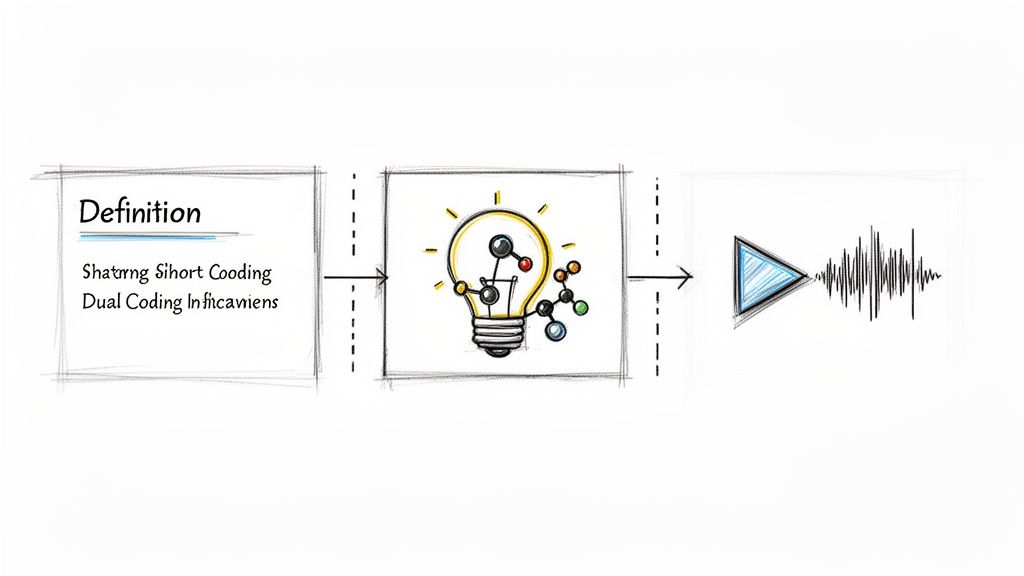
Just reading text over and over only engages one channel. By pairing words with visuals like diagrams, videos, or even your own doodles, you give your brain twice the chance to lock in the material. This is one of the most effective active learning strategies for students because it works exactly how our brains are wired.
How to Implement Dual Coding
Dual coding is a lifesaver for complex, abstract topics. Think chemistry students watching 3D molecular animations or language learners using audio clips with vocab images.
For Your Solo Grind:
Manual Method: As you take notes, sketch simple diagrams or flowcharts in the margins that represent the key ideas.
Time-Saving Method: Stop juggling a million tabs. Centralize your learning by uploading everything—your lecture notes, textbook chapters, and relevant YouTube or TikTok clips—into an AI tool like Vivora. It keeps all your resources organized in one place, so you can generate flashcards and quizzes that combine text and visuals for a true dual coding experience.
In the classroom:
Professors can pair their explanations with a clear visual on a slide, like a graph or timeline. They can also ask students to draw a concept from memory as a quick retrieval exercise.
Quick Tips for Success
Match Media to Message: Make sure your visuals actually explain the text. A random, decorative image won't help.
Create Your Own Visuals: The act of drawing a diagram, even a messy one, is a powerful way to process information.
Use Image-Text Flashcards: When making flashcards, put the term on one side and a relevant image with a short explanation on the other.
Don't Overdo It: Avoid sensory overload. A clean, simple diagram is often more effective than a cluttered, confusing video.
10. Distributed Practice and Study Scheduling
Pulling an all-nighter is a campus legend, but it’s a terrible way to learn. Distributed practice is the smart alternative: spreading your study sessions out over time instead of cramming them into one marathon. This is one of the top active learning strategies for students because it gives your brain time to process and store new info.
Think of it like going to the gym. You wouldn't do a single, 10-hour workout and expect results. You train for shorter periods, consistently. Distributed practice applies that same logic to learning, leading to stronger long-term memory and less burnout.
How to Implement Distributed Practice
This is key for managing a heavy course load and truly mastering subjects over a semester. It’s about playing the long game.
For Your Solo Grind:
Calendar Blocking: At the start of the semester, block out short, recurring study sessions for each class. Instead of a 3-hour cram session on Sunday, schedule 30-45 minute review blocks every other day.
Time-Saving Method: Planning this manually is a pain. A better move is to use a tool like Vivora to generate quizzes from your course materials. You can then schedule these quizzes to pop up consistently, creating an automated and distributed review system that keeps the material fresh.
In the classroom:
Professors can schedule smaller, more frequent quizzes instead of relying only on a midterm and a final. This encourages students to keep up with the material.
Quick Tips for Success
Start Day One: Create your study schedule during the first week of class. Don't let the material pile up.
Keep Sessions Focused: Shorter, 30-45 minute sessions are ideal for maintaining focus and preventing burnout.
Mix in Retrieval: Use your scheduled time to take a quick quiz or try to explain a concept from memory.
Plan for Breaks: Schedule lighter study days after intense ones to let your brain rest. Check out our guide to planning your weekend study sessions for maximum results to avoid burnout.
Comparison of 10 Active Learning Strategies
Strategy | Implementation Complexity 🔄 | Resource Requirements ⚡ | Expected Outcomes ⭐ | Ideal Use Cases 💡 | Key Advantages 📊 |
|---|---|---|---|---|---|
Spaced Repetition | Moderate — requires scheduling and discipline | Low–Moderate — software (Anki/Vivora) + regular time | Superior long-term retention; efficient consolidation ⭐ | Cumulative exams, language vocab, licensure prep | Reduces study time for same gains; adaptive review |
Interleaving | Moderate–High — requires mixed-content design | Moderate — organized question bank and planning | Improves transfer and discrimination between problem types ⭐ | Math, problem-solving, mixed-topic exams | Prevents false fluency; strengthens pattern recognition |
Elaborative Interrogation | Low–Moderate — prompt-driven self-explanation | Low — prompts and time for reflection | Deeper conceptual understanding and connections ⭐ | Concept-heavy courses (history, biology, engineering) | Enhances reasoning and metacognition |
Retrieval Practice (Testing Effect) | Moderate — regular quiz/test creation and scheduling | Moderate — question authoring, feedback mechanisms | Very high retention and diagnostic feedback ⭐⭐⭐ | Exam prep, weekly practice, professional tests | Strong evidence base; builds exam readiness |
Concept Mapping & Visual Organization | Moderate — time to create and refine maps | Low–Moderate — paper or digital mapping tools | Better organization, gap identification, comprehension ⭐ | Complex systems, essay planning, synthesis tasks | Externalizes mental models; aids spatial memory |
Peer Teaching & Collaborative Learning | Moderate — group formation and structure needed | Low–Moderate — peer time, coordination tools | Improved articulation, error detection, motivation ⭐ | Seminars, lab groups, study communities | Multiple explanations; social accountability |
Metacognitive Monitoring & Self-Assessment | Moderate — requires regular reflection and calibration | Low — tracking tools or journals | More efficient study, accurate confidence calibration ⭐ | Self-directed learning, long courses, exam prep | Targets weak areas; reduces overconfidence |
Problem-Based Learning & Case Studies | High — complex scenario design and facilitation | High — curated cases, instructor time, materials | Deep transfer, practical problem-solving skills ⭐ | Professional programs (medicine, business, engineering) | Authentic application; develops critical thinking |
Dual Coding & Multimedia Learning | Moderate — design and integrate multiple media | Moderate–High — multimedia creation and playback tools | Enhanced comprehension via multiple encoding routes ⭐ | Visuo-spatial topics, demonstrations, language learning | Multiple memory pathways; supports diverse learners |
Distributed Practice & Study Scheduling | Moderate — requires advance planning and habit formation | Low — scheduling tools and consistent time blocks | Strong long-term retention; reduced fatigue ⭐ | Semester-long courses, spaced test prep | Sustainable learning; lowers cognitive burnout |
Your New Study Playbook is Here. Go Ace That Exam.
You've made it. You could have spent this time passively highlighting a textbook, but instead, you invested it in learning how to learn. That's a power move that will pay off long after your next exam.
We've unpacked ten game-changing methods to turn you from a passive note-taker into an active, engaged learner. You're no longer just consuming information; you're interacting with it, questioning it, and making it your own.
From Knowledge to Action: Your Next Steps
Knowing these strategies is one thing, but actually using them is where you'll see a real glow-up in your grades. Shifting from passive to active learning isn't an overnight switch. It's about building new habits, one study session at a time.
Here’s a quick recap of the main principles and how to start using them today:
Move Beyond Rereading: Your biggest takeaway should be this: reading and rereading is one of the least effective ways to study. Instead, prioritize pulling info from your memory.
Embrace the Struggle: Active learning can feel harder than just staring at your notes. That feeling of effort is a sign that your brain is building stronger connections. This is where real learning happens.
Mix It Up: Don't just stick to one strategy. The magic happens when you combine them. Use spaced repetition for your flashcards, try elaborative interrogation to understand why something works, and then teach it to a friend to lock it in.
Let AI Be Your Study Buddy: Modern study tools like Vivora are designed to automate the most boring parts of active learning. Stop spending hours manually making flashcards. Let AI handle the prep so you can focus on the actual learning.
The goal is to stop being a passive spectator in your own education. You're now the architect of your knowledge. By using techniques like the testing effect, concept mapping, and interleaving, you are actively building a deeper understanding of your subjects. This is the difference between cramming for a test and actually mastering a topic for good.
Key Insight: The most effective students don't just study harder; they study smarter. They have a system. These active learning strategies are your blueprint for that system.
Think of it this way: you wouldn't try to build a house without tools. You shouldn't try to build knowledge without the right cognitive tools either. Spaced repetition, retrieval practice, and dual coding are your new power tools. They make the work more efficient and the final product stronger. Mastering these active learning strategies for students gives you a massive advantage that will serve you throughout your academic and professional career. You've got the playbook; now it's time to get to work.
Ready to put these strategies into action without the hassle? Upload your lecture notes, PDFs, or even a YouTube link to Vivora, and let our AI instantly generate the flashcards, quizzes, and study guides you need to start studying actively in minutes. Stop wasting time on setup and start mastering your material today at Vivora.