How to Study for Exams and Actually Reclaim Your Life
Feb 3, 2026

If you’ve ever pulled an all-nighter, you know the vibe. Fueled by questionable energy drinks and a whole lot of panic, you try to cram an entire semester's worth of info into your brain. It feels productive, but let’s be real: it’s the least effective way to actually learn anything long-term.
Cramming is like trying to fill a water bottle with a firehose. Your brain just isn't built for that kind of information dump, and most of it ends up splashing right out.
Move Beyond Cramming and Create Your Study Ecosystem
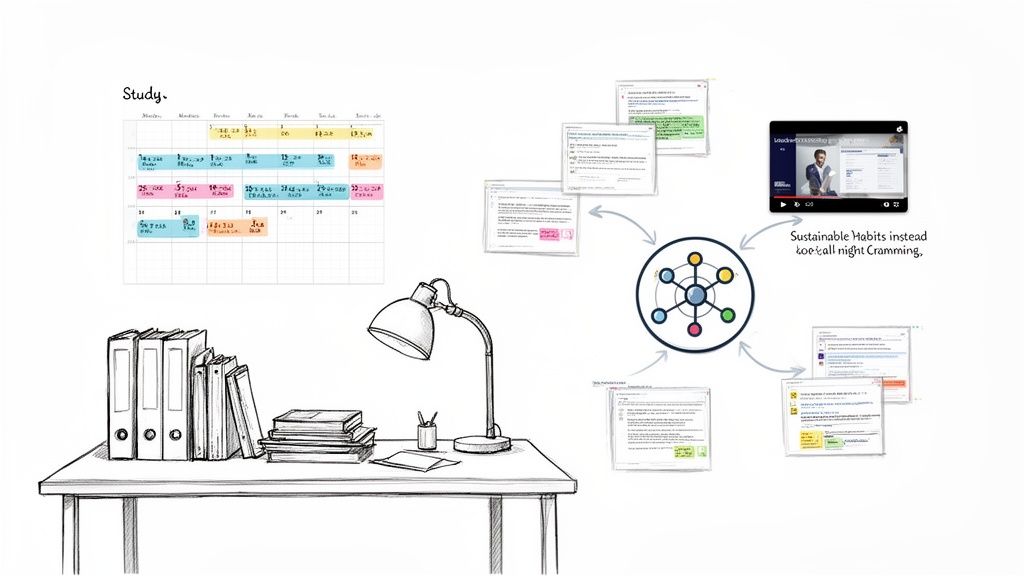
Look, acing your exams isn't about one heroic, last-minute effort. It’s about building a smart, sustainable system. The goal is to ditch the panicked cramming for a planned, active learning strategy that works with your brain, not against it. The key is to organize your materials early, review them consistently, and use active recall methods like self-quizzing instead of just passively re-reading your notes.
Embrace Spaced Repetition
The real secret to making information stick is a technique called spaced repetition. Instead of a single, brutal 8-hour study marathon, you break it down into several shorter, focused sessions spread out over days or even weeks. This simple shift works with your brain’s natural learning process, reinforcing what you know each time you revisit a topic.
This is a major reason why students are moving away from old-school methods. The global exam prep market is huge, growing from $66.12 billion in 2022 to a projected $70.67 billion in 2023. Students everywhere are looking for smarter, tech-driven ways to study because the old ways just don't cut it. In fact, some studies show that spaced repetition can boost long-term recall by up to 200% compared to cramming.
The biggest mistake students make is treating studying as a one-time event before an exam. The most effective way to study for exams is to see it as a continuous process that starts on the first day of class.
Let's quickly break down why this strategic approach beats the last-minute panic every single time.
The Cram Session vs. Smart Studying Showdown
Method | What It Looks Like | The Result |
|---|---|---|
The Cram Session | A frantic, 8-hour, caffeine-fueled marathon the night before the exam. | Information overload, high stress, and you forget almost everything a week later. It's short-term panic management, not learning. |
Smart Studying | Consistent, 45-minute review sessions two or three times a week, starting weeks in advance. | Deep understanding, low stress, and knowledge that actually sticks. You walk into the exam feeling prepared, not panicked. |
The difference is clear. One approach is about surviving, while the other is about truly succeeding.
Build Your Central Hub
To make spaced repetition and smart studying work, you need to get organized from day one. That’s where the idea of a "study ecosystem" comes in.
Right now, you probably have notes in one app, lecture slides in a messy desktop folder, and helpful YouTube links lost in your browser history. A study ecosystem brings all of that into a single, central hub.
Think of it as your digital command center for each class. This is exactly what tools like Vivora are built for. It’s an AI-powered study tool that lets you upload all your scattered content—PDFs from your professor, your own class notes, PowerPoint slides, even that one TikTok that finally explained a tricky concept—and transforms it into a personalized study guide.
By building this ecosystem early, you turn chaos into a clear, structured resource. You’re not just storing files; you’re creating a foundation for consistent, low-stress review. When it’s finally time for serious exam prep, everything you need is already organized and waiting for you. This is how you stop reacting and start preparing.
Ready to see how it works? Learn more about how an AI study assistant can build your ecosystem.
Build Your Digital Brain Before Panic Sets In
Let's be real: the biggest reason we end up cramming is because our stuff is everywhere. You've got lecture notes in one Google Doc, a random PDF textbook download on your desktop, PowerPoint slides buried in your email, and that one perfect YouTube video lost to the algorithm. When it’s finally time to study, half the battle is just finding everything.
This disorganization is procrastination's best friend. Instead of learning, you spend hours on a digital scavenger hunt. The key to studying effectively is to beat this chaos before it starts by building a centralized "digital brain" for each course.
This isn't just about making a neat folder. It's about creating a single source of truth for every class, so when you sit down to revise, everything you need is already there, ready to go. You’re not wasting precious energy on admin; you’re diving straight into the material.
From Digital Mess to Study-Ready
Building this digital brain should be your first move at the start of the semester, not your last resort during finals week. Think of all the different types of content you get for just one class:
Lecture Slides: Usually a jumble of PowerPoints or PDFs.
Your Notes: Typed, handwritten, or maybe just a few bullet points you texted yourself.
Reading Materials: Textbooks, articles, and supplementary PDFs.
Visual Aids: Links to YouTube tutorials or Khan Academy videos.
Gathering all these materials proactively is a game-changer. It turns a reactive, stressful process into a planned, low-effort habit. Once you have everything in one place, you can finally start making sense of it all.
This is where AI tools like Vivora completely change the dynamic. Instead of just storing files, Vivora takes all that scattered content you've gathered and instantly transforms it into a structured, personalized study guide. You’re not just organizing; you’re transforming raw information into usable knowledge from day one.
The goal is to spend your time learning the material, not just finding it. Proactive organization is the ultimate study hack because it saves you from future-you’s panic.
Imagine you're studying for Biology 101. You have a folder filled with lecture slides on cellular respiration, a few blurry photos of whiteboard diagrams, a link to a video on mitosis, and your own scattered notes. By yourself, you'd have to manually piece it all together.
With Vivora, you just upload everything. The AI reads the slides, understands the diagrams, processes the video content, and integrates your notes. Within minutes, it generates a clean, cohesive study guide.
Here's a glimpse of how Vivora instantly organizes your uploaded materials into a clear study guide format.
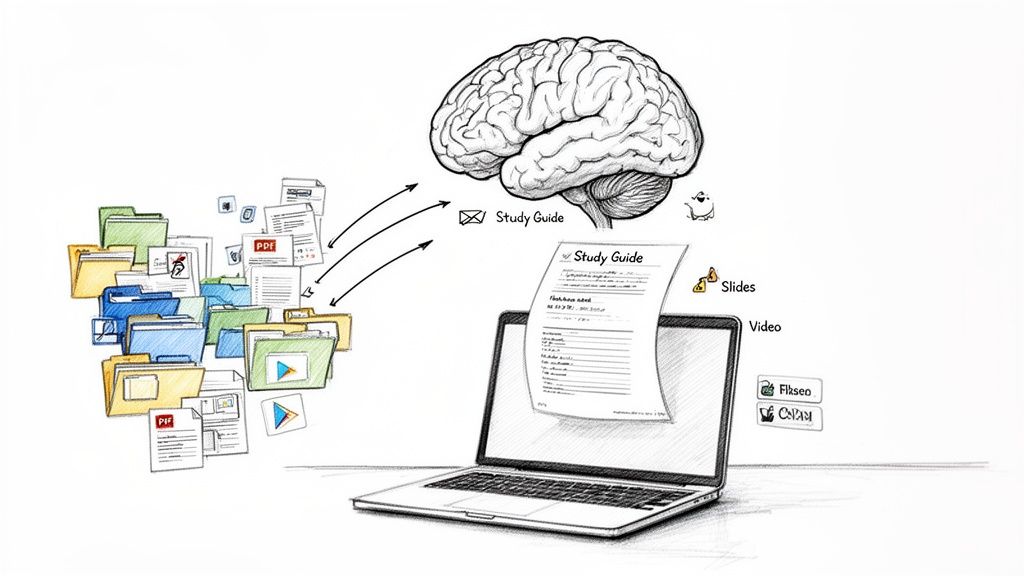
This process eliminates the tedious work of manually piecing information together, letting you focus on understanding the core concepts from the very beginning.
Why This Works
Creating a digital brain isn't just about being neat; it’s about reducing cognitive load. When your brain doesn't have to worry about where to find information, it has more power to actually process and remember it. You’re setting yourself up for success by removing the friction that leads to procrastination.
You can learn more about how to create automatically generated notes from your materials and see how this approach simplifies your workflow.
This proactive organization means that when exam season hits, you're not starting from scratch. You're starting from a position of power, with a complete, AI-organized resource at your fingertips. Instead of frantically searching for that one crucial slide on the Krebs cycle, you’ll have it neatly summarized and ready for review. This is the difference between surviving your exams and acing them.
Learn Actively to Actually Remember Things
Alright, so you’ve gathered all your course materials in one place. Big W. But this is where most students stumble. They fall into the trap of just re-reading their notes over and over, hoping the information will somehow soak into their brain through osmosis.
Spoiler alert: it won't.
Mindlessly scanning your notes is passive learning. It feels productive, but your brain is essentially asleep at the wheel. To actually lock in that information for your exam, you need to switch gears to active learning. This means forcing your brain to get its hands dirty—to wrestle with the concepts and actually pull information from your memory instead of just staring at it on a page.
Stop Highlighting and Start Explaining
One of the most powerful ways to do this is with the Feynman Technique. It sounds complicated, but the core idea is incredibly simple: try to explain a concept in your own words, as if you were teaching it to a friend who has no idea what you're talking about. If you stumble, get stuck, or have to use a bunch of jargon, you don't really get it yet.
For example, instead of just re-reading the definition of "photosynthesis," try explaining the entire process out loud without looking at your notes. You'll immediately discover where your understanding gets fuzzy. Those gaps are gold—that's where the real learning begins.
This simple exercise forces you to move beyond just recognizing a term. You have to actually understand the story behind it, which is a much deeper level of knowledge.
Make Your Brain Work with Active Recall
The true secret weapon for effective studying is active recall. It’s the simple act of deliberately retrieving information from your memory. Every time you pull a fact out of your brain, you strengthen the neural pathway to it, making it easier and faster to find next time—like during the actual exam.
The two best ways to put active recall into practice are self-quizzing and using flashcards.
Self-Quizzing: Don't wait for your professor to hand you a practice test. Make your own. After you review a chapter, close the book and scribble down everything you can remember. Or, go through your notes and turn every heading and subheading into a question, then try to answer it from memory.
Flashcards: They're a classic for a reason. They isolate one piece of information at a time, forcing you to retrieve a specific definition, formula, or key date without any clues.
The only hang-up? Creating all these quizzes and flashcards from scratch is a massive time sink—time you probably can’t afford to lose. This is where a tool like Vivora becomes your study MVP.
Instead of spending hours on the manual labor of creating study materials, you can invest that time in what really moves the needle: actually engaging with the content. The whole point is to automate the prep work so you can focus on the real work of learning.
Once you’ve uploaded your lecture slides and notes into Vivora, its AI goes to town. It automatically reads and understands the content, then generates practice quizzes and digital flashcards for you.
Think about it. You upload your messy notes and a 50-slide PowerPoint for your history class. In minutes, Vivora hands you back a custom quiz on the major battles of the Civil War and a complete deck of flashcards with key figures and dates. All that tedious work is just… done. You can jump straight into the most effective part of studying: testing yourself.
This is a complete game-changer, no matter the subject.
For a science class like Anatomy: Upload your lecture on the muscular system. Vivora instantly creates flashcards for every single muscle, origin, and insertion point.
For a literature class: Give it your notes on The Great Gatsby, and it will generate a quiz testing you on major themes, symbols, and character motivations.
By automating the busywork, you remove the friction that keeps most students from using these incredibly powerful techniques. You can learn more about how to level up your study sessions with AI-generated flashcards. It’s all about working smarter, not harder, so you can walk into your exam knowing you’ve got this.
Schedule Your Study Sprints Like a Pro
Okay, you’ve organized your digital brain and embraced active learning. Now it's time to tackle the final boss of effective studying: time management. Knowing what to study is only half the battle. Knowing when and how to schedule it is what separates the prepared from the panicked.
The goal isn't to study for eight hours straight—your brain literally checks out after the first hour or so. It’s about scheduling short, intense study sprints that maximize your focus and energy. Quality over quantity is the name of the game here.
Master the Pomodoro Technique
If you haven’t heard of the Pomodoro Technique, it’s about to become your new best friend. It’s a ridiculously simple but effective way to manage your focus. You just study in intense 25-minute sprints (called "pomodoros"), then take a 5-minute break. After four of these sprints, you take a longer break of 15-30 minutes.
This method works because it forces you into a state of deep focus for a short, manageable period. It helps you fight off distractions and prevents the burnout that comes from those long, draining study sessions. Instead of telling yourself, "I have to study for three hours," you just need to commit to the next 25 minutes. Easy.
The secret to effective time management isn't finding more hours in the day. It's about making the hours you have more intentional and focused. Short bursts of deep work are always more productive than long hours of distracted "studying."
Time Blocking Your Week for Success
The Pomodoro Technique works best when you pair it with time blocking. This is where you actually schedule your study sprints into your calendar like appointments. And I mean be specific. Don't just block off "Study Bio." Instead, schedule "Review Chapter 3 Flashcards (1 Pomodoro)" or "Practice Psych Quiz (2 Pomodoros)."
Here’s what a smart study week might look like, baking in some spaced repetition:
Monday: Attend class. That evening, spend one Pomodoro sprint uploading your new lecture notes into Vivora to generate a study guide.
Wednesday: Do a quick 15-minute review of Monday's material using Vivora’s auto-generated flashcards. This reinforces the concepts before you forget them.
Friday: Use two Pomodoro sprints to take a practice quiz on the week's content.
Sunday: Dedicate a longer block (3-4 Pomodoros) to review all the material from that week and tackle any tricky concepts.
This approach builds a feedback loop. You're constantly studying, testing yourself, and figuring out what you don't know before the pressure of a big exam hits.
This is exactly the kind of modern approach students are looking for. The demand for personalized and efficient learning is why the test preparation market is booming, expected to grow from $126.0 billion in 2024 to $177.9 billion by 2030. This surge is all about flexible, data-driven methods that give you an edge. AI tools that benchmark your performance are part of this trend, helping you focus your time efficiently instead of just guessing. You can learn more about the massive growth of the test preparation industry on marketresearch.com.
Let Your Data Guide Your Schedule
This is where your study plan gets really smart. After taking a practice quiz on Vivora, you get immediate feedback on your performance. You're no longer just guessing what your weak spots are—you have the data to prove it.
Maybe you scored 95% on cellular respiration but only 60% on mitosis. Boom. Now you know exactly what to focus on in your next study block. You can tell Vivora’s AI chatbot to give you more practice questions on mitosis or generate a new set of flashcards specifically for that topic.
This simple workflow shows how you can use Vivora to turn your class content into a powerful, data-driven study loop.
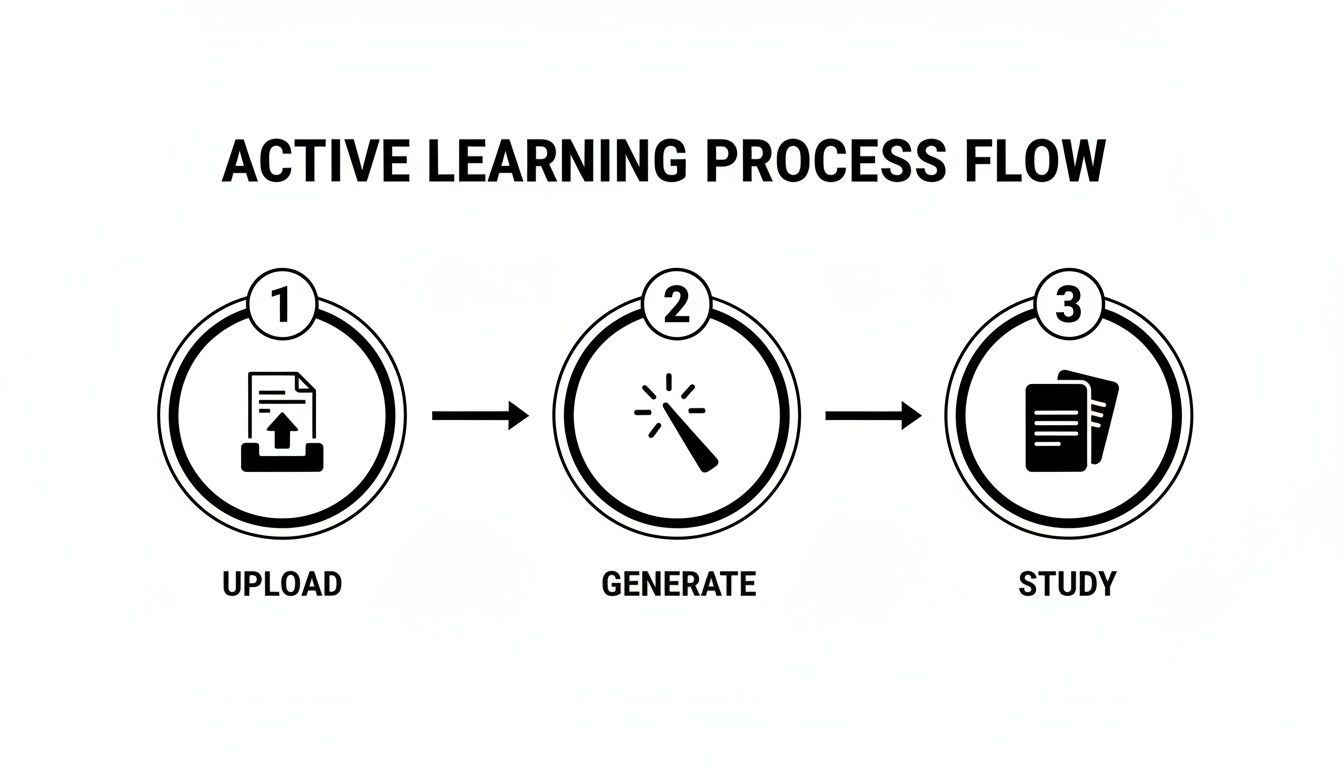
By following this upload-generate-study process, you’re creating a personalized learning cycle that adapts to your needs. This data-driven approach allows you to prioritize your schedule with surgical precision, ensuring you spend your limited time on the topics that will actually move the needle on your grade.
Own Your Exam Day with Confidence
You’ve built your digital brain, mastered active recall, and scheduled your study sprints. The finish line is in sight. But let's get one thing straight: the final 24-48 hours before an exam are not for cramming new information.
Think of it as the cool-down lap after a hard workout, not a frantic final sprint. This is where you shift from intense learning to smart, strategic review. It's time to trust the work you’ve put in.
The Final Review: Not a Cram Session
Let’s be really clear about this: a final review is the opposite of cramming. It’s a strategic pass-through of the most important concepts, just to bring them to the front of your mind. It’s like loading the software right before you run the program.
Your focus should be on high-level summaries and those few tricky spots you've been working on. This is where your organized Vivora ecosystem becomes your secret weapon.
Skim Your Summary Notes: Do a quick read-through of the high-level summary notes Vivora generated for you. This will snap the big-picture connections between topics back into focus.
Target Your Trickiest Flashcards: Don’t waste time flipping through every single card. Zero in on the decks that cover concepts you’ve consistently stumbled on.
Get Last-Minute Clarifications: Got that one nagging question about a specific formula or historical date? Instead of falling down a Google rabbit hole, just ask Vivora’s AI chatbot. Getting a clear, concise answer in seconds can be a massive confidence boost the night before.
The night before an exam, your brain's main job is to rest and organize the information you've already learned. Overloading it with new material is counterproductive and will only spike your anxiety.
Fuel Your Brain and Body
How you treat your body in the hours leading up to the test is just as important as your final review. You wouldn't run a marathon without sleeping or eating properly, and taking a major exam is no different. Neglecting your physical and mental well-being is a rookie mistake that can undo weeks of hard work.
Make these non-negotiables a priority:
Get a Full Night's Sleep: Seriously. Aim for 7-9 hours. Sleep is when your brain solidifies memories through a process called memory consolidation. Sacrificing sleep for an extra hour of studying is scientifically one of the worst trade-offs you can make.
Eat a Balanced Breakfast: Ditch the sugary cereal or energy drink. Go for a meal with protein, healthy fats, and complex carbs—think eggs, avocado toast, or oatmeal. This provides sustained energy and prevents that dreaded mid-exam crash.
Hydrate: Drink water, but don't overdo it right before you walk into the exam hall. You want to be focused on the questions, not on finding the restroom.
Tame Test Anxiety
Feeling nervous is completely normal. A little bit of adrenaline can even sharpen your focus. The problem starts when those nerves turn into overwhelming anxiety, which can absolutely sabotage your performance.
The key is to have a simple, go-to technique to calm your nervous system down. One of the most effective methods out there is box breathing. It's discreet, quick, and incredibly powerful.
Here’s how you do it:
Inhale slowly for a count of four.
Hold your breath for a count of four.
Exhale slowly for a count of four.
Hold at the bottom for a count of four.
Repeat this cycle three or four times right before the exam starts, or anytime you feel a wave of panic setting in during the test. This simple act sends a signal to your brain that you're safe and in control, helping you think more clearly.
You’ve prepared for this. Now go show them what you know.
Your Questions on Effective Studying Answered
Even with the best game plan, you're bound to have some questions pop up. That’s perfectly normal. Let's run through some of the most common ones I hear from students trying to nail down their study process.
Think of this as a quick-fire round to fine-tune your approach and help you walk into your next test feeling like you've got it handled.
How Long Should I Actually Study Each Day?
This is the million-dollar question, isn't it? But the answer isn't some magic number. First, forget the idea that you need to pull an eight-hour library marathon. The real goal is quality over quantity.
Most research shows that for focused learning, your brain has its limits. A solid starting point is 1-2 hours of dedicated study per day outside of class. The trick is to break this time into shorter, intense sprints. Remember the Pomodoro Technique we talked about? Think 25 minutes of focused work, then a 5-minute break.
This approach stops burnout in its tracks and actually helps your brain lock in the information. So, instead of one long, draining session, aim for a few powerful sprints. It's way more effective and a whole lot less painful.
What Is the Single Best Way to Study?
If you only have the bandwidth to add one new habit to your routine, make it active recall. This is the non-negotiable, MVP of all study techniques. Seriously.
Active recall is the simple act of pulling information out of your brain, not just passively shoving it in by re-reading. It’s the difference between vaguely recognizing a concept on the page and truly knowing it.
The best ways to do this are pretty straightforward:
Self-Quizzing: Don't just scan your notes. Turn them into questions and try to answer them from memory, without peeking.
Flashcards: A classic for a reason. They force you to retrieve one specific piece of information at a time.
The Feynman Technique: Grab a whiteboard or a blank piece of paper and try to explain a tough topic in simple terms, as if you were teaching it to a friend.
This is exactly why tools like Vivora are such a game-changer. Instead of spending hours creating all these materials yourself, the AI does the heavy lifting. You can upload your lecture slides and instantly get auto-generated quizzes and flashcards, letting you jump straight into the good stuff—active recall.
The most common mistake students make is confusing familiarity with real understanding. Just because you recognize something in your notes doesn't mean you can explain it on an exam. Active recall is the only way to bridge that gap.
How Do I Deal with Subjects I Find Super Boring?
We’ve all been there. That one required class that feels like watching paint dry. Staying motivated when you dislike a subject is tough, but it's not impossible. The trick is to find an angle that makes the material more engaging for your brain.
Try connecting the boring topic to something you actually find interesting. If history puts you to sleep but you love video games, think about the military strategies behind historical battles. If economics is a drag but you're into fashion, research the supply chain and market forces that dictate what's in style.
Another great strategy is to gamify it. Use Vivora’s practice quizzes to challenge yourself to beat your last score. Introducing a little bit of competition—even if it's just with yourself—can make reviewing even the driest material feel a little more compelling.
Should I Study in a Group or Alone?
This one really comes down to your personality and the subject itself. There’s no single right answer here, and honestly, a mix of both is usually the best approach.
Here’s a quick breakdown to help you decide when to fly solo and when to team up:
Study Method | Best For | Watch Out For |
|---|---|---|
Studying Alone | Deep, focused work like memorizing facts, reading dense material, and taking practice tests. | Getting stuck on a concept with no one to ask, or losing steam without some accountability. |
Group Studying | Explaining concepts to each other (hello, Feynman Technique!), brainstorming big ideas, and quizzing one another. | Sessions turning into social hour, getting way off-topic, or one person doing all the talking. |
A solid strategy is to do the initial heavy lifting on your own. Get a decent grasp of the material first. Then, get together with a small group to hash out the tricky concepts and test each other.
Is It Okay to Use AI Tools to Help Me Study?
Absolutely. Using AI to study isn't cheating; it's just being efficient. Think of it less like getting the answers and more like having a personal TA who's available 24/7 to organize your notes and whip up practice materials for you.
The demand for smarter study tools is exploding. In fact, the global test prep market is projected to hit USD 825.68 million by 2030. A big reason for that growth is that students need more effective, tech-driven ways to keep up. Research has even shown that adaptive assessments—a core part of many AI platforms—can boost scores on major tests like the SAT by 20-30%. This just proves that personalized, data-informed studying is the future. You can check out more insights on the growth of the test prep market over at Business Wire.
Tools like Vivora don’t do the learning for you. They automate the tedious, time-sucking tasks—like making flashcards from scratch or trying to organize a semester's worth of chaotic notes. That frees up your time and mental energy to focus on what actually moves the needle: understanding and remembering the material.