AI for Learning: Your Guide to Smarter Studying
Feb 23, 2026
Let's be real, studying can feel like trying to drink from a firehose. You’re juggling lecture slides, PDFs, YouTube tutorials, and a mountain of messy notes. It's chaotic.
This is where AI for learning completely changes the game.
It’s not about robots taking over your classes. Think of it as a study sidekick that finally gets how students actually work. Imagine an app that takes all your scattered materials—yep, even that rambling two-hour lecture recording—and instantly organizes them into something you can actually use.
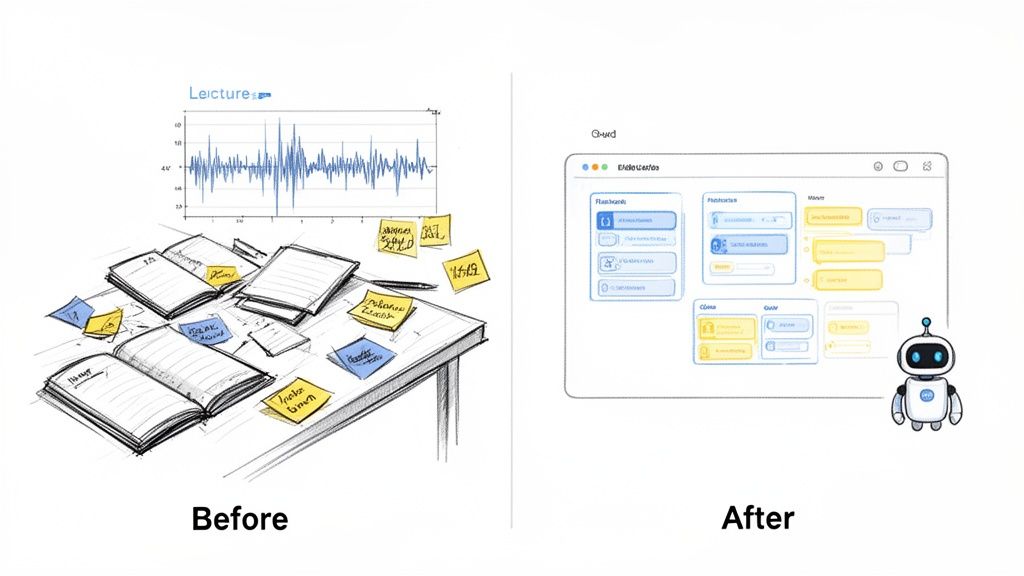
The Old Way vs. The AI Way to Study
This isn’t just a minor tweak to your routine; it's a complete study workflow glow-up. Think about all the hours you've wasted just trying to track down the right info or re-watching lectures to find that one key concept. AI tools cut out all that frustrating busywork.
They pull everything into one place, pinpoint the important stuff, and get you ready to practice what you’ve learned in a matter of minutes.
The goal is simple: study smarter, not harder. AI helps you focus on actually understanding the material instead of getting bogged down in endless organization.
For example, instead of manually making flashcards for your biology midterm, you could just upload your lecture notes to a tool like Vivora. The AI scans the content and generates a full set of cards based on the key terms and definitions your professor covered.
This shift from manual prep to automated learning is where the magic happens. You can find more helpful strategies in our guide to the best AI study tools that transform learning.
To see just how big of a difference this makes, check out this quick comparison of the old study grind versus the new, smarter way with AI.
Study Task | The Old Grind Without AI | The Smart Way With AI for Learning |
|---|---|---|
Note Taking | Frantically typing during lectures, then spending hours re-organizing messy notes. | Uploading a lecture recording or slides and getting an instant, clean summary. |
Making Flashcards | Manually writing out dozens (or hundreds) of cards, one by one. | Automatically generating a full deck of flashcards from your class materials in one click. |
Reviewing Content | Endlessly re-reading dense textbook chapters or scrolling through PDFs. | Asking an AI chatbot specific questions about your content and getting instant answers. |
Practice Quizzes | Searching for generic practice questions online that don't match your class. | Taking practice quizzes created directly from your own lecture notes and readings. |
Basically, AI handles the tedious parts of studying so you can dedicate your brainpower to what really matters: learning the material and acing your exams.
Why Is Everyone Suddenly Talking About AI Study Tools?
If it feels like AI study tools popped up on your feed overnight, you're not wrong. But this trend has been bubbling under the surface for years. Now, it's hitting a boiling point for one simple reason: students are fed up with outdated study methods.
The old-school approach of just re-reading textbooks and lecture notes doesn't cut it anymore. You’re juggling a full course load, maybe a job or an internship, and trying to squeeze in a social life. Your time is stretched incredibly thin, and you need study methods that are actually flexible and effective.
The Shift to Personalized Learning
Let's be real—every single student learns differently. Some people can pull key ideas from a dense academic paper, while others need a 2-minute video to make it all click. The problem is that traditional studying forces everyone down the same, often frustrating, path.
This is exactly why AI for learning is having a major moment. Students are actively hunting for smarter, more efficient tools that adapt to them, not the other way around. You need something that can take all your scattered materials—from PowerPoint slides to YouTube videos—and pull them into a single, cohesive study experience that actually works for your brain.
This huge demand is fueling a massive wave of innovation, and the AI education market is absolutely booming. The numbers are almost hard to believe.
The global AI in education market was valued at $7.05 billion in 2025 and is on track to hit a jaw-dropping $136.79 billion by 2035. This isn't just a small trend; it's a fundamental shift in how learning gets done.
This isn't just an abstract number, either. All that investment is being poured directly into building better, smarter, and more affordable tools designed specifically for students like you. In the U.S. alone, the market is expected to leap from $2.01 billion in 2025 to over $39.83 billion by 2035. If you want to see the full breakdown, check out this comprehensive AI in education report.
So, What Does This Mean for You?
Why should you care about market reports and growth charts? Because it means more competition to solve the exact problems you face every day. All this cash flooding the market directly benefits you.
It's the very reason tools like Vivora exist. We saw the chaos of students trying to piece together information from scattered files and disorganized notes and knew there had to be a better way. This market boom means companies are laser-focused on:
Accessibility: Building powerful AI tools that are genuinely easy to use. You should be able to get started in minutes, not spend hours learning a new system.
Affordability: Creating pricing that actually makes sense for a student budget. The goal is a massive return on your investment, both in time saved and better grades.
Real-World Solutions: Developing features that fix actual student headaches, like turning a long lecture recording into instant flashcards or answering specific questions about your course readings.
At the end of the day, the explosion of AI study tools is a direct response to students saying, "There has to be a smarter way to do this." And now, thanks to this tech boom, there is.
How AI Actually Makes Studying Less Painful
So everyone's talking about AI. But how does it actually save you from those brutal, energy-drink-fueled all-nighters? Let's break down how it works, no confusing tech jargon necessary.
Think of an AI study tool like a personal DJ for your brain. You hand it a chaotic mess of lecture slides, textbook chapters, and random YouTube links, and it remixes everything into a perfectly curated study playlist designed just for you. It's not magic; it’s just a seriously smart workflow.
It Starts with Content Consolidation
First things first, AI has to kill the digital clutter. You know the routine—your history notes are in a Google Doc, the professor’s slides are on the campus portal, and that one super helpful explainer video is buried deep in your YouTube history. It’s a mess.
AI tools like Vivora act as a central hub for all of it. You can drop everything for one class into a single spot:
PDFs of your required readings
PowerPoint lecture slides
Links to videos from YouTube or TikTok
Even your own half-finished notes
This initial step, content consolidation, is an absolute game-changer. Instead of wasting time hunting through ten different folders and browser tabs before you can even start studying, everything is organized and ready to go. No more "Where did I save that file?" moments at 1 AM.
The diagram below shows how these tools are built around solving core student problems like efficiency, personalization, and just having a flexible way to study.
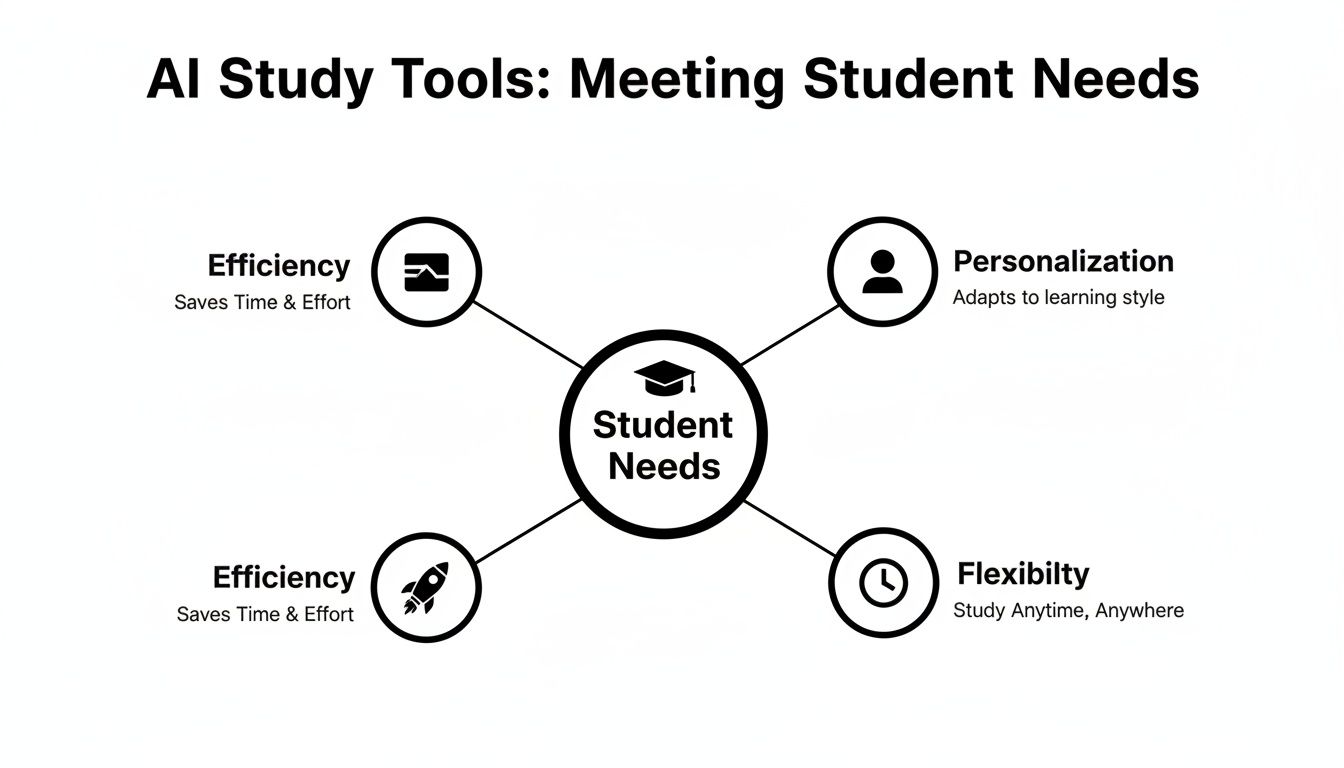
It’s a good reminder that this isn't just about cool tech; it's about tackling the real, practical headaches students deal with when trying to manage their time and workload.
Intelligent Summarization and Organization
Once all your materials are in one place, the AI gets to work. It reads, watches, and analyzes everything you’ve uploaded, with one goal: figuring out what’s actually important.
AI acts like a super-smart highlighter, automatically finding the key concepts, main ideas, and crucial vocabulary from hours of content. It then structures all that information into a logical, easy-to-read study guide.
This isn’t just a simple copy-paste job, either. The AI understands context. It can pull the definition of "mitochondria" from your textbook, connect it to the diagram in your lecture slides, and even add a summary from that video you uploaded, creating one cohesive explanation. This process of intelligent summarization saves you from the tedious, mind-numbing task of piecing everything together yourself.
Active Recall and Practice on Demand
This is where using AI for learning really starts to pay off. We all know that passively re-reading notes is one of the least effective ways to study. To actually remember things, your brain needs to be challenged—a method called active recall.
Instead of you spending hours writing out flashcards, the AI generates them for you instantly. It takes the key terms and concepts it already identified and turns them into a full deck of digital flashcards and practice quizzes. This is a massive time-saver, but the real win is how it changes your study sessions.
Custom Quizzes: The AI can generate multiple-choice questions or short-answer prompts based only on what your professor taught. No more sifting through generic Quizlet sets that don't quite match your curriculum.
Instant Feedback: You get immediate answers, helping you pinpoint what you know and where you need to focus your energy.
A 24/7 Tutor: Got a question at 3 AM? You can ask an AI chatbot to explain a concept using the information from your class materials, giving you a relevant, reliable answer on the spot.
This automated practice loop turns studying from a passive chore into an active, engaging process. If you want to dive deeper into making information stick, check out our guide on how to create flashcards that help you remember everything. By handling all the prep work, AI frees you up to spend time on the high-impact activities that actually lock knowledge in your brain.
Does AI for Learning Actually Boost Your Grades?
Okay, theory is cool, but let's talk about what actually matters: results. Does using AI for learning really help you score better on that midterm you’re stressing about?
The answer is a resounding "yes," and the proof is starting to pile up. This isn't just about saving time; it's about seeing a real, measurable impact on your GPA.
Students are already using these tools to get an edge, and it’s working—no matter what kind of student you are or what you're studying. The feedback is clear: this stuff works.
Real Scenarios, Real Results
Think about it. Maybe you're a high school student drowning in AP classes, with exams for Bio, US History, and Calc all hitting in the same week. Instead of building a fortress of textbooks in your room, you could upload your class notes and review packets into a tool like Vivora. In minutes, you’d have separate, organized study guides, flashcard decks, and practice quizzes for each subject, letting you switch gears without losing your rhythm.
Or maybe you’re a community college student pushing to transfer to a top-tier university, where every single grade is critical. You’re stuck on a tricky chemistry concept at midnight, and office hours are days away. With Vivora, you could ask its context-aware chatbot a direct question, and it would pull the answer straight from your professor's lecture slides. It’s like having a 24/7 tutor that knows exactly what you need to focus on.
This isn’t just a nice-to-have anymore; it's a serious academic advantage.
The Numbers Don't Lie
Universities are watching this shift closely, and they're seeing tangible improvements. In fact, AI-powered tools are delivering clear boosts in academic performance. Some studies report exam scores rising by as much as 10% for students using chatbots and guided support systems.
For most students, that’s the difference between a B+ and an A.
This isn't just hype—it reflects a booming market that’s laser-focused on student success. The AI education market hit $7.57 billion in 2025 and is on track to cross $30 billion by 2029. You can explore detailed AI in education statistics to see the full picture of this growth.
The bottom line is that AI provides personalized learning paths that traditional study methods just can't match. It adapts to your course load and your content.
This is even more critical for online students. It can be tough to stay engaged when you're learning from a distance. AI tools help bridge that gap by turning passive lecture videos into interactive materials, making it easier to stay focused and actually test your knowledge.
The social proof is right there: students who adopt these tools are seeing real benefits. They feel more confident, less stressed, and walk into exams better prepared. That's the true power of AI for learning.
Your Step-By-Step Guide to Using AI for School
Alright, you get the hype. Now it’s time to actually use AI for learning and see the results for yourself. Getting started is way easier than you think—no complicated setups or tech skills needed.
This is your practical playbook for building a smarter, faster study workflow. We’ll use Vivora as our example to show you just how quickly you can go from total chaos to a perfectly organized study hub.
Step 1: Gather Your Chaos
First things first, pick one class you want to conquer. Now, round up all the digital materials you have for it. We’re talking about every single file and link scattered across your hard drive and browser tabs.
Lecture slides (PowerPoints, Google Slides, PDFs)
Your own messy notes from class
Required reading articles and textbook chapters
Links to helpful YouTube tutorials or even TikTok explainers
The goal here is simple: get everything into one folder on your desktop. It might feel like a small step, but it’s the foundation for everything that comes next. You’re wrangling the digital mess before the AI even steps in.
Step 2: One-Click Upload
Now for the easy part. Once you have all your files, you just upload them directly into Vivora. It’s built to handle all the different formats you use every day, so you don't have to waste time converting anything.
Just drag, drop, and paste. That's it.
This single action moves all your scattered information into one central, intelligent space. No more bouncing between five different apps and a dozen browser tabs just to find one piece of information.
This four-step visual shows the entire process, from gathering your files to actively testing your knowledge.
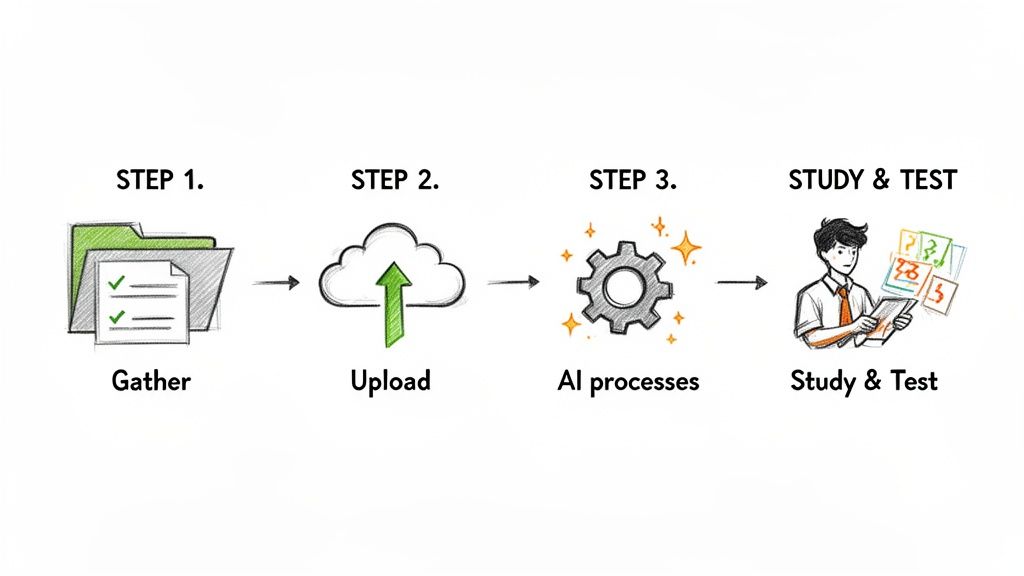
This workflow turns a messy pile of digital content into a powerful study resource in just a few minutes.
Step 3: Let the AI Work Its Magic
This is where you get to sit back and watch the heavy lifting happen. As soon as your content is uploaded, Vivora’s AI gets to work scanning, analyzing, and structuring everything.
It reads your lecture notes, "watches" the videos, and pulls the key concepts from your PDFs. Then, it automatically generates a complete, personalized study guide just for you.
Within a few minutes, you’ll have:
Clean, organized notes that summarize the most important information.
A full deck of digital flashcards based on key terms and definitions.
Practice quizzes that test you on concepts from your actual class material.
This isn’t some generic summary; it’s a study kit built entirely from the content your professor assigned. You’ve just turned hours of manual prep work into a task that takes less time than making a cup of coffee.
Step 4: Engage and Test Yourself
Your new study guide is ready, but here’s where you really lock in the knowledge. The final step is all about active recall—engaging with the material instead of just passively reading it.
Start by flipping through the AI-generated flashcards. Then, take a practice quiz to see where you stand. The instant feedback will show you exactly which topics need more of your attention.
The best part? If you get stuck on a concept, you don't have to go digging through your notes. You can use Vivora's built-in AI chatbot. Ask it a direct question like, "Can you explain the main causes of the Peloponnesian War based on the lecture slides?" It will give you a clear answer using only the information you uploaded. It's like having a 24/7 TA that knows your course inside and out. To get the most out of this feature, you can learn more about how to use AI homework help effectively in our other guide.
By following these four steps, you can turn a chaotic pile of files into a powerful study engine. You’ll spend less time organizing and more time actually learning—which is the ultimate goal.
Using AI Study Tools Responsibly
Let's talk about the elephant in the room. While AI is an incredible study partner, it isn't a magic wand. Think of it less like a machine that does the thinking for you, and more like a super-smart assistant who preps your materials so you can do your best work.
Using these tools the right way is what separates the students who thrive from those who get into trouble. It's all about being an active, critical user, not just a passive one.
Don't Trust Blindly—Always Check Your Facts
AI is fantastic at pulling out key ideas and summarizing dense material, but it's not perfect. It can occasionally misunderstand a super-complex topic or, even worse, have what developers call a "hallucination." It's a fancy term for when the AI makes something up that sounds completely plausible but is flat-out wrong. It happens.
This is exactly why you should treat anything an AI generates as a first draft, not the final word.
The golden rule is simple: Always cross-reference AI summaries with your original source material. Use the notes from a tool like Vivora as your guide, but take 60 seconds to scan your professor's slides or textbook chapter to confirm the key details are spot-on.
That quick double-check keeps you in the driver's seat and ensures you’re not studying confidently incorrect information. The last thing you want is to walk into an exam with bad info you got from a machine.
The Line Between AI for Studying and AI for Cheating
This is the big one, so we need to be crystal clear. Using AI to help you understand your material is smart studying. Using it to do the work for you is cheating. Period. And trust me, professors are getting shockingly good at spotting the difference.
Here’s the honest breakdown:
Smart Use (Studying): You upload your lecture notes to Vivora to get instant flashcards and a practice quiz. You’re using AI as a tool to create better study materials from your own content.
Not Smart (Cheating): You paste an essay prompt into an AI and submit whatever it spits out. You didn't do the thinking, and you certainly didn't learn a thing.
Academic integrity isn't just a buzzword; it's the foundation of your education. The whole point of AI for learning tools like Vivora is to help you process and truly master information faster—not to skip the learning part entirely. Use them to generate outlines, explain tough concepts in a new way, and test your knowledge. Just don't use them to write your papers.
Your Quick Checklist for Picking a Safe AI Tool
Not all AI tools are created equal, especially when it comes to your privacy and data. Before you start uploading your entire academic life to a random website, run through this quick mental checklist.
Do They Respect Your Privacy? Hunt for a clear privacy policy. Your notes and personal information shouldn't be used to train their models without your explicit permission or, worse, sold to someone else.
Is It Actually Built for Students? Generic AI models are powerful, but tools designed specifically for studying, like Vivora, are built with features that support learning, not just text generation.
Does It Encourage Active Learning? The best tools don't just hand you answers on a silver platter. They create materials like quizzes, flashcards, and practice questions that force you to engage your brain and actually lock the information in for your exams.
By being mindful and a little bit critical, you can turn AI into one of the most powerful assets in your academic toolkit. The goal is to enhance your own brainpower, not replace it.
Common Questions About AI for Learning
Got questions about using AI for learning? You’re not the only one. Diving into new tech can feel a bit weird, especially when your grades are on the line. Let's tackle the biggest questions students have so you can start studying smarter with total confidence.
Will Using AI Get Me in Trouble for Plagiarism?
This is the big one, so let’s be super clear: using an AI study tool like Vivora is not plagiarism. The line between a smart tool and a cheating machine is all about how you use it.
Think of it like this. Using Vivora to automatically generate flashcards and quizzes from your own lecture notes is just a faster, more efficient way to study. You’re still learning your material. Plagiarism is when you ask an AI to write your essay for you and then pass that work off as your own. One helps you learn; the other is just cheating.
To keep it simple, here are the do's and don'ts:
DO: Upload your class materials to get organized notes, flashcards, and practice tests.
DO: Ask an AI chatbot to explain a concept from your lecture in a different way.
DON'T: Ask an AI to write an original paper or answer your homework problems for you.
DON'T: Copy and paste AI-generated text directly into an assignment and claim it as your own.
Tools like Vivora are designed to be your personal study assistant, not your ghostwriter. They help you master your content, which is the whole point of school.
Is This Really Better Than Google or Quizlet?
Google and Quizlet are fine, but they're generic. When you search for a topic online, you get a flood of information that might not match what your professor actually taught. When you use a pre-made Quizlet deck, you're studying someone else's notes—and you have no idea if they’re even right.
The real difference with AI for learning is hyper-personalization.
An AI tool like Vivora learns from your specific class content—your lecture slides, your textbook readings, your notes. The study guides it creates are 100% relevant to the exam you’re about to take.
Instead of sifting through random stuff online, you get practice questions and summaries tailored precisely to your curriculum. It's the difference between a generic map and a GPS that knows your exact destination. This targeted approach is way more efficient and saves you from studying totally irrelevant material.
Is It Worth the Cost for a Student on a Budget?
We get it—every dollar counts when you're a student. Many AI study tools, including Vivora, operate on a subscription model, but they're built with the student budget in mind. Most offer a free trial so you can see the value for yourself before committing.
Think about the return on your investment. If a small monthly fee saves you dozens of hours of manual study prep and helps you bump your grade from a B to an A, is it worth it? For most serious students, the answer is a clear yes. It’s an investment in your time and your grades.
Ready to stop drowning in disorganized notes and start studying smarter? Vivora turns your chaotic class materials into personalized study guides in minutes. Give it a try and get your first study guide for free at https://vivora.ai.