What Is Active Learning and How Can It Save You From All-Nighters?
Feb 22, 2026
Ever sat through a lecture, furiously typing notes, only to realize an hour later you remember literally nothing? Yeah, we’ve all been there. That’s classic passive learning, where you’re basically a sponge trying to absorb info that just won't stick. The problem? Our brains aren't wired for that kind of info dump.
This is where active learning comes in clutch.
It’s the simple but game-changing idea that you learn best by doing things—like debating a topic, solving a problem, or even just trying to explain a concept to a friend. Think of it as the difference between watching a TikTok recipe and actually trying to cook it. One is entertainment; the other actually teaches you something.
From Passively Cramming to Actively Understanding
Active learning flips the script. Instead of just receiving information, you’re wrestling with it, questioning it, and connecting it to what you already know. You go from being a spectator in the lecture hall to a player on the field.
This one shift separates the students who actually get the material from those who just memorize it long enough to pass the test and forget it a week later.
The old-school way of studying is all about cramming, which is why that info vanishes from your brain post-exam. Active learning, on the other hand, is about building real, lasting understanding.
Here’s what that actually means for your life:
Fewer all-nighters: When you engage with concepts from day one, you don't need to panic-cram a semester's worth of content the night before the final.
Better grades (for real): A huge 2014 study found that students in active learning classes were 1.5 times less likely to fail than those in traditional lectures.
Skills that actually matter: Problem-solving and critical thinking aren’t just for passing exams; they’re the skills that will get you hired.
Let's quickly break down the difference.
Passive vs. Active Learning: The TL;DR
This table shows the core differences between just zoning out in a lecture and actually participating in your own education.
Activity | Passive Learning (The Old Way) | Active Learning (The Smart Way) |
|---|---|---|
Your Role | Listener, Observer | Participant, Creator |
Brain State | Absorbing, Memorizing | Questioning, Connecting |
Primary Goal | Information Reception | Skill Building |
Key Activities | Reading, Listening, Watching | Discussing, Solving, Teaching |
Retention Rate | Low (often < 20% after 24 hours) | High (often > 75%) |
Example | Watching a video on coding | Writing your own code |
As you can see, the difference isn't just what you do—it's how you think.
"Active learning isn't about studying more; it's about making the time you do study actually count for something. It’s the ultimate study hack."
The goal is to work smarter, not harder. Instead of re-reading a textbook chapter for an hour, spend 20 minutes trying to explain its main ideas to a friend. That one simple switch forces you to process the info, find your own knowledge gaps, and solidify what you actually know. This saves you hours of wasted effort and leads to real knowledge that sticks around long after the final.
Why Active Learning Actually Works, According to Science
Okay, so active learning sounds good, but does it actually help your GPA? The short answer is a hard yes—and it’s not even close. The science shows it’s one of the most legit ways to level up your grades.
It's not just about feeling more engaged in class. It’s about creating stronger connections in your brain so you can actually recall information when it counts, like during a high-stakes exam.
Think of it like this: passively listening to a lecture is like watching someone else’s workout video. You see the moves, but you’re not building any muscle. Active learning is you actually doing the workout—struggling through the reps and getting stronger as a result.
The Proof Is in the Grades
When you participate, discuss, and solve problems, you force your brain to engage with the material on a much deeper level. This isn't just a vibe; the data backs it up.
The stats are pretty wild. For instance, active learning sessions can hit a student participation rate of over 62%, while traditional lectures often get less than 5%. This massive jump in engagement leads directly to better outcomes.
Students in active classes have been shown to score up to 54% higher on tests and are 1.5 times less likely to fail. One university even saw its math course pass rates jump from 63% to 81% after making the switch. You can see more details about these impressive active learning results online.
This side-by-side comparison makes the difference painfully obvious.
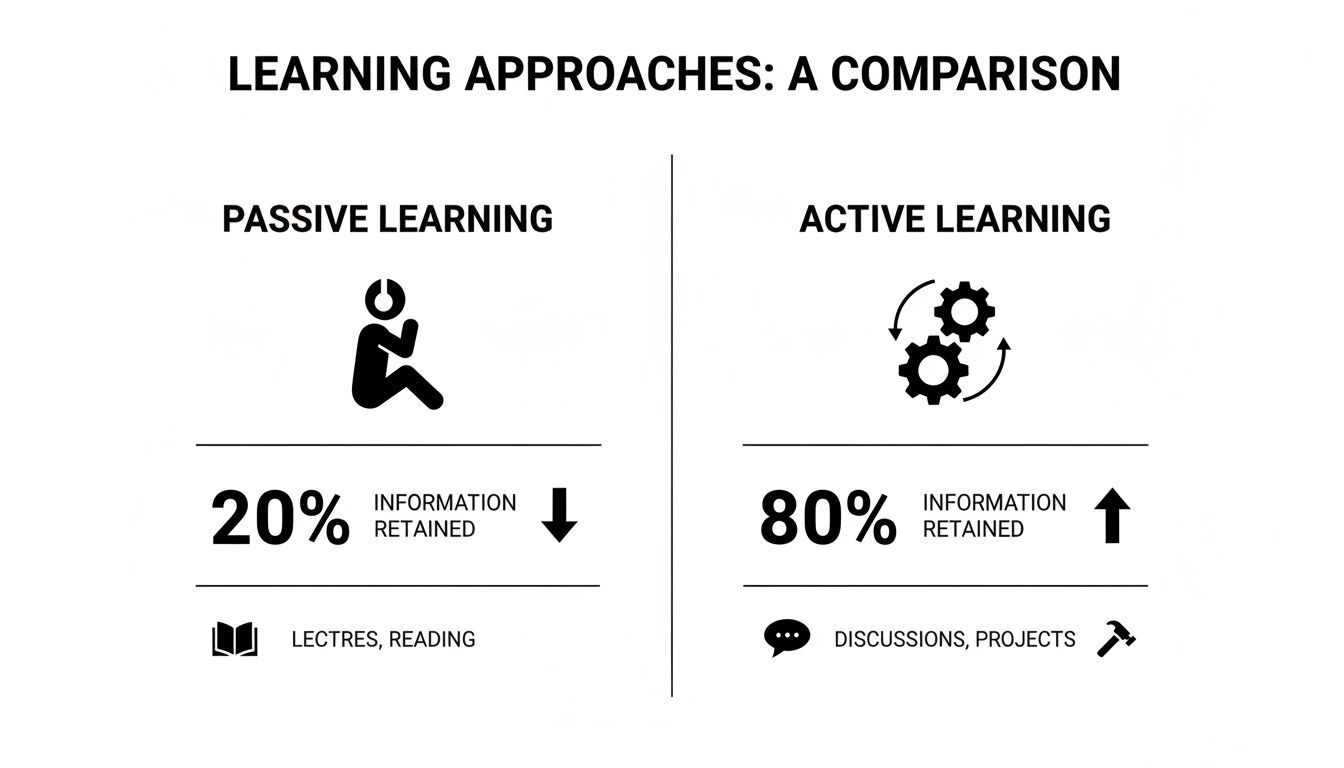
The visualization makes it crystal clear: active learning isn’t just a different style. It’s a more effective way to actually understand and remember things.
From Good Grades to Real-World Skills
The benefits go way beyond just acing your next midterm. Active learning is your training ground for the skills that actually matter after you yeet that graduation cap in the air.
When you learn actively, you're not just memorizing facts for a test. You’re building the mental toolkit for critical thinking and problem-solving that you’ll use for the rest of your career.
Every time you debate a topic in a breakout group or try to explain a complex idea to a classmate, you’re sharpening your communication and analytical abilities. These are the skills that employers are actually looking for, and they'll give you a serious edge. It’s a direct investment in your future, not just your GPA.
Active Learning Strategies You Can Use Right Now
Alright, theory is great, but let's get to the good stuff—the actual strategies that will level up your study game. Think of these as your new toolkit for making every class and study session count. No more highlighting your textbook into oblivion and just hoping for the best.
These are simple, actionable methods you can start using today. They’re designed to make learning less of a chore and help concepts actually stick, without the last-minute, all-night cramming sessions.
Quick Wins for Your Next Class
Even if your professor just lectures, you can still sneak some active learning into the experience. These techniques are low-key but super effective for processing info in real time.
Think-Pair-Share: This is a classic for a reason. When the prof asks a question, take a solid minute to think about it yourself. Then, turn to a classmate and quickly compare notes before anyone shares with the whole class. It’s a low-pressure way to test your understanding and hear another POV.
Turn Headings into Questions: Before you even start a reading assignment, scan the headings and subheadings. Flip each one into a question (e.g., "What were the main causes of the Cold War?"). This simple trick primes your brain to actively hunt for answers instead of just passively scanning words on a page.
Power Up Your Solo Study Sessions
This is where you can really take control. Active study habits are the secret to shorter, more effective study sessions and, you guessed it, better grades.
The Feynman Technique: Pick a concept you’re struggling with. Now, try to explain it out loud in the simplest terms possible, like you were teaching it to a middle schooler. If you get stuck or use a bunch of jargon, that’s your brain telling you to go back and review that specific part until you can explain it clearly.
Problem-Based Learning (PBL): Instead of just memorizing theories, find real-world problems or case studies related to your topic. Tackling a practical challenge forces you to actually apply what you've learned, which is way more effective than just reading about it.
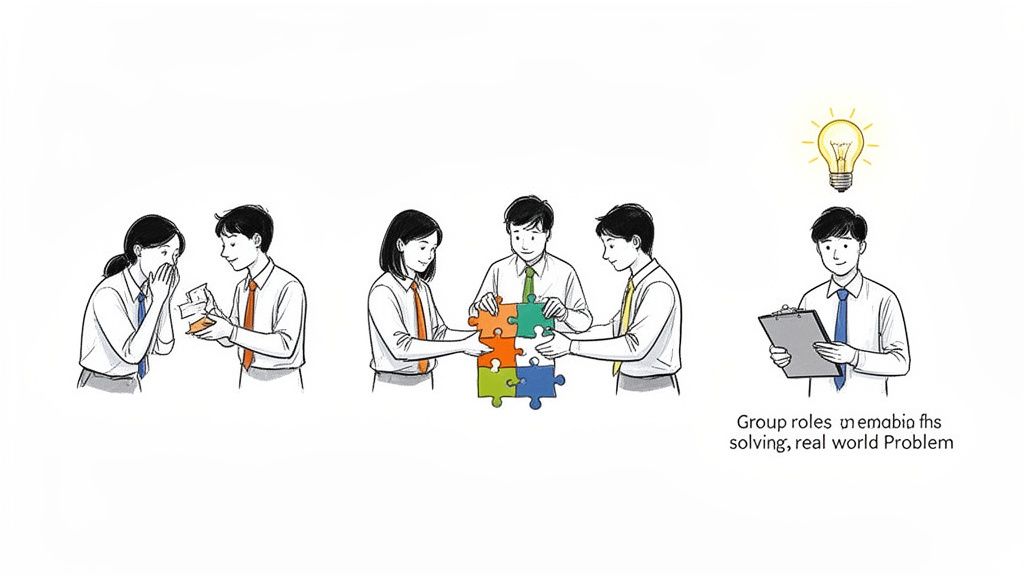
The Jigsaw Method: This one is clutch for group projects. Your team breaks a big topic into smaller pieces, and each person becomes an "expert" on one of those pieces. Then, you teach your section to the rest of the group. Everyone learns the whole topic by relying on each other.
The goal isn't just to cover the material; it's to uncover your own understanding. Active strategies force you to confront what you don't know, which is the fastest way to actually learn it.
Crush Your Next Exam with These Techniques
When it's crunch time, active recall methods are your best friends. They’re all about pulling information out of your brain, which is what strengthens your memory for test day.
Peer Instruction: Team up with a friend and quiz each other on the tough concepts. Having to explain an idea to someone else is one of the best ways to lock it into your own brain. You'll quickly find out what you really know vs. what you just kinda know.
Create Your Own Study Guides: Don't just mindlessly copy your notes. Synthesize all your class materials—slides, lecture recordings, textbook chapters—into one master guide. Or better yet, let an AI tool like Vivora do the heavy lifting. It can turn all that scattered content into organized notes, quizzes, and flashcards automatically. For more tips on making killer study materials, check out our guide on how to create flashcards that help you remember everything.
Your Active Learning Cheat Sheet
Feeling a little overwhelmed? Don't be. Here’s a quick-reference guide to help you pick the right tool for the job.
Technique | What It Is | Best For |
|---|---|---|
Think-Pair-Share | A 3-step process: think alone, discuss with a partner, then share with the class. | Quickly testing your understanding during a live lecture. |
Feynman Technique | Explaining a complex topic in simple terms, as if to a kid. | Finding and fixing the gaps in your own understanding. |
Problem-Based Learning | Solving a real-world problem using course concepts. | Applying abstract theories to concrete situations. |
Jigsaw Method | Each group member "masters" one part of a topic and teaches it to the others. | Efficiently covering a ton of material in a study group. |
Peer Instruction | Teaming up with a partner to quiz and explain concepts to each other. | Pre-exam review and making sure info actually sticks. |
Think of this table as your starting point. Experiment with a few and see what clicks for you and your classes. The key is to find what keeps you engaged and makes learning feel less like a chore and more like a challenge you can actually beat.
Turn Any Lecture into an Active Study Session
Let's be real—we’ve all sat through those mind-numbingly boring lectures. It’s just a fact of student life. But even when a professor just reads off the slides for an hour, you still have the power to turn that passive content into a powerful study tool.
This is where you stop being a passive listener and become the architect of your own learning. The trick is to transform that one-way info dump into an interactive study session—on your own time.
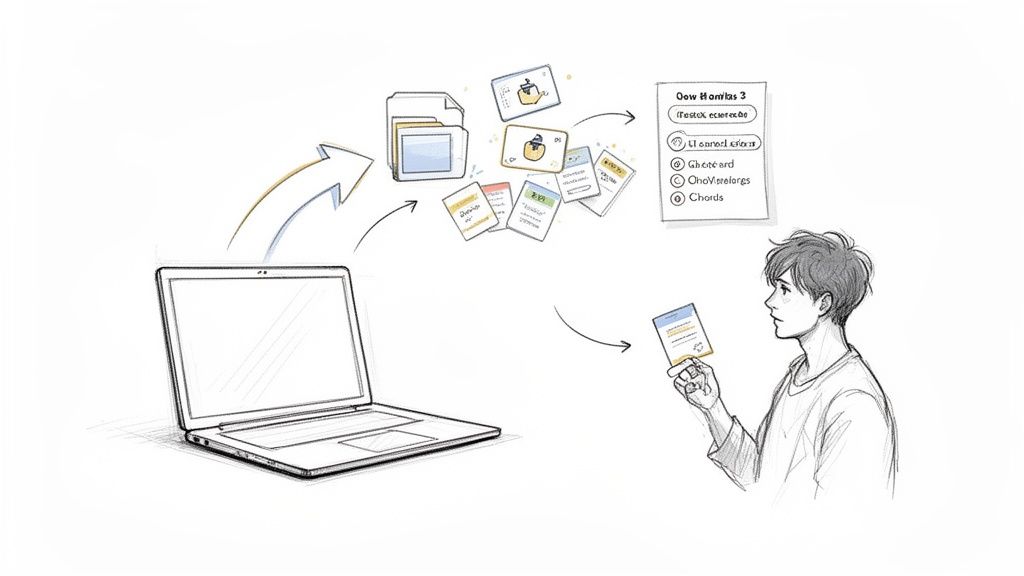
From Passive Content to a Personalized Study Guide
Instead of just re-watching a lecture or re-reading slides, your mission is to rework that raw material into something you can actually interact with. Manually, this means spending hours turning notes into flashcards or writing your own practice questions.
But who has time for that? The smarter move is to use technology to do the grunt work for you. This is where an AI-powered study tool like Vivora becomes your secret weapon.
The workflow is ridiculously simple:
Upload Everything: Grab your lecture recordings, slide decks, PDFs, or even a link to a YouTube video and drop them into Vivora.
Let AI Do the Work: The AI instantly analyzes all your content to pull out the key concepts, definitions, and important details.
Get Your Study Kit: In minutes, Vivora generates a complete, personalized study guide—with flashcards, practice quizzes, and organized notes ready to go.
This is what active learning in education looks like when it's powered by smart tech. You're not just studying; you're building a personalized learning engine.
Why This Method Saves You Hours
This process is the definition of working smarter, not harder. You’re automating the most time-consuming parts of study prep, freeing you up to focus on the actual learning. Instead of spending two hours making flashcards, you spend five minutes uploading files and get right to quizzing yourself.
By transforming passive course materials into interactive tools, you're building a system for active recall. This is way more effective than just passively re-reading the same info over and over.
This approach is perfect for:
Making sense of a dense or confusing lecture.
Quickly catching up on a class you missed.
Prepping for exams without the last-minute panic.
You’re no longer limited by a professor's teaching style. With the right tools, any content can become the foundation for a truly active and effective study session. Interested? Check out Vivora’s AI quiz generator and see how it can upgrade your study routine.
How AI Helps You Study Smarter, Not Harder
Okay, so you're sold on active learning, but finding the time to turn every lecture into a personalized study guide feels like a whole other assignment. Let’s be real, you’ve got enough on your plate. This is where AI stops being a buzzword and becomes a legit game-changer for your study routine.
AI tools like Vivora are built to automate the most tedious, time-consuming parts of active learning. Instead of burning hours manually creating flashcards or practice questions, you can let AI handle the grunt work. That frees you up to focus on the stuff that actually matters—like, you know, learning.
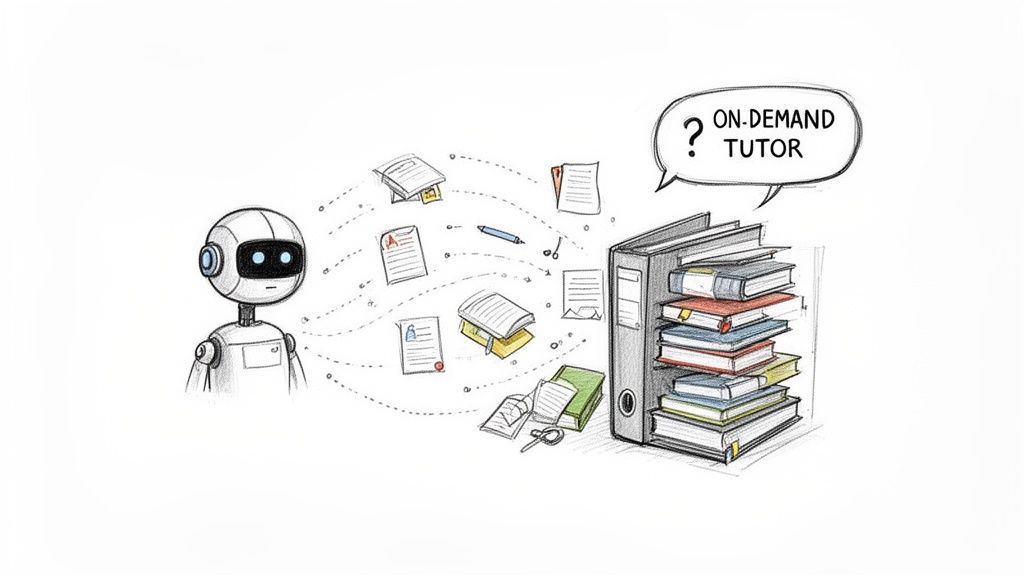
How AI Powers Up Proven Learning Methods
Using a tool like Vivora isn’t a shortcut; it's just a smarter way to apply proven learning principles more efficiently. The features are literally built around the active learning techniques we’ve been talking about.
Here’s the breakdown:
Auto-Generated Quizzes = Retrieval Practice: Those instant practice tests Vivora creates aren't just for checking your knowledge. They're based on retrieval practice. Forcing your brain to pull information from memory is scientifically proven to make it stick way better than just re-reading.
AI Chatbot = On-Demand Peer Instruction: Got a question at 2 AM? The AI chatbot acts like an instant tutor. This mimics the benefits of peer instruction—getting a concept explained in a different way until it finally clicks, without having to wait for office hours.
Unified Study Guides = Information Synthesis: The act of taking scattered files, slides, and links and organizing them into a single, cohesive guide is a learning process called synthesis. Vivora does this for you automatically, helping you see the big picture without drowning in digital clutter.
The Real Advantage of Using AI? More Free Time.
The biggest benefit is time. Students often bail on active learning not because it’s hard, but because it feels like too much work. AI removes that barrier.
It puts powerful study methods on autopilot, so you can adopt better habits without having to overhaul your entire schedule.
Using an AI study tool isn't about avoiding the work. It's about optimizing your effort so you spend less time on boring prep and more time actually understanding the material.
By bridging the gap between passive class content and active study sessions, AI makes effective learning accessible to everyone. It helps you take control of your education, one lecture at a time. To see it in action, explore how an AI study assistant can change your entire workflow.
Common Questions About Active Learning
Switching up your study routine can feel like a huge commitment, especially when you’re already swamped. It’s totally normal to have questions. Let's tackle the most common ones so you can feel confident making the switch.
What If My Professor Only Gives Boring Lectures?
This is probably the most common student reality, but it's not a dealbreaker. Active learning is more about how you engage with the material than how your professor presents it. Even if your class is 100% a lecture snoozefest, you can still take that passive content and transform it into an active study session later.
For instance, after a lecture, don't just re-read your notes. That's a rookie move. Instead, try one of these:
Summarize It: Without looking at your notes, write a quick one-paragraph summary of the lecture in your own words.
Teach It: Grab a friend (or your roommate, or even your pet—no judgment) and try to explain the main concepts out loud.
Quiz Yourself: Turn the main topics from the lecture into practice questions and force yourself to answer them. Vivora does this automatically, saving you the hassle.
The key is to interact with the material after class, even if you couldn’t during it.
Doesn’t Active Learning Take More Time?
It might feel that way at first, but this is a classic "work smarter, not harder" situation. Spending one hour actively grappling with the material is way more effective than spending three hours passively re-reading a textbook until your eyes glaze over.
The upfront effort of quizzing yourself or explaining a concept actually saves you a ton of time later. Why? Because you won't have to cram as much before exams since the information will actually stick.
The goal isn't to add more hours to your packed schedule. It’s to make the hours you do study actually count.
Think of it this way: less time spent on useless highlighting means more time for, well, literally anything else.
How Can I Start Without Feeling Overwhelmed?
Easy: don’t try to do everything at once. Just pick one small strategy to try first. Seriously, just one.
Maybe for your next class, you try the Think-Pair-Share method with the person next to you. Or for your next study session, you decide to use the Feynman Technique on that one concept you just can't seem to get.
Starting small makes it feel manageable and helps you build momentum. Once you see how effective even one tiny change can be, you’ll naturally start doing more.
Want to make it even easier? Let technology do the heavy lifting. Instead of burning hours making flashcards by hand, just upload your lecture notes and let a tool like Vivora handle the tedious part for you.
With Vivora, you can turn any class content—notes, slides, you name it—into a personalized study guide with flashcards and quizzes in minutes. Stop wasting time on manual prep and start acing your exams. See how it works.