How to Memorize Information Quickly: The Ultimate Guide for Students
Mar 1, 2026

Let's be real: trying to memorize stuff for exams feels like fighting a losing battle. It’s less about being a genius and more about working smarter, not harder. Instead of cramming until your brain feels like mush, you need to be strategic. The secret is reviewing info at just the right time to tell your brain, "Yo, this is important—don't delete it!"
This simple but clutch method is called spaced repetition, and it’s basically the best hack for building long-term memory.
Why You Forget Things So Fast (It's Not Just You)
Ever feel like your brain is a leaky bucket? You pull an all-nighter for a midterm, thinking you've got it on lock, but by the next afternoon, half of it has vanished. It’s super frustrating, but it’s not a you problem. It’s literally how our brains are wired.
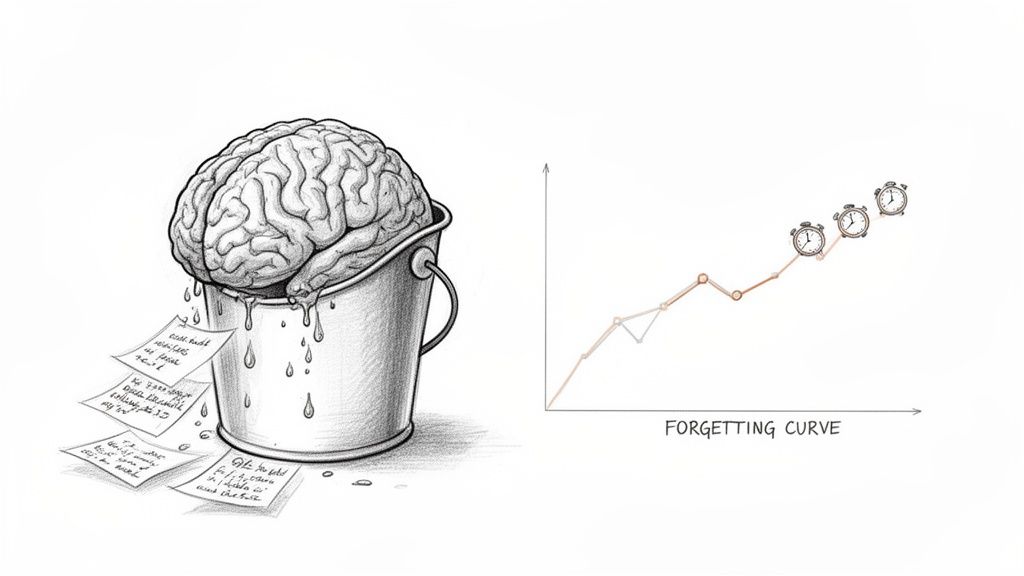
Think of your brain as a hyper-efficient bouncer at a club. It's constantly getting hit with new info, and to avoid a total system overload, it has to decide what gets to stay and what gets kicked to the curb. If you only see something once, your brain assumes it’s just noise and tosses it to make space. This cleanup happens shockingly fast.
The Forgetting Curve Is Working Against You
This isn't just a vibe; it's a proven thing called the "forgetting curve." It shows exactly how fast we ditch new information if we don't actively try to remember it.
This whole idea goes back to the 1880s with a psychologist named Hermann Ebbinghaus, the OG of memory research. His experiments revealed a pretty brutal truth about our brain's default settings.
The data he gathered shows a massive drop in memory almost immediately after learning something new. Peep the timeline.
Forgetting Curve Timeline: What You Lose and When
Time After Learning | Average Information Forgotten |
|---|---|
20 Minutes | 42% |
1 Hour | 56% |
1 Day | 66% |
1 Week | 75% |
1 Month | 79% |
Without any review, Ebbinghaus found that we forget more than 56% of what we learn within an hour. A day later, 66% is gone. And after a week? A wild 75% has just vanished. You can dig deeper into these foundational memory experiments on the National Center for Biotechnology Information's website.
This is exactly why cramming for your AP US History exam or college finals feels so pointless a week later. You're basically forcing info into a system that's already set up to delete it. Your all-nighters are a direct fight against your brain's natural process.
Key Takeaway: Your brain isn't trying to sabotage you. It's just programmed to trash information it thinks is a one-off. To memorize things quickly—and for good—you have to prove to your brain that the content matters by revisiting it.
This "aha!" moment is a game-changer. It means your old study methods are probably busted and it's time for an upgrade. The good news is you don't need to study harder; you just need to study smarter. You need a system that works with your brain, and that means ditching last-minute cram sessions for strategies that actually beat the forgetting curve.
Brain Hacks That Actually Make Information Stick
We’ve all been there. You pull an all-nighter, convinced you’re a genius, only to have it all disappear by the time you sit down for the exam. Your brain is basically a ruthless bouncer, tossing out any information that doesn’t seem important. Your cram sessions are just feeding it a stream of disposable info.
To beat this “forgetting curve,” you need to stop cramming and start using some real brain hacks. Think of them as cheat codes for your memory.
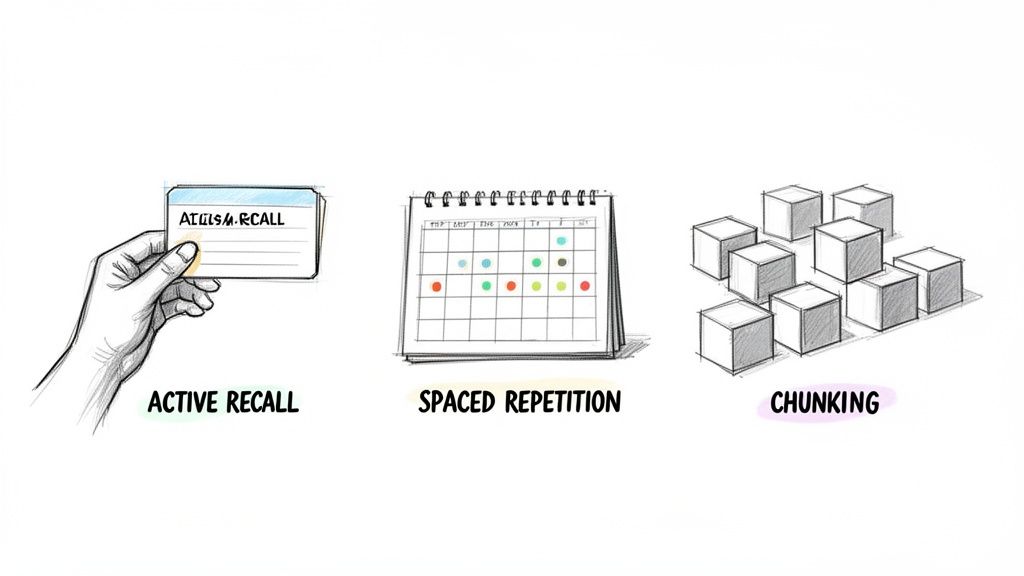
These aren’t just random tips from a forum; they're science-backed strategies that work with your brain's natural wiring. Let's get into the big three that top students swear by: Active Recall, Spaced Repetition, and Chunking.
Force Your Brain to Remember with Active Recall
Let’s get one thing straight: rereading your notes or highlighting textbook pages is passive learning. It feels productive, but it’s the mental equivalent of doom-scrolling—the info goes in one ear and out the other.
Active recall, on the other hand, is forcing your brain to pull information out of storage. It's a workout for your mind.
Instead of just rereading a chapter on cellular respiration, you close the book and try to explain the process out loud. Instead of staring at your sociology notes, you whip up a quick quiz for yourself. The struggle to retrieve the info signals to your brain that this stuff matters, strengthening the neural pathways to it.
Active recall is 2x more effective than passive review. The struggle of trying to remember something is what actually builds the memory.
Of course, manually creating quizzes for every topic is a massive time-suck. This is where AI tools like Vivora seriously level up your game. It can take your lecture slides or notes and automatically generate practice questions and quizzes, making active recall a seamless part of your study flow instead of another chore.
Outsmart the Forgetting Curve with Spaced Repetition
So, you know active recall builds strong memories. But when you do it matters just as much. That’s where Spaced Repetition comes in. It’s the simple but brilliant idea of reviewing info at increasing intervals over time.
Think of it this way: when you first learn a new history date, you might review it in an hour, then a day later, then a few days after that, and then a week later. Each time you successfully recall it, the memory gets stronger, and you can wait longer before the next review. This method directly fights the forgetting curve by refreshing the information right before your brain decides to ditch it.
Here’s what that could look like in practice:
Day 1: Learn the key players of the French Revolution.
Day 2: Quiz yourself on their names and roles.
Day 4: Try to sketch out a timeline from memory.
Day 8: Explain the causes and effects to a friend (or your roommate).
This is way more effective than cramming it all in the night before. But keeping track of review schedules for all your classes sounds like a nightmare, right? This is another place where a smart tool becomes your BFF. Vivora’s AI, for example, transforms your class materials into personalized study guides, including flashcard decks that put spaced repetition on autopilot. If you're looking for an easier way to study, check out how AI-powered flashcards work.
Make Big Ideas Bite-Sized with Chunking
Ever tried to memorize a long phone number? You don’t remember it as a single string of ten digits. You break it down into smaller groups: (555) 867-5309. That’s chunking—grouping tons of information into smaller, meaningful units.
Your brain's working memory can only handle about four "chunks" of info at once. Trying to memorize 20 steps in a lab procedure is a recipe for disaster. But if you group them into four phases—like Setup, Reaction, Observation, and Cleanup—it's instantly more manageable.
When you're studying for a history final, don't try to memorize a random list of 15 different events. Instead, chunk them by theme, like "Causes of the War," "Major Battles," and "Post-War Treaties." By organizing the info logically, you create mental hooks that make everything way easier to recall later.
This is another area where Vivora helps big time. It automatically summarizes long lectures and documents into organized, bite-sized notes that are perfect for your chunking strategy, saving you a ton of prep time.
Turn Boring Notes into Unforgettable Visuals
Ever found yourself staring at a wall of text for your history class? Or rereading the same dense paragraph on cellular respiration for the tenth time and still not getting it? Your brain isn't broken—it's probably just bored.
Let's be real, our brains are visual powerhouses. We're wired to process images way faster than text. So when you're trying to brute-force a chapter into your memory, you’re completely ignoring one of your brain's biggest strengths. It’s time to start working with your brain using a technique called Dual Coding.
Why Pictures Beat Words for Memory
The idea behind Dual Coding is refreshingly simple: you learn and remember things better when you combine words with relevant visuals. When you do this, you’re creating two separate but linked mental pathways to the same information. If you forget the text, the image can trigger your memory, and vice versa. It’s like having a built-in backup system for your brain.
This isn’t just some study hack theory; it’s backed by a well-known psychological principle called the Picture Superiority Effect, which shows that we recall images with much higher accuracy than words. A Stanford study looking into this found that the results for younger students were dramatic. They recalled 65-80% of pictorial information after a delay, compared to just 40-50% for words alone.
This diagram breaks down how Dual Coding creates two distinct channels for processing information.
By engaging both your verbal and visual systems, you’re encoding the information more deeply. This makes it stickier and way easier to recall later on—exactly what you need when you have to memorize a lot of information fast.
Making Visual Learning Easy
Here's the good news: you don't need to be an artist to make this work. The goal is to create quick mental associations, not a museum-worthy masterpiece. Forget about professional graphics; we're talking about simple, effective visuals that actually save you time.
Here are a few practical ways to apply dual coding to your study routine:
Quick Doodles: Sketch a simple flowchart on your tablet to map out that complex chemistry process. Draw stick figures to represent historical figures and their relationships.
Mind Maps: Instead of taking linear notes for your psychology chapter, try a mind map. Put the main concept in the center and branch out with related ideas, using colors and small icons to make connections pop.
Color-Coding: This is an easy one. Use different colored highlighters or pens to group related themes in your notes. Just assigning colors to categories helps your brain visually cluster and organize the information.
Pro Tip: The act of creating the visual is just as important as the visual itself. When you draw a diagram or build a mind map, you're forced to think critically about how concepts are connected. That’s a powerful form of active learning right there.
But let's be realistic, who has the time to turn every single lecture into a visual masterpiece? This is where technology like Vivora becomes a total lifesaver.
Vivora's AI takes your boring lecture slides, dense textbook PDFs, and even YouTube videos and helps turn them into personalized, visual study guides. It automatically extracts key concepts and helps you organize them, so you can spend your time learning instead of doing all the manual prep work. You can see how this works by checking out how Vivora helps organize your integrated class notes.
Your Study Plan: The Cram Session vs. The Long Game
Alright, theory is great, but let's get real. Your final is on Friday, or you have a midterm in two weeks, and you need a concrete plan. Knowing about active recall and spaced repetition is one thing; actually using them when you’re stressed and short on time is another.
So, let's ditch the theory and build two practical study routines: one for when you're in a serious time crunch and another for when you have the luxury of planning ahead.
The 48-Hour Power Session
It happens. You’ve got an exam in two days and need to get the most important info into your brain, fast. This isn't about long-term mastery; it's a high-intensity push focused on maximizing your score. Forget deep learning—this is strategic survival.
Here’s your game plan:
First 2 Hours: Information Dump & Organize. Your first move is to consolidate everything. Stop scrolling through folders. Upload all your lecture slides, messy notes, and textbook PDFs into a tool like Vivora. Its AI will instantly organize this chaos, pull out the key concepts, and give you a clean, structured overview. This step alone saves hours of frantic searching.
Next 6 Hours: Active Recall Blitz. This is where the real work begins. Use Vivora’s auto-generated quizzes to start hammering active recall. Don’t just passively review the answers; force your brain to retrieve the information. If you get stuck, don’t panic. Ask Vivora’s AI chatbot to explain the concept in a simpler way, like, "Explain the Krebs cycle like I'm five."
Final 36 Hours: Spaced Repetition (Cram Edition). Now, it’s all about high-intensity, short-interval reviews. Go through the auto-generated flashcards Vivora made. Separate them into three piles: “I got this,” “Kinda shaky,” and “No clue.” Review the “No clue” pile every few hours, the “shaky” pile twice a day, and the “I got this” pile just once. This is your rapid-fire way to interrupt the forgetting curve when time is short.
The Two-Week Mastery Plan
If you have a bit more runway, you can build memory that actually lasts beyond the exam. This plan uses the same principles as the power session but spreads them out for deeper, more durable learning. It’s how you avoid the stress of last-minute cramming and actually understand the material.
A huge part of this mastery plan involves connecting words to visuals, a technique known as dual coding.
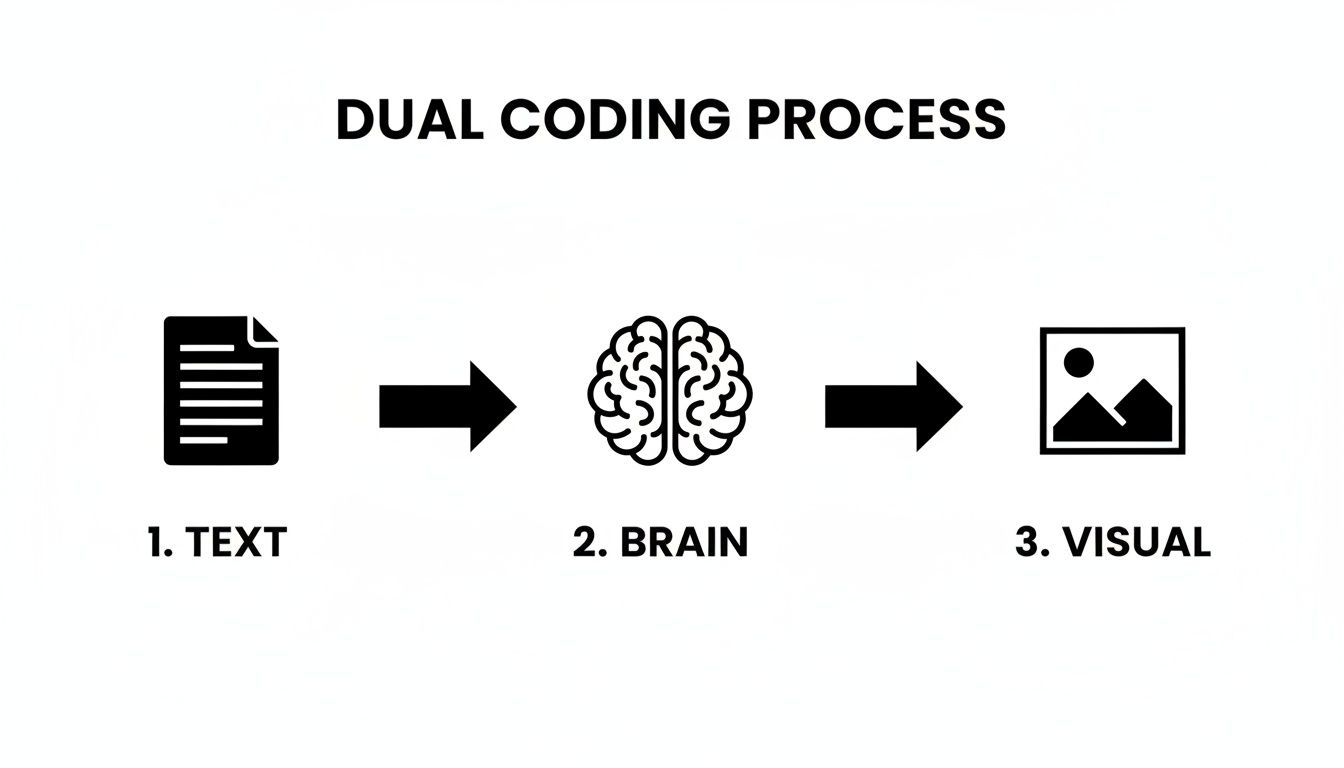
When your brain links text to a visual, it creates a much stronger, more resilient memory trace. It's like giving yourself two ways to remember the same thing.
To help you visualize how these two approaches differ, here’s a quick breakdown of how you’d allocate your time.
Power Session vs Mastery Plan Workflow
Study Component | The 48-Hour Power Session | The Two-Week Mastery Plan |
|---|---|---|
Initial Prep | 2 hours of rapid consolidation. | Days 1-2: Organize all materials, create initial mind maps, and skim key topics. |
Active Recall | Intense, back-to-back quizzes and self-testing. | Days 3-7: Daily 30-minute quizzes on new topics. Use a tool like Vivora's AI quiz generator to make this automatic. |
Spaced Repetition | High-frequency reviews every few hours. | Days 8-14: Review flashcards every other day. The interval gets longer as you get more confident. |
Visual Learning | Focus on existing diagrams and charts. | Spend time creating your own simple diagrams and flowcharts from your notes to solidify connections. |
The bottom line? Your study strategy has to adapt to your timeline. A last-minute cram session requires ruthless prioritization and high-intensity recall. A longer schedule, on the other hand, allows for deeper encoding through spaced-out practice and visual creation.
No matter which path you take, the goal is the same: to stop fighting your brain and start working with it. By using tools that automate the boring parts—like organizing notes and creating quizzes—you can focus your limited time and energy on the techniques that actually make information stick.
Build Your Personalized Study Hub with Vivora
Let's be real: juggling all these study techniques is one thing, but doing it with scattered class notes, messy slide decks, and random YouTube links is pure chaos. Trying to figure out which flashcards go with which lecture is a surefire way to waste precious time you don't have.
This is where you stop being a digital packrat and start acting like a chief strategist for your own brain. The goal is to create a single, intelligent study hub.
Imagine you're prepping for a big Macroeconomics exam. Instead of spending hours hunting down files and manually creating flashcards or summaries, your workflow can become ridiculously simple.
Go from Chaos to Clarity in Minutes
First things first: consolidate everything. Stop digging through folders and browser tabs. Just get all your materials into one place by uploading them to Vivora:
That 80-page PDF of your textbook chapter on fiscal policy.
The professor's lecture slides on supply and demand.
A link to that helpful YouTube video explaining inflation.
Once your content is uploaded, Vivora's AI gets to work instantly. It doesn't just store your files—it actually reads, understands, and organizes them. This is how Vivora turns hours of tedious prep work into minutes of strategic, focused studying. You get to reclaim your time and actually focus on the stuff that matters: learning.
This shift from manual prep to automated studying is the key to memorizing information quickly without getting overwhelmed. You spend your energy on active recall, not on administrative busywork.
From all that raw material, Vivora automatically generates a personalized study guide. It creates custom flashcard decks based on key terms from your slides, drafts concise summaries of that dense textbook chapter, and even builds practice quizzes from the YouTube video you linked.
Instead of drowning in a mess of disorganized materials, you now have a central command center where everything is connected and ready for action. The content for your Macroeconomics exam is no longer just a pile of files; it's an interactive, intelligent study guide built specifically for you.
This is how you stop just managing your notes and start mastering the concepts.
Got More Questions? We've Got Answers
If you're still wondering about a few things when it comes to memorizing information faster, you're not alone. Let's tackle some of the most common questions students have as they start to study smarter.
How Long Until These Memory Techniques Actually Work?
You'll feel the difference with techniques like active recall almost instantly. Seriously, try it tonight. Just one study session where you quiz yourself instead of passively rereading will feel way more productive.
But the real magic for long-term memory comes from spaced repetition. This is about building that mental muscle over several days or weeks. The key is consistency over time, not cramming everything into one marathon session.
Can I Use Vivora for Classes That Aren't Just Reading Textbooks?
Absolutely. While Vivora is a beast at turning lecture slides and textbook chapters into study materials, it's incredibly versatile.
For Math & Science: Upload your notes filled with formulas and create targeted flashcard decks. You can also ask the AI chatbot to explain a tricky physics concept or break down a calculus theorem in a way that actually clicks.
For Problem-Based Classes: Got a ton of practice problems? Upload your notes with them to generate quizzes. This tests you on the core principles behind the solutions, not just whether you memorized the answer to one specific problem.
The bottom line is, if you can get your material into Vivora, you can turn it into a powerful, interactive study guide. It handles a whole lot more than just plain text.
Is It Better to Study One Subject for Hours or Switch Things Up?
It's tempting to block out three straight hours for chemistry, but the research actually points to a technique called interleaving. This just means switching between different—but related—subjects during a single study block.
For instance, try 45 minutes of chemistry, then 45 minutes of biology, and finish with 45 minutes of physics. It feels a little tougher in the moment, but it forces your brain to work harder to recall different sets of information. That struggle is what strengthens your memory way more effectively than just hammering away at one topic for hours on end.
Ready to stop wasting time and start studying smarter? Vivora transforms your chaotic class content into a personalized study hub with AI-generated flashcards, quizzes, and summaries. Sign up for your free trial and build your first study guide in minutes.