AP Chemistry Acids and Bases: The Ultimate Survival Guide
Mar 2, 2026
Struggling with AP Chemistry acids and bases? You’re not alone. This unit can feel like learning a new language, full of weird symbols and rules that just don't vibe. But dw, we're here to help you crack the code.
Acids and bases are a huge part of the AP exam, making up 11-15% of your score. Nailing this topic isn't just a good idea—it’s a must for a 4 or 5.
Your Guide to Acing AP Chemistry Acids and Bases
Let's be real—the acids and bases unit in AP Chem is a legit boss level. It’s dense, throwing new theories, complicated math, and graphs at you that all blur together. No wonder it's one of the most-weighted topics on the test.
But what if you had a clear game plan instead of just trying to memorize a mountain of facts? That's what this guide is for. We're skipping the dry, textbook-style explanations that are a total snoozefest.
Instead, we'll use relatable analogies and step-by-step breakdowns to make the toughest concepts finally click. Think of this as your personal playbook for conquering one of the biggest challenges in AP Chem, covering everything from the basic defs to the tricky titration curves you’ll 100% see on the exam.
How We’ll Tackle This Topic
Our goal isn't just to get you a passing grade; it's to help you actually get it. True mastery comes from connecting the dots, not just cramming. Here's the rundown:
Building the Foundation: We'll start with the core theories (Arrhenius, Brønsted-Lowry, and Lewis) and explain why each one matters and what problem it solves. No fluff.
Mastering the Math: We'll walk through pH calcs, equilibrium constants, and buffer problems without the confusing jargon, showing you the logic behind the formulas.
Visualizing the Concepts: We'll demystify titration curves so you can read them like a pro and absolutely crush those FRQs.
This guide is all about building your confidence from the ground up. By the end, you'll see how each concept flows into the next, creating a complete picture of acid-base chem.
And here’s a pro tip for saving your sanity: juggling lecture notes, textbook chapters, and practice problems is exhausting. An AI-powered study tool like Vivora is a total game-changer. You can literally dump all your scattered class content—PowerPoints, lecture recordings, even random YouTube links—and Vivora instantly transforms it into a personalized study guide, complete with flashcards and practice quizzes. This frees you up to focus on actually learning, not just organizing.
Let's get into it.
The Three Main Theories of Acids and Bases
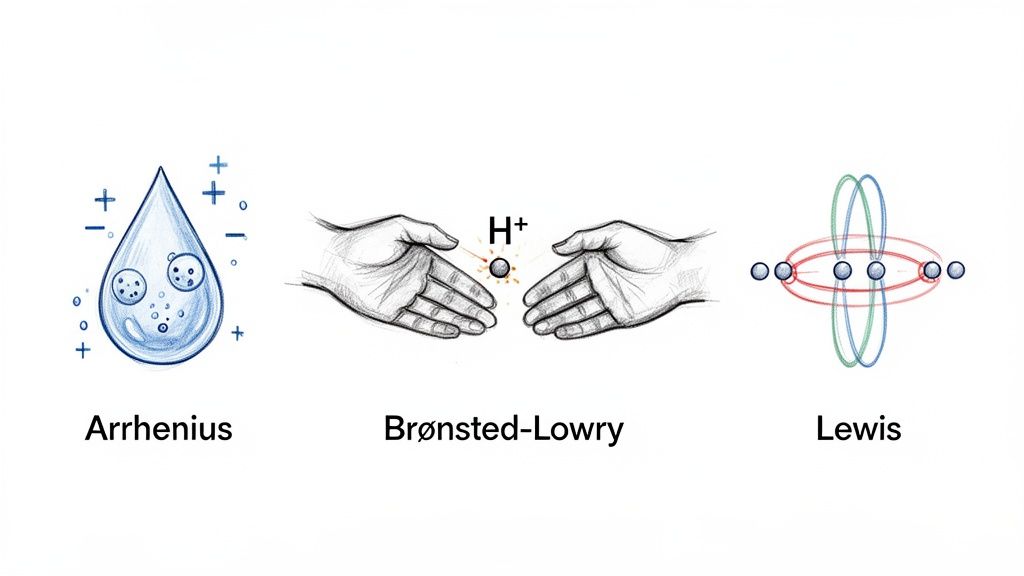
Alright, let's dive into the core concepts you absolutely need to lock down for the AP Chemistry exam. Think of this as meeting the three main characters in the acid-base saga. Each one has a slightly different take, and knowing all three gives you the flexibility to solve any problem the test throws your way.
We'll skip the long, boring history lesson and get straight to what you need to know. The key is seeing these theories as leveling up. Each new theory came along to explain something the last one couldn't, giving us a more complete picture.
Arrhenius Theory: The Water-Only Vibe
The first and most basic theory comes from Svante Arrhenius. His idea is super simple: it’s all about what happens when you dissolve something in water.
An Arrhenius acid is any substance that boosts the concentration of hydrogen ions (H⁺) when you drop it in water. Put some hydrochloric acid (HCl) in water, and it immediately splits into H⁺ and Cl⁻. That's an Arrhenius acid doing its thing.
An Arrhenius base is any substance that boosts the concentration of hydroxide ions (OH⁻) in water. The classic example is sodium hydroxide (NaOH), which breaks apart into Na⁺ and OH⁻ ions.
This is a great starting point. It’s clean and easy. But it has one major flaw: it only works for reactions in water. What about all the other reactions? That’s where the next theory comes in.
For a bit of context, early chemists actually thought oxygen was the key to acidity. It wasn't until the 1800s that Humphry Davy's work with HCl (no oxygen!) shifted the focus to hydrogen. Arrhenius's 1884 proposal tying acidity to H⁺ and basicity to OH⁻ was the real breakthrough, earning him a Nobel Prize. It remains a cornerstone of chemistry, with acid-base topics making up a significant 12% of the 2023 AP exam. If you're curious, you can explore more of the history of acid-base discoveries to see how these ideas evolved.
Brønsted-Lowry Theory: It's All About the Proton
The Brønsted-Lowry theory zooms out a bit, focusing on the movement of protons (which are really just H⁺ ions). I like to think of it as a game of "proton hot potato."
Key Idea: An acid-base reaction is just a proton transfer. One thing gives a proton, and another thing takes it. Simple.
This definition is way more flexible and powerful because water doesn't have to be involved.
A Brønsted-Lowry acid is a proton donor. It's the one passing the H⁺ potato.
A Brønsted-Lowry base is a proton acceptor. It's the one catching the potato.
This was a huge glow-up because it finally explained why stuff like ammonia (NH₃), which has no OH⁻, acts as a base. When ammonia reacts with water, it snags a proton from H₂O to form NH₄⁺ and OH⁻. In that reaction, water is actually being the acid! Wild, right?
Lewis Theory: The Big Picture with Electrons
Finally, we have the Lewis theory, which gives us the most zoomed-out, all-encompassing view. G.N. Lewis wasn't focused on protons at all; he looked at what the electrons were doing.
A Lewis acid is an electron-pair acceptor. It has an empty orbital, like an open parking spot, ready for a pair of electrons.
A Lewis base is an electron-pair donor. It has a lone pair of electrons it can share to form a new bond. It's the car looking for that empty spot.
This is the most inclusive definition of the three. It explains reactions the other two can't, like many reactions involving metal ions or those without any protons at all.
With three different definitions, it's easy to get them mixed up. This little cheat sheet will be your BFF.
Acid-Base Theory Cheat Sheet
Theory | Acid Definition | Base Definition | Key Concept |
|---|---|---|---|
Arrhenius | Increases H⁺ in water | Increases OH⁻ in water | Dissociation in water |
Brønsted-Lowry | Proton (H⁺) donor | Proton (H⁺) acceptor | Proton transfer |
Lewis | Electron-pair acceptor | Electron-pair donor | Electron pair sharing |
Think of these like Russian nesting dolls: pretty much all Arrhenius acids are Brønsted-Lowry acids, and almost all Brønsted-Lowry acids are Lewis acids. The AP exam will expect you to know which definition to use in different situations.
Still trying to keep them all straight? Just upload your messy class notes to Vivora. Its AI will instantly generate custom AP Chem flashcards for you. Quizzing yourself is legit the fastest way to make these definitions stick.
Strong vs. Weak Acids and Bases: A Tale of Two Parties
Okay, we've got the main acid-base theories down. Now, let’s get to one of the most crucial distinctions you’ll face in AP Chemistry: strength. It’s a simple concept that trips up a lot of students, but getting it right is the key to acing equilibrium.
Not all acids and bases are created equal. Think of it like a party. A strong acid is the ultimate extrovert. The moment it shows up to the party (your beaker of water), it completely ditches its friends to mingle with everyone. It dissociates 100%. Every single molecule of a strong acid, like HCl, splits into H⁺ and Cl⁻ ions the second it hits water. It’s a one-way street; there's no going back.
A weak acid, on the other hand, is like a shy guest who comes to the party but pretty much just hangs out with the friend they came with. It only partially dissociates. When acetic acid (CH₃COOH), the acid in vinegar, enters water, only a tiny fraction of its molecules actually break apart into H⁺ and CH₃COO⁻. The vast majority just stay as intact CH₃COOH molecules, floating around. This creates an equilibrium—a two-way street where some molecules are breaking up while others are getting back together.
What Really Makes an Acid Strong or Weak?
At its core, "strength" is all about how willing an acid is to give up its proton. Strong acids yeet their protons without a second thought. Weak acids are way more hesitant. The same exact logic applies to bases.
Strong Bases: These are the extroverts of the base world. They completely fall apart in water to release a flood of OH⁻ ions. Sodium hydroxide (NaOH) is a classic example—it fully splits into Na⁺ and OH⁻.
Weak Bases: These are much more reluctant. They only partially react with water to accept a proton, creating just a little bit of OH⁻. Ammonia (NH₃) is the textbook weak base; it grudgingly accepts a proton from water, forming NH₄⁺ and OH⁻ in an equilibrium reaction.
The Brønsted-Lowry theory was a game-changer for understanding this. Back in 1923, Johannes Brønsted and Thomas Lowry independently defined acids as proton donors and bases as acceptors. This was a huge leap beyond Arrhenius's water-focused view and finally explained why things like ammonia act as bases even without having an OH⁻ in their formula. By the 1950s, this concept was linked to buffer calculations, becoming fundamental to modern lab work. Today, Brønsted-Lowry concepts are so critical that they are expected to appear in over 15% of scored questions on upcoming AP exams, as you can explore in more detail through the historical context of acid-base theories.
Meet the Conjugate Pairs
Every single Brønsted-Lowry reaction has a dynamic duo: a conjugate acid-base pair. This sounds way more complicated than it is. When an acid donates its proton, what's left is its conjugate base.
Acid − H⁺ = Conjugate Base
And when a base accepts a proton, it becomes its conjugate acid.
Base + H⁺ = Conjugate Acid
Let’s go back to our weak acid example: CH₃COOH (acid) + H₂O (base) ⇌ H₃O⁺ (conjugate acid) + CH₃COO⁻ (conjugate base)
See the pairs? CH₃COOH and CH₃COO⁻ are a conjugate pair. The other is H₂O and H₃O⁺. Notice how they just differ by one single proton (H⁺). Identifying these pairs is a skill you're guaranteed to need on the AP exam.
Here's a crucial rule to burn into your brain: a strong acid has a super weak conjugate base, and vice versa. HCl is a powerful acid, which means its conjugate base, Cl⁻, is incredibly weak and has basically zero interest in taking a proton back.
Keeping all these new terms like 'strong,' 'weak,' and 'conjugate' straight is a real headache during late-night study sessions. The fastest way to lock them in is through active recall. Instead of just rereading your notes, use Vivora to instantly turn your lecture slides into custom AP Chem flashcards. Quizzing yourself for just 10 minutes a day will make these concepts second nature.
Alright, let's get into the math-heavy side of AP Chemistry's acids and bases. If you've been staring at logs and weird-looking formulas with a sense of dread, you're in the right place. We're about to tackle pH, pOH, and those notorious titration curves head-on.
The real secret here isn't just memorizing formulas and button-mashing on your calculator. It’s about actually understanding what those formulas are telling you. Once the logic clicks, the math stops being a chore and becomes just another tool in your problem-solving kit.
From Concentrations to pH: The Basics
So you have a beaker of some solution. How acidic or basic is it, really? This is where pH comes in to save the day. The "p" in pH is just a math-y way of saying "power of," and it’s a log scale designed to make it way easier to talk about the teeny-tiny concentrations of H⁺ (or H₃O⁺) ions.
Think about it—it’s much simpler to say "pH 6" than "a hydrogen ion concentration of 0.000001 M."
These are the four formulas that are the absolute foundation of your acid-base calcs. You need to know these by heart:
pH = -log[H⁺]
pOH = -log[OH⁻]
pH + pOH = 14 (at 25°C, the standard temp for the AP exam)
[H⁺] * [OH⁻] = 1.0 x 10⁻¹⁴ (This is Kw, the ion-product constant for water)
Think of these four equations as your personal toolkit for switching between pH, pOH, [H⁺], and [OH⁻]. Get so comfy with them that you can flip between them without even thinking. For instance, if you have the pH and need the [H⁺], you just rearrange the formula: [H⁺] = 10⁻ᵖᴴ.
This diagram nails the Brønsted-Lowry Theory, which is the lens through which we view most acid-base reactions in AP Chem—acids are proton donors, and bases are proton acceptors.
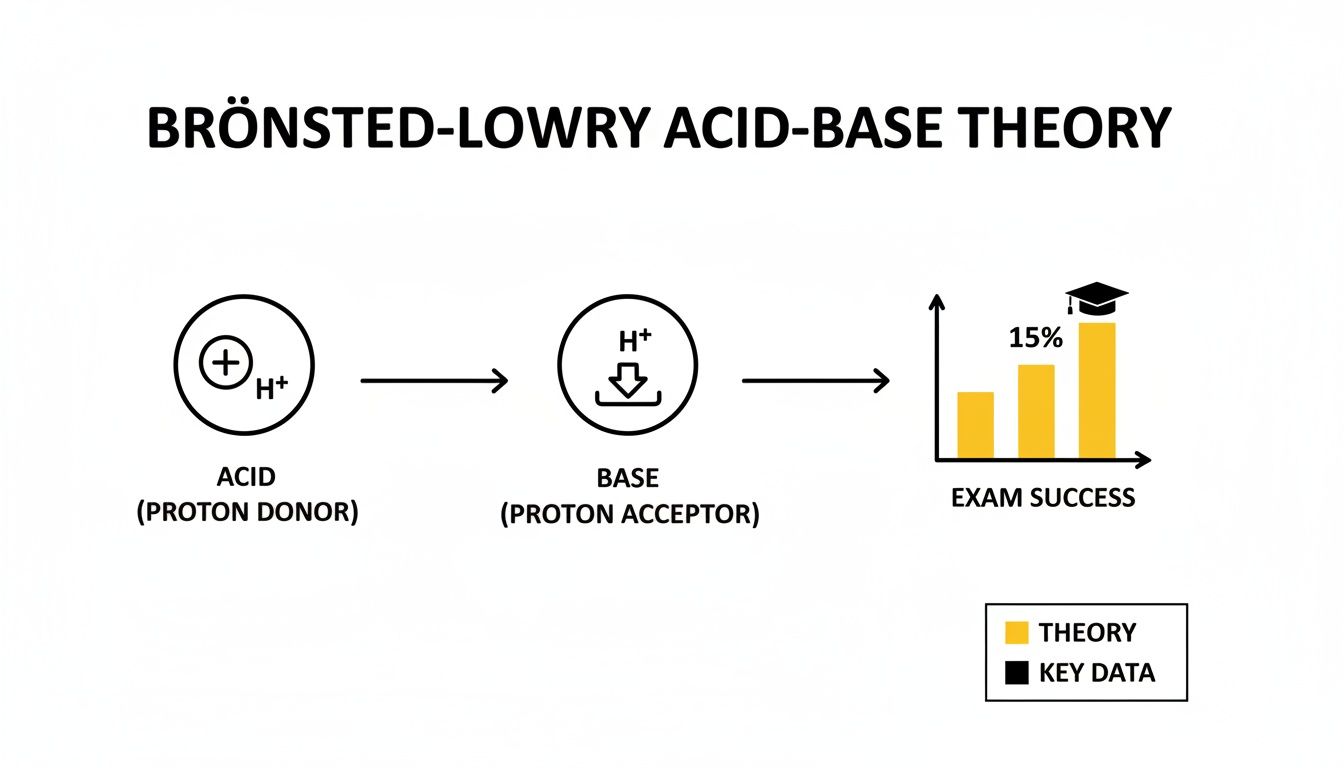
Internalizing this concept of proton-swapping is non-negotiable. You can expect questions based on Brønsted-Lowry ideas to make up over 15% of the acid-base questions on your AP exam.
Your Shortcut for Buffers: The Henderson-Hasselbalch Equation
Now, let's talk about buffers—those awesome solutions made from a weak acid and its conjugate base that resist pH changes. When you're working with buffers, the Henderson-Hasselbalch equation is your best friend. It’s a brilliant shortcut that lets you calculate a buffer’s pH directly, skipping the tedious ICE table drama.
pH = pKa + log ( [Base] / [Acid] )
A word of warning, though: this equation is a specialist. It only works for buffer solutions. Don't even think about using it for a simple solution of a strong acid or a weak base on its own. You'll get the wrong answer every single time. It’s a specific tool for a specific, important job.
Demystifying Titration Curves
Titration curves can look super intimidating, but they're really just a graph telling the story of an acid-base reaction, one drop at a time. They plot the solution's pH as you add a "titrant" (an acid or base of known concentration). For the AP exam, you need to recognize and interpret three main types.
Strong Acid-Strong Base: The classic. The curve has a very steep, almost vertical jump in pH right around the equivalence point—that perfect moment when moles of acid equal moles of base. For this specific combo, the equivalence point is always at pH 7.
Weak Acid-Strong Base: This curve looks a bit different. It starts at a higher pH than a strong acid would. The equivalence point will be above pH 7 because the conjugate base left over from the weak acid makes the solution slightly basic. You'll also see a "buffer region" before the equivalence point, where the curve flattens out and the pH barely changes.
Strong Acid-Weak Base: This is basically the mirror image of the last curve. It starts low, ends high, but the equivalence point is below pH 7. Why? Because the conjugate acid from the weak base makes the final solution acidic.
Look, mastering these calculations and graphs boils down to one thing: practice. You can read this guide a hundred times, but nothing makes it stick like actually doing the problems. If your teacher's PowerPoint on titrations is just a blur of confusing graphs, don't waste hours trying to decode it. Instead, you can use a tool like Vivora's AI quiz generator to instantly transform those slides into a custom practice quiz. Getting hands-on with problems is the absolute fastest way to make these concepts stick for exam day.
Alright, let's get into the stuff that separates a good score from a great one on the AP Chem exam. This is where we hit the advanced topics—the concepts that love to pop up on the Free-Response Questions (FRQs). Nail these, and you’ll have a serious edge on exam day.
First up is one of the most clutch concepts in all of chemistry and biology: buffers.
Understanding Buffer Systems
Imagine you’re in the lab, running a delicate experiment where the pH has to stay rock-solid. Even a single drop of stray acid or base could nuke your results. This is where a buffer solution becomes your chemical superhero.
Buffers are these amazing solutions that fight back against big pH changes when you add a little acid or base. So, what’s their secret? A buffer is a specific cocktail made of two key ingredients:
A weak acid paired with its conjugate base (think acetic acid and sodium acetate)
Or, a weak base paired with its conjugate acid (like ammonia and ammonium chloride)
Think of the weak acid as a "proton piggy bank." If you add a strong base (like OH⁻), the weak acid in the buffer steps up and donates protons to neutralize it. On the flip side, if you add a strong acid (H⁺), the conjugate base swoops in and absorbs those extra protons. This incredible teamwork is what keeps the pH from swinging wildly.
Your own blood is the perfect real-world example. It’s a buffer system that holds your body’s pH right around 7.4. Without it, even the acids and bases from the food you eat could cause life-threatening pH swings.
The Common-Ion Effect Explained
The common-ion effect sounds intimidating, but it's really just Le Châtelier's principle in a different costume. The main idea is that the dissociation of a weak acid or base gets suppressed when you add a salt that shares one of its ions (a "common ion").
Let's break it down. Say you have a solution of weak acetic acid, CH₃COOH. It’s sitting in equilibrium, with a tiny fraction of its molecules split into H⁺ and CH₃COO⁻ ions.
CH₃COOH ⇌ H⁺ + CH₃COO⁻
Now, what happens if you toss in some sodium acetate (NaCH₃COO)? It dissolves completely, flooding the solution with CH₃COO⁻ ions. That CH₃COO⁻ is our common ion. Le Châtelier's principle tells us that adding a product forces the equilibrium to shift back to the left, toward the reactants.
This means fewer acetic acid molecules will bother dissociating. The H⁺ concentration drops, and as a result, the pH of the solution goes up.
Key Takeaway: Adding a common ion to a weak acid or weak base solution shuts down its dissociation. This is the fundamental magic that makes buffers work.
Tackling Polyprotic Acids
So far, we've mostly dealt with acids that donate just one proton, like HCl or HF. But some acids are more generous. We call them polyprotic acids, and they can donate more than one proton. Sulfuric acid (H₂SO₄) is a diprotic acid (two protons), while phosphoric acid (H₃PO₄) is a triprotic acid (three protons).
The key is that these acids lose their protons one at a time, and each step has its own Ka value.
H₂SO₄ → H⁺ + HSO₄⁻ (Ka1 is huge; this first step goes to completion)
HSO₄⁻ ⇌ H⁺ + SO₄²⁻ (Ka2 is much, much smaller)
For the AP exam, the single most important thing to remember is that the first dissociation is always the strongest (it has the largest Ka). Each step after that gets progressively weaker, meaning it gets harder and harder to pull off each extra proton.
These concepts aren't just for a test; they explain real-world environmental crises. Back in 1963, scientists discovered acid rain with a pH as low as 4.2—nearly 100 times more acidic than normal rain. The culprits? Pollutants that formed polyprotic acids like H₂SO₄ in the atmosphere. You can actually read more about the historical fight against acid rain and see how these very chemical principles helped scientists solve the problem.
Wrestling with these multi-step equilibrium problems can feel overwhelming, especially when your lecture notes on polyprotic acids look like a foreign language. When you hit that wall, just upload your notes to Vivora. The AI will instantly create a clear, step-by-step study guide, breaking down each dissociation and calculation into something you can actually follow. It's a lifesaver.
You've battled your way through the toughest concepts, from equilibrium calculations to deciphering titration curves. Now it’s time for the final push—learning how to dodge the common traps that cost students points on AP Chemistry acids and bases questions. Let's lock in your strategy for exam day.
The Free-Response Questions (FRQs) are where a deep understanding really shines. Tiny mistakes can snowball, so mastering the details here is absolutely critical. Let’s walk through the most common Ls so you can confidently avoid them.
Master the Math and Avoid Common Traps
One of the biggest pitfalls is misusing equations. The Henderson-Hasselbalch equation is a fantastic shortcut for buffer pH, but students often try to apply it to solutions that aren't buffers. Remember its golden rule: only use it for weak acid/conjugate base pairs. If it's not a buffer, you can't use the shortcut. Period.
Another frequent error is with the "x is small" approximation. It’s a great way to dodge the quadratic formula, but you have to prove it’s a valid move. Always, always check if 'x' is less than 5% of the initial concentration. Forgetting this check is like throwing away easy points.
Here are a few more quick tips to drill into your brain:
Show Your Work: On FRQs, graders want to see your thought process, not just a final number. Clearly write out every step, including units and formulas, to get all possible partial credit.
Watch Your Sig Figs: Don't lose points on a calculation you totally understood. Pay close attention to significant figures, especially in multi-step problems.
Label Titration Curves: When asked to draw a curve, don't just sketch a squiggle. Label the axes, the equivalence point, and the buffer region. These labels are part of your answer and show you know what you're talking about.
Final Exam Day Checklist
Confidence on exam day comes from one thing: solid prep. Run through this final checklist to make sure you have all your acid-base skills on lock. Can you confidently…
Explain the difference between Arrhenius, Brønsted-Lowry, and Lewis definitions?
Spot the conjugate acid-base pairs in any reaction?
Calculate pH, pOH, [H⁺], and [OH⁻] for any solution thrown at you?
Set up and solve an ICE table for a weak acid or base without hesitating?
Correctly identify the equivalence point and buffer region on all three main types of titration curves?
If any of these make you pause, that's your sign. That's exactly where you need to focus your final review. Those last few hours of studying are precious, and knowing exactly where to aim your effort makes all the difference.
When you're stuck on a tricky practice problem at 1 AM, what do you do? This is where having an AI study partner is clutch. With Vivora, you can use the AI chat like a 24/7 tutor. Just type in your question, and it gives you instant, step-by-step help, guiding you through the problem without just giving away the answer.
This kind of immediate feedback is a lifesaver during those late-night cram sessions. As you gear up, you might want to check out our guide on how to use AI for homework help effectively to get the most out of your study tools. You’ve got this.
Common Questions (And Expert Answers)
Still have a few questions rattling around in your head? Good. That means you're thinking critically. Let's tackle some of the most common sticking points students have with AP Chemistry acids and bases.
What's the Fastest Way to Memorize the Strong Acids and Bases?
Honestly, rote memorization is a trap. It works for a quiz tomorrow, but it will ghost you under the pressure of the AP exam. The goal is to make it stick for real.
A classic mnemonic for the seven strong acids is: "So I Brought No Clean Clothes" (H₂SO₄, HI, HBr, HNO₃, HCl, HClO₃, HClO₄). It’s cheesy, but it works.
For the strong bases, just picture the periodic table. They’re the hydroxides from Group 1 (like NaOH and KOH) and the heavier ones from Group 2 (Ca(OH)₂, Sr(OH)₂, Ba(OH)₂).
But the best method? Active recall. Spend just 5-10 minutes a day with flashcards. It’s way more powerful than one long, painful cram session.
When Should I Actually Use the Henderson-Hasselbalch Equation?
The Henderson-Hasselbalch equation is a fantastic shortcut, but it's a specialist tool. It only works for buffer solutions. Remember, a buffer has to contain a weak acid and its conjugate base (or a weak base and its conjugate acid).
Reach for this equation when you need to:
Calculate the pH of a buffer you already have.
Figure out the ratio of base-to-acid needed to create a buffer with a target pH.
Warning: Never, ever use this equation for a solution that just has a strong acid, a strong base, or a weak acid/base on its own. It's like using a screwdriver to hammer a nail—wrong tool for the job.
How Do I Know if the 'x Is Small' Approximation Is Okay?
Ah, the "x is small" approximation. It's your best friend for dodging the dreaded quadratic formula in weak acid or base equilibrium problems.
As a quick rule of thumb, you can usually get away with it if the initial concentration of your acid or base is at least 1,000 times larger than its Ka or Kb value.
But to be absolutely sure, always double-check with the "5% rule." After you solve for 'x,' divide it by the initial concentration and multiply by 100. If that number is less than 5%, your approximation was valid. You're golden. If it’s over 5%, you have to bite the bullet and use the quadratic formula.
What's the Real Difference Between Equivalence Point and Endpoint?
This is a classic point of confusion, but it's pretty simple when you break it down.
The equivalence point is the theoretical point in a titration. It’s the exact moment when the moles of acid precisely equal the moles of base. You can't see it directly, but you find it by looking at the steepest part of your titration curve.
The endpoint, on the other hand, is the physical thing you actually see in the lab. It's the point where your indicator (like phenolphthalein) physically changes color. In a well-designed experiment, the goal is to pick an indicator whose endpoint is almost identical to the reaction's equivalence point.
Even with these answers, trying to make sense of a whole semester's worth of notes can feel impossible. Instead of drowning in disorganized PowerPoints and PDFs, let Vivora do the heavy lifting for you. Just upload all your class materials, and Vivora’s AI instantly organizes everything into a clean study guide, complete with flashcards and practice quizzes. This way, you can focus your energy on actually mastering AP Chemistry acids and bases. Start your free trial today at https://vivora.ai.