
How to Study Smarter, Not Harder: The Ultimate Gen Z Guide
Feb 6, 2026
So, you wanna study smarter? It’s time to ditch the whole "endless rereading" vibe and switch to active, focused learning strategies. This isn't about pulling all-nighters; it's about using legit, science-backed methods like active recall and spaced repetition to make info actually stick, all without burning out.
The secret is to work with your brain, not against it.
Moving Beyond Burnout Culture In Studying
Let’s be real for a second—the old advice to "just study harder" is completely broken. We've all been there: a Google Drive that looks like a digital bomb went off, folders spilling over with random lecture slides, PDFs, and at least one doc shamefully named "final_notes_real_one_v3.docx."
It’s the classic recipe for a late-night panic session, usually fueled by an energy drink and pure desperation right before a huge exam.
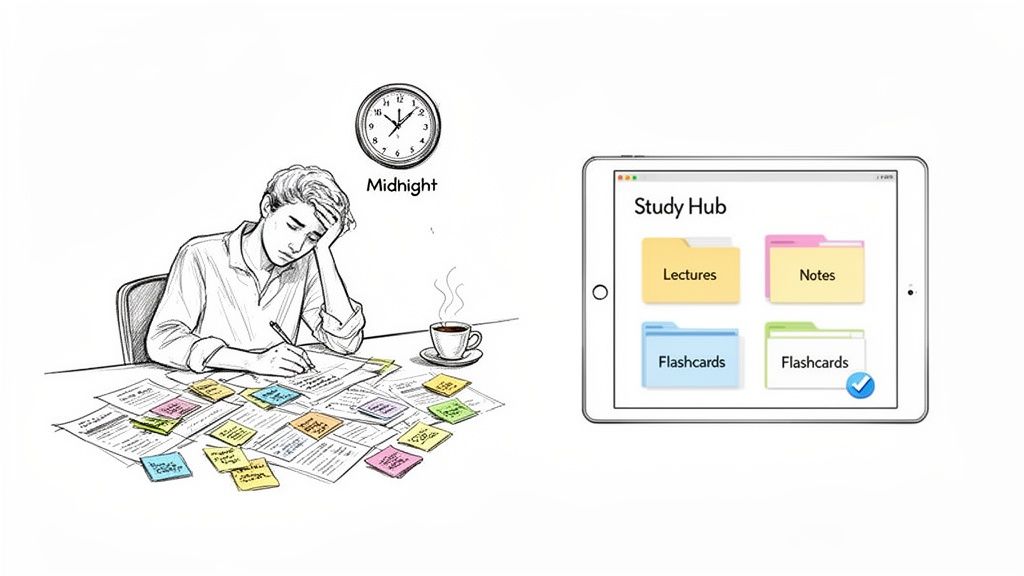
This chaotic approach is the very definition of studying harder. It’s spending hours highlighting your textbook until it’s a neon blur, only to forget most of it a week later. It’s that awful feeling of drowning in course materials with no clear path to actually understanding any of it.
The Problem With 'Grind Culture'
We tend to glamorize the "grind," but honestly, it’s an inefficient and exhausting way to learn. Think about it: you spend hours buried in scattered notes, cram everything right before the test, and still walk in feeling unprepared. It's a trap so many of us fall into.
The truth is, modern study problems demand modern solutions. A 2025 meta-analysis found that effective study habits have a massive impact, correlating with academic performance at a value of 0.519. That means students who study smarter see nearly 52% better outcomes in their grades and retention. You can discover more insights on effective study habits from the research for yourself.
This is where a change in mindset is so important. It’s not about how many hours you clock in; it’s about what you do with those hours.
Check out the difference between the old-school grind and a modern, smarter approach that actually works, saves you time, and gets better results.
The Old Grind (Studying Harder) | The Smart Approach (Studying Smarter) |
|---|---|
Rereading notes over and over (passive) | Using active recall (flashcards, quizzes) |
Cramming everything the night before | Spacing out study sessions over time |
Highlighting entire pages | Summarizing key concepts in your own words |
Studying for long, unfocused hours | Using focused intervals (like the Pomodoro Technique) |
Disorganized notes scattered everywhere | A single, organized "Study Hub" |
Hoping information will just "sink in" | Deliberately testing your knowledge |
This table really highlights the difference between simply putting in the time and making that time count. The smart approach isn't about being lazy; it's about being strategic.
A Smarter Way Forward
So, instead of wrestling with the chaos, what if a tool could do all the organizing for you? That's the whole idea behind studying smarter.
Picture this: you dump all your messy class files—the PowerPoints, the PDFs, even a link to a YouTube lecture—into one central place. In seconds, Vivora transforms it all into a clean, personalized study guide. No more frantic searching. Just clear notes, flashcards, and quizzes, all ready to go.
The goal isn’t to eliminate effort but to direct it where it counts. Smarter studying is about focusing your energy on understanding and recalling information, not on the busywork of organizing it.
Vivora is literally built to do this. It’s designed to take that digital mess and instantly transform it into your ultimate study sidekick. By automating the tedious parts, it frees you up to concentrate on the active learning strategies that actually move the needle—which is exactly what we’ll dive into next.
Connect Your Classes To Your Future
Let's be real. Forcing yourself to study a topic you couldn't care less about is like trying to push a car uphill. We've all been there, staring at a textbook while the words blur into a meaningless soup because our brain has officially checked out.
The secret to studying smarter isn't about brute-force willpower; it's about finding a genuine reason to care.
Motivation is the fuel. When you can draw a straight line from that brutal organic chemistry lecture to your dream of getting into med school, the entire game changes. It stops being a chore and starts feeling like a mission. You shift from "I have to memorize this" to "I get to learn this to build my future."
Find Your Why
It might sound a little cheesy, but finding your ‘why’ is a game-changer for focus and retention. When you're intrinsically motivated, your brain is just more engaged, making it way easier to lock in complex information. This isn't just fluffy advice—it's the engine that powers smarter studying.
And the data backs this up. An Inside Higher Ed survey found that 55% of US college students enroll specifically to chase a certain career. That means connecting your current academic grind to a future payoff is one of the most powerful study hacks there is.
So, how do you actually do that?
Connect the Dots: For each class, jot down one tangible skill it gives you for your future. Macroeconomics could teach you market analysis for that business you want to start. A coding class builds the literal foundation for a software engineering job.
Talk to People in the Field: Hop on LinkedIn or tap into your school’s alumni network. Find people who have the job you want and ask them which of their college classes were surprisingly useful. Their answers might completely reframe a subject you thought was boring.
Visualize the Goal: When you feel the burnout creeping in, take five minutes. Close your eyes and picture what success looks like. Is it that acceptance letter to grad school? Landing a killer internship? A clear mental image is a surprisingly powerful motivator.
Break It Down To Beat Procrastination
Even with a strong 'why,' a massive final exam can feel completely overwhelming. That feeling is what kicks off the classic procrastination death spiral. The fix is to break that huge, scary goal into tiny, achievable wins. This builds momentum and makes the work feel manageable.
Instead of a vague, intimidating goal like, "I need to study for my history final," make a mini-checklist:
Review lecture notes from Chapter 5
Make 10 flashcards for key dates
Watch a 15-min summary video on the French Revolution
Take a 5-minute practice quiz on Chapter 5
Each item you check off delivers a small dopamine hit, making it easier to keep the ball rolling. This is where you can let technology do the heavy lifting for you.
A motivated mind learns faster. When you remove the friction of organizing, you free up mental energy to focus on what truly matters—understanding the material and connecting it to your future.
For example, with a tool like Vivora, you can just upload your professor's chaotic slide deck. It instantly organizes everything and creates those flashcards and practice quizzes for you. This completely eliminates the boring setup work that so often leads to procrastination, letting you jump straight into active, motivated learning.
You get to focus on the 'why' while the AI handles the 'how.'
Build An Unbeatable Study System
Alright, now that you’re fired up and have your eyes on the prize, let's get into the game-changing, science-backed techniques that will completely rewire how you study. This is where we go beyond basic tips and break down the big three of studying smarter: Active Recall, Spaced Repetition, and Interleaving.
Forget passively rereading your notes. These methods force your brain to actually work to remember things, which is how you build real, lasting knowledge.
Active Recall Is Your New Best Friend
So, what is Active Recall? It's the simple act of pulling information out of your brain without looking at your notes. Instead of reading a chapter five times, you read it once, close the book, and try to explain the key concepts out loud.
It feels harder because it is harder. But that’s exactly why it works.
Think of it this way: rereading is like watching someone else lift weights at the gym. Active recall is you actually picking up the weights yourself. That effort—the struggle to remember—is what strengthens the neural pathways in your brain, making the memory stronger and easier to access later.
So, how do you actually do it?
Explain It To A Friend: Grab a friend (or even your dog) and try to teach them a concept from class. If you can explain it simply, you really get it. If you stumble, you’ve just found a weak spot you need to review.
The Blank Page Method: After a lecture, open a blank document or grab a sheet of paper and write down everything you can possibly remember. Don't peek! Once you’re done, compare what you wrote to your actual notes to see what you missed.
Self-Quizzing: Don't wait for your professor to test you. Constantly quiz yourself. This is where you can stop wasting hours manually creating questions from your notes.
This is exactly how Vivora becomes your personal active recall machine. Just upload your lecture slides or notes, and it instantly generates practice quizzes for you. No more grunt work—just a constant stream of opportunities to test yourself and lock in that knowledge.
The goal is to shift from being a passive receiver of information to an active participant in your own learning. It’s a small change in approach with massive results.
Master Anything With Spaced Repetition
Next up is Spaced Repetition. This is the secret sauce to never forgetting anything again. The concept is based on the "forgetting curve," a well-documented phenomenon showing that we naturally forget information over time. Spaced repetition fights this by prompting you to review information at increasing intervals—right as you’re about to forget it.
Instead of cramming for a test by reviewing flashcards 50 times the night before, you'd review them:
One day after learning them.
Then a few days later.
Then a week later.
And so on...
This system interrupts the forgetting process and essentially tells your brain, "Hey, this stuff is actually important. Hold onto it for the long term." It’s dramatically more efficient than cramming because it works with your brain's natural memory consolidation process, not against it.
By spacing out your reviews, you can study less overall but remember way more. It’s the ultimate hack for long-term retention without the burnout.
This is another area where technology can save you a ton of time. Manually tracking a spaced repetition schedule for hundreds of flashcards is a nightmare. But with Vivora, you can turn your course content into digital flashcards in seconds. The platform makes it easy to cycle through your cards, helping you focus on the concepts that need the most reinforcement. To get the most out of this, check out our guide on how to create flashcards that help you remember everything.
The combination of Active Recall (quizzing yourself with the flashcard) and Spaced Repetition (reviewing at smart intervals) is an unbeatable one-two punch for effective learning.
Mix It Up With Interleaving
The final piece of the puzzle is Interleaving. This means mixing up the subjects or topics you study in a single session instead of tackling them in isolated blocks. For instance, instead of doing an hour of math, then an hour of physics, then an hour of chemistry, you’d do 20 minutes of math problems, then 20 minutes of physics, then 20 minutes of chemistry, and repeat the cycle.
I know, it sounds counterintuitive, but it works wonders. When you block-study one subject, you’re basically on autopilot, solving similar problems with the same strategy over and over. But when you interleave, you force your brain to switch gears, figure out which strategy to apply for each problem, and make connections between different concepts.
It helps you learn how to differentiate between ideas and choose the right solution—a much deeper level of understanding than just memorizing a formula. Research has shown this can significantly boost long-term retention and problem-solving skills.
This concept map shows how a clear mindset and defined goals connect to your future career, fueling your study motivation.
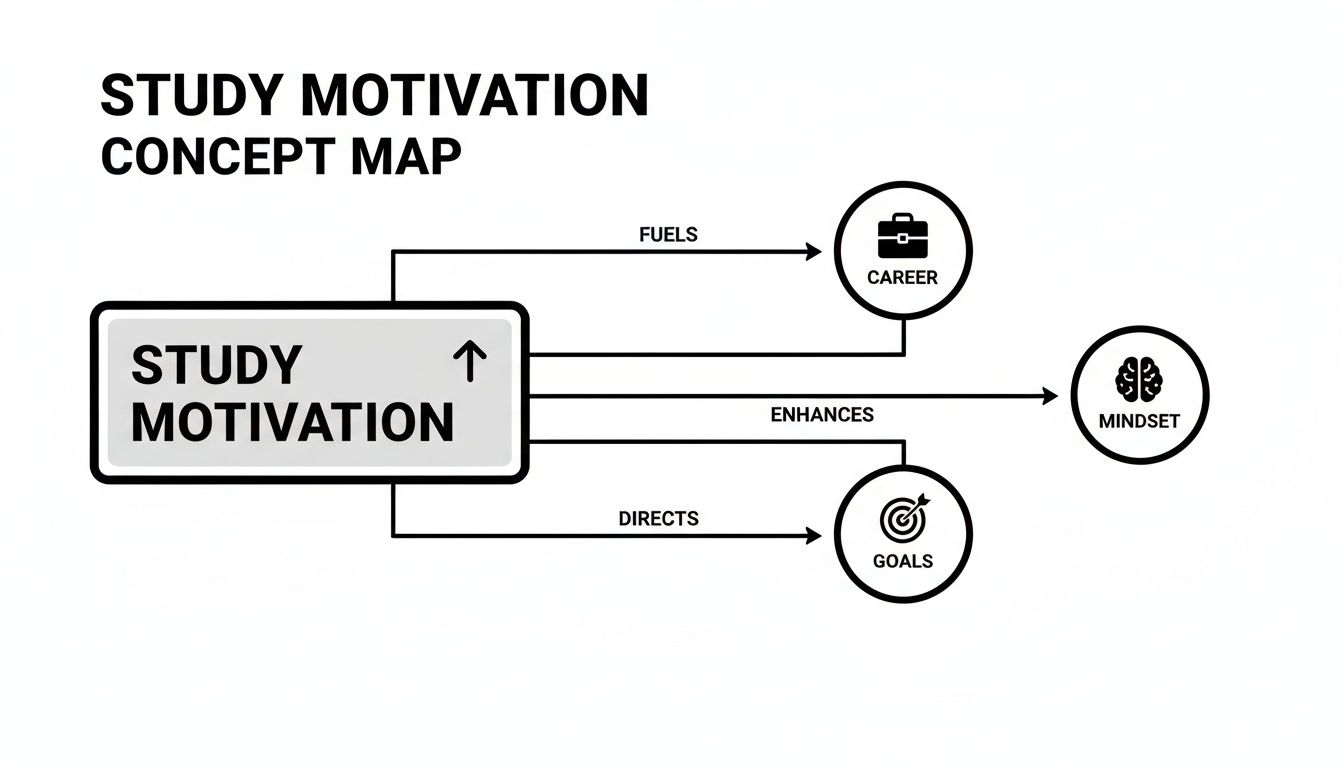
The visual flow is a great reminder that effective study habits aren't just about passing a test; they're about building the foundation for your future.
By building a system around these three core principles, you can create an unbeatable study workflow. It’s not about finding a magic bullet, but about consistently applying proven methods that align with how your brain actually learns. It's the definitive way to study smarter, not harder.
Design A Study Routine That Actually Works
Having the best study techniques is like owning a high-performance car, but a solid routine is the road map that actually gets you to your destination. Without a plan, even the most powerful methods can fall flat. This is all about building a sustainable study routine you can actually stick with—one that values consistency over last-minute intensity.
Forget those miserable all-nighters that just leave you feeling like a zombie. The real secret to studying smarter is breaking your work into manageable, focused chunks. It’s about creating a rhythm that prevents burnout and keeps you making steady progress, even when life gets messy.
Master Your Focus With The Pomodoro Technique
If your attention span feels like it's been hijacked by TikTok, you’re not alone. The Pomodoro Technique is an absolute lifesaver for reclaiming your focus. It’s deceptively simple but incredibly powerful for anyone trying to study smarter, not harder.
The whole idea is to work in short, intense bursts, followed by a quick break to recharge. This method is brilliant because it fights off mental fatigue and keeps you from spiraling into a procrastination doomscroll.
Here’s the basic breakdown:
Pick a single task. Seriously, no multitasking.
Set a timer for 25 minutes. Go all-in on that one thing. Phone away, notifications off.
When the timer dings, stop. Take a genuine 5-minute break. Get up, stretch, grab some water—anything but staring at your screen.
After four "Pomodoros," take a longer break of 15-30 minutes. Let your brain really reset.
This technique helps train your brain to stay locked in for short periods, which makes huge study sessions feel way less intimidating. It’s not about studying for eight hours straight; it's about making 25 minutes count, over and over again.
Building A Schedule For Your Real Life
Okay, theory is great, but let's get real. Your schedule is probably jammed with classes, maybe a part-time job, and hopefully, some kind of social life. A one-size-fits-all plan just isn’t going to cut it. The goal here is to build a routine that actually fits your life.
Here are a couple of real-world scenarios to get you thinking:
The Busy Student With A Part-Time Job:
Monday/Wednesday: Use those 1-2 hour gaps between classes for focused Pomodoro sessions. This is perfect for reviewing lecture notes or chipping away at smaller assignments.
Tuesday/Thursday: Block out a solid 2-hour study session in the evening after your shift. Use this uninterrupted time for tougher subjects that require deeper focus.
Friday: A lighter day for review. Use Vivora’s flashcards for 30 minutes to quickly run through the week's key concepts.
Weekend: Dedicate one 3-hour block on Saturday or Sunday for major assignments and prepping for the week ahead.
The Student With A Heavy Course Load:
Daily Morning Block (1-2 hours): Before classes start, tackle your most challenging subject. Your brain is fresh and ready for the heavy lifting.
Afternoon Gaps: Use those 30-45 minute breaks for active recall. Quiz yourself using Vivora or try the blank page method for what you just learned in your last class.
Evening (2-3 hours): Mix it up with interleaving. Spend 45 minutes on Subject A, 45 on Subject B, and 45 on Subject C, with short breaks in between.
Sunday Review: Spend two hours reviewing all the material from the past week. This helps cement the information before Monday hits.
A great study routine isn't about filling every free minute with work. It's about being intentional with the time you do have, ensuring every session is productive and moves you forward.
The key is to schedule your study sessions just like you would any other important appointment. Put them in your calendar and protect that time. For more tips on making the most of your study time, especially on weekends, you might want to check out our stress-free weekend study guide.
Ultimately, your routine should be a tool that serves you, not a rigid prison. This is where smart tech becomes your biggest ally. For instance, if you upload your course material to Vivora, it creates quizzes for you. When you see you’re consistently scoring low on Chapter 3 of your bio class, you know exactly what to do. You can schedule a targeted Pomodoro session to master that specific weak spot, turning a vague feeling of "I don't get this" into a concrete action plan.
Using AI To Get Ahead Of Your Coursework
Alright, let's talk about the ultimate study hack that isn't really a hack at all—it’s just being smart about your tools. We’ve covered how to build a solid routine and use proven techniques, but now it's time to add a secret weapon. Think of AI not as some sketchy shortcut, but as your own hyper-efficient personal tutor that works 24/7.
The real advantage here is technology’s ability to handle all the boring, time-consuming grunt work that makes studying feel like a total drag. It’s about automating the chaos so you can focus your brainpower on what actually matters: learning the material.
From Chaos to Clarity in Minutes
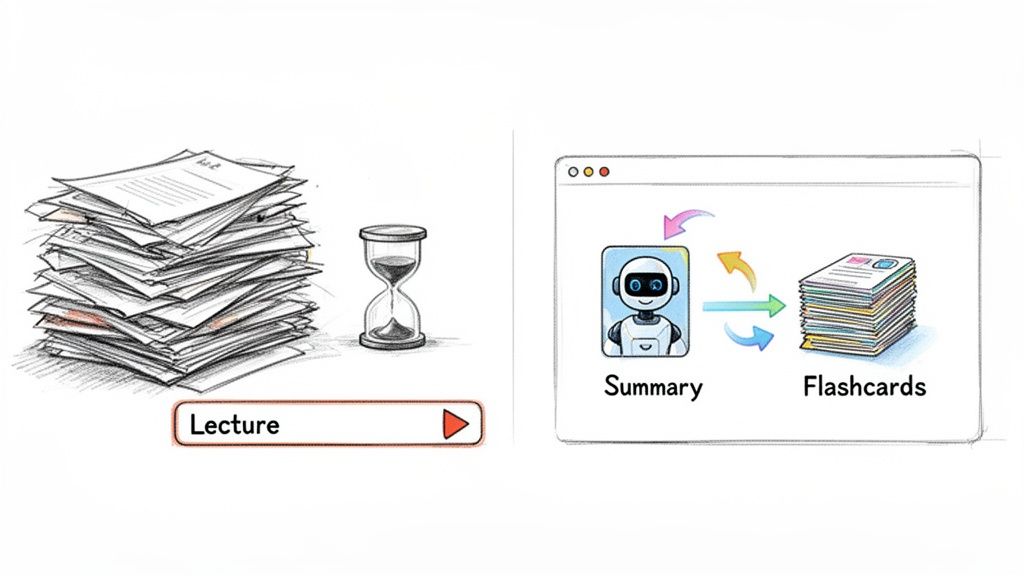
Picture this totally common scenario. It's Tuesday, and your history professor just assigned a two-hour documentary on YouTube to watch before Friday's quiz. On top of that, you have a 78-slide PowerPoint from sociology and a dense PDF reading for biology. The old way to tackle this is pure pain.
You'd have to sit through the entire video, pausing every few minutes to scribble down notes. Then, you'd blow another hour trying to turn those notes into flashcards. Next, you'd slog through that massive slide deck, trying to pick out the key terms. It’s a multi-hour process before you even start the actual studying.
Now, imagine the AI-powered way. You drop the YouTube link, the PowerPoint file, and the PDF into a tool like Vivora. In less time than it takes to make a cup of coffee, you get back:
A concise, bullet-pointed summary of the entire two-hour video.
A complete set of digital flashcards covering all the key terms from the lecture.
An organized study guide that pulls the most important info from all three sources.
A practice quiz, ready to go, so you can immediately start testing yourself with active recall.
You’ve just saved yourself at least three hours of tedious, mind-numbing work. That’s time you can now spend actually engaging with the material, running through flashcards, or, you know, having a life. This isn't just about speed; it's about reclaiming your time and energy.
Your Personal On-Demand Tutor
One of the most frustrating parts of studying is getting stuck on one small concept. Maybe your professor explained cellular respiration in a way that just didn't click, and the textbook is even more confusing. You could spend ages digging through forums or trying to find a clear explanation on Google.
Or, you could just ask an AI chatbot that already understands the full context of your course materials.
With Vivora, the integrated AI chat has already processed your lecture slides and readings. So when you ask, "Can you explain the Krebs cycle like I'm five?" it doesn't give you a generic web answer. It gives you an explanation tailored to the specific way your professor taught it, maybe even referencing slide 14 of the lecture you uploaded. It’s like having a TA who is always online and never gets tired of your questions. For a deeper dive, our guide on how to use AI for homework help effectively offers more strategies.
The smartest students aren't the ones with the most time; they're the ones who are masters of allocation. They direct their focus to high-impact activities like critical thinking and problem-solving, while automating the repetitive, low-impact tasks.
This strategic approach is fast becoming the new norm. Recent global surveys show that students are using an average of 2.1 AI tools to slash inefficiency, with a 92% regular adoption rate completely changing study habits. It's a clear sign that effective time management is a major driver of academic performance. You can learn more about how AI tools are shaping college study habits and see the data for yourself.
By building a modern study system with AI at its core, you stop being a passive victim of your coursework and become the architect of your own learning. You get to spend less time drowning in logistics and more time mastering the concepts that will actually get you that A.
Your Questions On Smarter Studying Answered
Got questions? We've got answers. Let's tackle some of the most common hurdles students face when trying to upgrade their study habits. Think of this as your personal cheat sheet for how to study smarter, not harder.
How Much Should I Study Every Day?
Honestly, there's no magic number here. Quality crushes quantity every single time.
It's far more effective to have one laser-focused hour where you finally master a tough concept than to spend three hours passively rereading notes while half-watching Netflix. Instead of clock-watching, focus on hitting specific, small goals for each session.
A classic rule of thumb for college is the 2-for-1 rule: for every hour you’re in class, plan on about two hours of study time. But here's the kicker—if you're using efficient methods like active recall and spaced repetition, you might find you need less time to get even better results. Consistency is what really moves the needle.
Is It Better to Study in a Group or Alone?
This totally depends on your personality and what you're studying. Both have massive upsides, which is why a hybrid approach is usually the winner.
Solo Study: This is non-negotiable for the initial learning phase. You need deep focus to absorb core concepts, watch lectures, and get your first draft of notes down without distractions.
Group Study: This is where the magic happens for review and application. Trying to explain a concept to someone else is one of the most powerful forms of active recall you can do. It's also a great way to catch blind spots you might have missed on your own.
A killer workflow is to learn the material on your own first. Then, get together with a group to quiz each other and grind through practice problems.
How Can I Stop Procrastinating for Good?
Procrastination almost always comes from one place: feeling overwhelmed. The task just seems too big, too boring, or too difficult, so our brains hit the eject button and we... don't start.
The only real fix is to make the first step ridiculously easy.
Instead of a vague, intimidating goal like, "I need to study for my history final," break it down into something tiny. Your goal could be as simple as, "I'm going to find my lecture notes and upload them to Vivora." That’s it. That's the entire task.
Once you’ve done that, the AI can start organizing it for you, creating flashcards and practice quizzes. Now your next step is just, "I'll do 10 flashcards." By breaking the work into these tiny, manageable wins, you build momentum and trick your brain into actually getting started.
The secret to beating procrastination isn’t about finding some mythical burst of motivation. It’s about making the next step so small and simple that it feels almost effortless to take it.
What’s the Single Best Way to Prepare for an Exam?
If you only have time for one "smart" technique, make it active recall. Just rereading your notes is one of the biggest traps in studying. It creates an "illusion of competence"—you recognize the material, so you think you know it. But recognition and recall are two completely different things.
The best way to prep is to simulate the exam experience as much as you can. That means constantly testing yourself.
Work through practice questions without looking at your notes.
Use flashcards to force your brain to pull information from scratch.
Try the "blank page" method: grab a blank sheet of paper and write down everything you can possibly remember about a topic.
This is where a tool that auto-generates quizzes becomes a game-changer. It gives you an endless supply of practice tests, forcing you to actively retrieve information over and over until it’s locked in for good.
Ready to stop the grind and start studying smarter? Vivora transforms your chaotic class materials into the organized, personalized study guides you need to succeed. Get your free trial today and see the difference in minutes.