Your Ultimate AP English Language Study Guide for 2026
Mar 4, 2026
A solid AP English Language study guide isn't just a list of terms to memorize. It’s a strategy—a clear plan that breaks down the whole exam into chill, manageable steps, showing you how to tackle the complex questions and essays with confidence. It's about building real skills for analyzing texts and crafting killer arguments, not just cramming definitions.
Your Game Plan for Conquering the AP Lang Exam
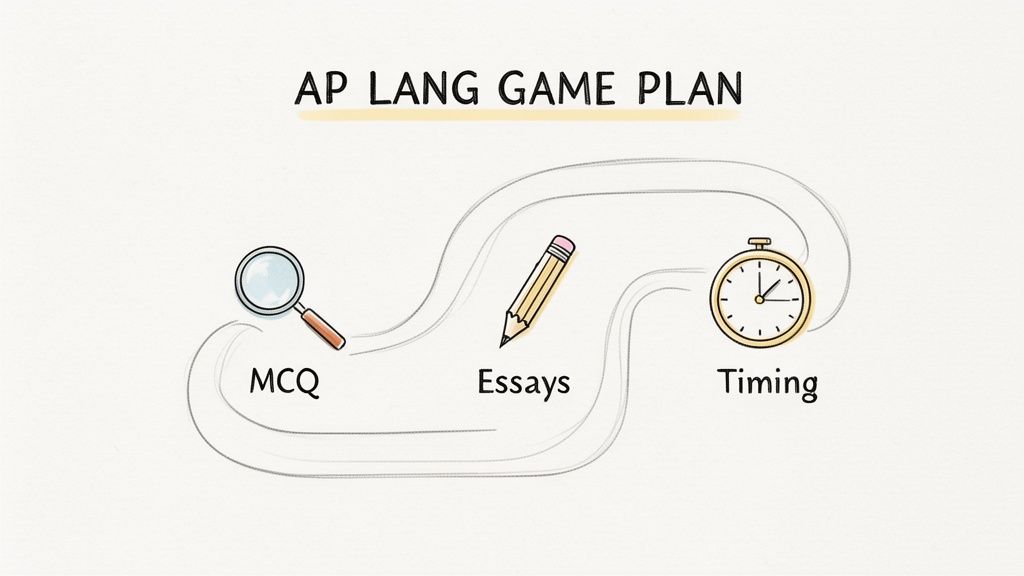
Let's be real, the AP Lang exam can feel like the final boss of your junior year. Between the notoriously tricky multiple-choice questions (MCQs) and having to write three entirely different essays back-to-back, the overwhelm is real. But what if you had a clear game plan?
Think of this guide as your personal strategy map. We're going to break down every part of the exam so you know exactly what’s coming and how to handle it. No cap.
What We Will Cover
This isn't your average textbook summary. We're cutting through the noise to focus on practical skills and smart strategies that will help you prep without the burnout. We’ll show you how to turn a mountain of scattered class notes and last-minute cram sessions into a confident, organized approach.
Here's what this AP English Language study guide will walk you through:
Deconstructing the Exam: We'll dive deep into the exam format, timing, and exactly how each section—the MCQs and the three essays—is scored and weighted. No surprises on test day.
Mastering the Essays: You'll get specific, repeatable strategies for the Synthesis, Rhetorical Analysis, and Argument essays so you can stop staring at a blank page and start writing with purpose.
Building Your Skills: Forget the boring jargon. We’ll focus on the skills you actually need, like how to spot an author’s rhetorical choices and use them to build your own rock-solid analysis.
The goal isn’t just to pass; it’s to walk into that exam room feeling prepared and in control. A good plan makes all the difference, especially when only 9.8% of students managed to earn a 5 in 2024.
Throughout this guide, we'll also show you how a tool like Vivora can be your secret weapon. Imagine turning all your chaotic class materials—readings, lecture notes, even links to YouTube videos—into a personalized study hub with a single click.
Instead of wasting hours organizing everything yourself, you can instantly generate quizzes and flashcards from your content. Think of it as your personal AI study buddy, helping you ditch the stress and start actually mastering the material. Let's get started.
On exam day, let's be real: the clock is your biggest enemy. Seriously. Nailing your pacing is just as important as knowing your rhetorical devices. If you don't have a strategy for the clock, all that knowledge won't do you much good.
So, let's break down the exam's structure. Once you know the layout like the back of your hand, you can stop stressing about time and start focusing on showing the graders what you can do.
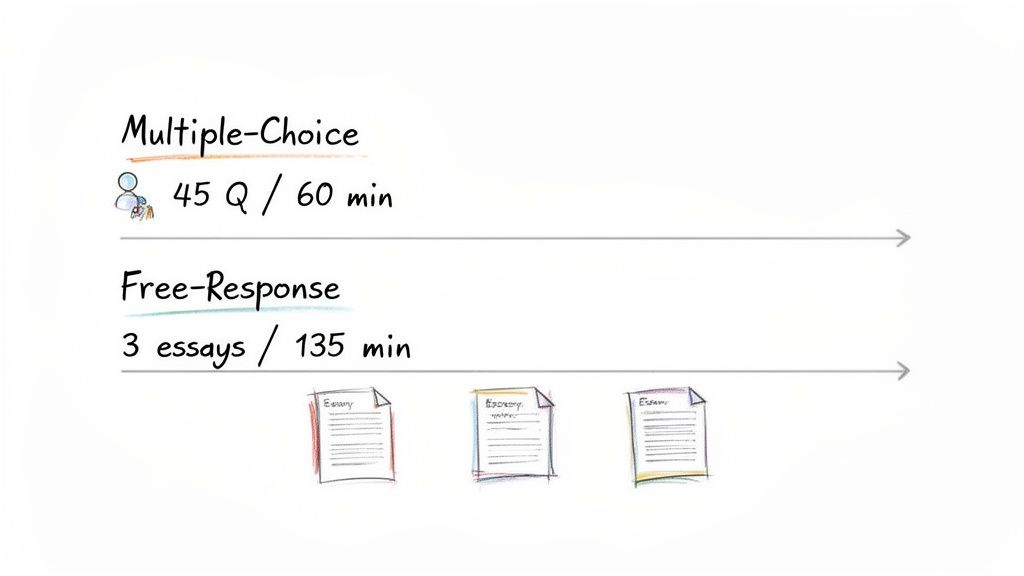
Think of the AP Lang exam as a game of two halves. Each one tests different skills under some serious time pressure. Knowing the rules of engagement is half the battle.
To get a quick overview, here's a simple breakdown of what you're up against.
AP English Language Exam at a Glance
Section | Number of Questions | Time Allotted | Percentage of Score |
|---|---|---|---|
Section I: Multiple-Choice | 45 questions | 60 minutes | 45% |
Section II: Free-Response | 3 essays | 2 hours, 15 minutes | 55% |
As you can see, the essays carry a bit more weight, but you can't afford to slack on the multiple-choice section either. A balanced performance is key.
H3: Part 1: The Multiple-Choice Sprint
First up is the Multiple-Choice Question (MCQ) section. This is a rapid-fire test of your analytical reading skills. It's a total sprint.
You'll get 45 questions to answer in just 60 minutes, and it makes up 45% of your total score. The questions are all based on a handful of non-fiction passages you'll read right there on the spot.
That breaks down to about one minute and 20 seconds per question. But here’s the kicker: that time includes reading the passages themselves. Some questions will be quick hits, but others will require you to go back and really think. The trick is to not get stuck on any single one.
Part 2: The Free-Response Marathon
After a quick break, you’ll dive into the Free-Response Question (FRQ) section. This is where you get to flex your writing and argumentation skills. It’s less of a sprint and more of a strategic, long-distance race.
You get a total of 2 hours and 15 minutes to write three different essays. This time chunk also includes a 15-minute reading period, but you're ultimately in charge of how you manage the entire block of time.
A smart strategy that most high-scoring students use is to aim for about 40 minutes per essay. This gives you a solid 5-10 minutes to read the prompt and sources, make a quick outline, and then 30-35 minutes to actually write.
Here's the breakdown of what you’ll be writing:
Synthesis Essay: You'll build an argument using a set of provided sources.
Rhetorical Analysis Essay: You'll analyze how an author uses rhetorical choices to achieve their purpose.
Argument Essay: You'll develop your own argument on a specific topic, drawing on your own knowledge.
Together, these three essays make up a massive 55% of your total score. Your performance here can make or break your final result, so it’s critical to have a plan.
Getting the feel for this kind of pacing isn't something you can just read about—you have to practice it. It’s one thing to know you have 40 minutes for an essay, but it's another thing entirely to execute that under pressure.
This is where your prep can really pay off. Try uploading a past exam prompt into a tool like Vivora to instantly generate a timed practice session. Simulating real exam conditions helps you get used to the rhythm and pressure, so when test day arrives, that 40-minute timer feels like a familiar challenge, not a reason to panic.
Alright, let's break down how to conquer the multiple-choice section of the AP Lang exam.
How to Beat the Multiple-Choice Questions
Let’s be real for a second. The AP Lang MCQ section isn't your average reading quiz where you just hunt for a specific fact in the text. It's more of a mental game, designed to see if you can think like a writer and a sharp, critical reader. To win this game, you need a system, not just a talent for guessing.
The questions themselves are split into two different flavors. Getting a feel for this difference is the absolute first step to mastering this part of the exam.
Cracking the Code on Reading vs. Writing Questions
First up, you've got Reading Questions. These make up a bit more than half of the section, and they're all about your ability to dissect a finished piece of writing. They'll ask you to pinpoint an author's purpose, unpack their argument, or explain how a specific rhetorical move affects the audience.
Then come the Writing Questions. These are a totally different beast. They put you in the editor's chair, asking you to clean up and improve a passage that reads like a rough draft. You'll see questions like, "Which of the following sentences, if added here, would best back up the main argument?" or "The writer wants to add stronger evidence. Which of these choices would be most effective?"
Think of it this way:
Reading Questions: You're the movie critic, analyzing a film that's already out.
Writing Questions: You're the director in the editing room, deciding which scenes to add, cut, or shift around to make the final cut more powerful.
Dodging the Traps: How to Spot Distractor Answers
The people who create this exam are masters of the "distractor" answer. These are the answer choices that look super tempting because they might be partially true, use fancy language, or state a correct fact that just doesn't answer the actual question.
A classic trap is an answer choice that correctly names a rhetorical device but gets its purpose in the passage completely wrong. The test makers know you've been memorizing terms like anaphora and zeugma, and they use that to bait you.
To sidestep these traps, your mantra should be: go back to the passage. Always. Your answer has to be 100% supported by the text. If an answer choice feels like a reach or forces you to make an assumption, it's almost certainly wrong. The right answer is usually the one that connects directly and logically to the author's specific words and their overall mission.
A System for Attacking Every Single Question
Don't just read the passage from top to bottom and then jump into the questions, hoping for the best. That's a recipe for second-guessing and running out of time. You need a consistent process.
Read the Blurb First: Before every passage, there's a short, italicized blurb giving you context—who the author is, the year it was written, the genre. This is a goldmine! It helps you frame your thinking before you even read the first sentence.
Read Actively, Not Passively: As you read the passage, get your pencil moving. Quickly underline what you think is the author's main claim or thesis. In the margins, jot down tiny notes about what each paragraph is doing. Is it giving evidence? Telling a story? Shutting down an opposing view?
Use Process of Elimination: This is your most powerful weapon. Instead of trying to find the one right answer, make it your mission to find the three wrong ones. For every choice, ask yourself, "Can I prove this with specific evidence from the text?" If the answer is no, cross it out and move on.
This systematic approach saves you from that dreaded feeling of being stuck between two "good" answers and helps you move through the section with confidence. Remember, you have only about 80 seconds per question, and that includes reading the passage. Efficiency is everything.
Having a modern toolkit alongside your AP English Language study guide can make a huge difference here. All those class notes are critical, but they're useless if they're buried in a folder. With a tool like Vivora, you can turn your notes into an actual practice engine. Just upload your lecture slides on logical fallacies, and Vivora's AI can instantly generate a targeted quiz that drills you on identifying those exact fallacies in short passages. This takes your notes from passive info to an active study session, getting you ready for whatever tricky questions the test throws at you.
Alright, let's get into the heart of the AP Lang exam: the essays. Officially called the Free-Response Questions (FRQs), this is where you put your analytical and writing skills on full display. This section is worth a massive 55% of your total score, making it the single most important part of the test. If you want a 4 or 5, you have to master these essays.
Think of the FRQs as your main character moment. It’s your chance to go beyond just pointing out what other writers are doing and start building compelling arguments of your own. It’s not about just spotting a rhetorical device or dropping in a quote; it’s about crafting a cohesive, persuasive piece of writing under serious time pressure.
We're going to break down the game plan for all three essays. By the end, you'll know exactly what the graders are looking for and how to give it to them.
The Synthesis Essay Playbook
First up is the Synthesis Essay. Think of this one as a mini research paper, but on a super tight deadline. You’ll get a prompt and a packet with about 6-7 sources—these could be short articles, charts, political cartoons, or images. Your mission is to use at least three of them to build your own argument in response to the prompt.
The biggest trap students fall into here is the "source dump." This is where you just summarize one source after another. Don't do it. It’s a fast track to a low score because it shows you're not actually thinking.
Instead, your goal is to make the sources "talk" to each other to back up your argument.
Craft a defensible thesis: Your thesis needs to take a clear, arguable stand. Don't just state the topic; have a point of view.
Weave, don't just drop: Seamlessly integrate quotes and ideas from the sources into your own sentences. They are your evidence, not your entire argument.
Always add commentary: After you use a source, explain why it matters. How does this piece of evidence prove your point? Connect everything back to your main thesis.
Decoding the Rhetorical Analysis Essay
Next, you'll face the Rhetorical Analysis Essay. Here, you get a single, usually powerful, piece of non-fiction text. Your job is to break down how the author uses specific rhetorical choices to achieve their purpose and connect with their audience.
This is where a lot of students get tripped up. It’s not enough to just say, "The author uses pathos to make the audience feel sad." So what? The real points are in explaining how the specific word choice or anecdote creates that feeling and why making the audience feel sad helps the author achieve their ultimate goal.
The core of a high-scoring rhetorical analysis isn't just identifying devices; it's explaining their effect. Focus on the triangle: the specific choice the author made, the intended effect on the audience, and how that effect helps achieve the overall purpose.
To score well, forget about creating a laundry list of every single device you can spot. Pick two or three of the most significant, powerful strategies the author uses. Dedicate a full paragraph to each one, diving deep into how it works and why it’s so effective.
Mastering the Argument Essay
Finally, we have the Argument Essay. No sources, no text to analyze. It’s just you, a prompt presenting a debatable claim, and your own brain. You have to write an essay that defends, challenges, or qualifies that claim, using evidence from your own knowledge, reading, or experience.
The key to crushing this essay is your evidence. "My own knowledge" isn't an invitation to tell a random story about your pet. It means drawing from what you know about history, current events, science, literature, or even well-reasoned personal experiences that directly and powerfully support your position.
Specificity is your best friend here. Vague generalities like "society believes" or "throughout history" won't convince anyone. Your goal is to build a case so logical and so well-supported with concrete examples that the reader can’t help but be persuaded.
Bringing It All Together with AI
The only way to get good at these essays is to practice them. A lot. But just writing them isn't enough; you need feedback to spot your bad habits and fix them. This is where you can study smarter, not just harder.
Think about it. You finish a timed practice essay. What now? Instead of just putting it aside, you can use an AI tool as an on-demand writing coach.
With Vivora, after you turn your class materials into study guides, you can use its AI chat feature to analyze your writing. Just upload your practice essay and ask specific, targeted questions:
"Is my thesis for this argument essay clear or is it too vague?"
"In paragraph 2 of my rhetorical analysis, where could my commentary be stronger?"
"Suggest a way to integrate this quote from Source C more smoothly into my synthesis essay."
This gives you immediate, focused feedback that helps you see the weaknesses in your own writing. You can refine your arguments and sharpen your analysis before you turn an essay in for a grade, making every single practice session count. It’s a genuine game-changer for building the skills you need for this crucial 55% of the exam.
Your 8-Week AP Lang Study Schedule
Trying to cram for the AP Lang exam a week before is a certified recipe for disaster. We've all been there, and let's be real—the burnout just isn't worth it. The key to walking into that exam room feeling confident isn't about pulling all-nighters; it's about having a smart, manageable plan.
This 8-week schedule is your personal roadmap. We’ve broken down the entire prep process into bite-sized weekly goals, so you can build your skills layer by layer without losing your mind. Think of it less like a calendar and more like a strategic training plan that puts you in control.
First, let's get a high-level view of the three essays you'll need to absolutely nail. This timeline helps visualize where your focus should be throughout the year.
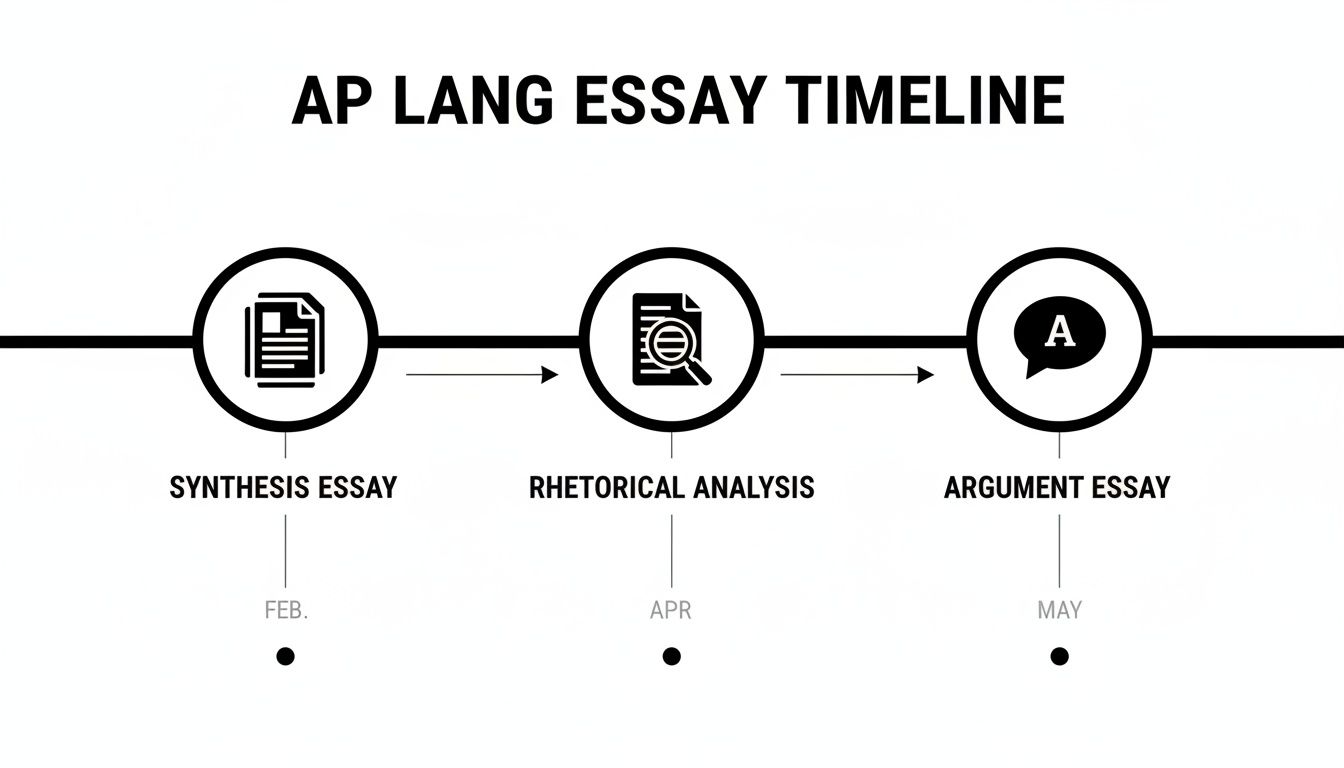
The icons really capture the core task of each essay: combining documents for Synthesis, analyzing an author's moves for Rhetorical Analysis, and building your own case for the Argument essay.
Now, here's a closer look at our 8-week sprint. This table gives you a quick snapshot of where your energy should be focused each week.
Your AP Lang 8-Week Study Sprint
Weeks | Focus Area | Key Activity with Vivora |
|---|---|---|
Weeks 1-2 | Building the Foundation | Upload class notes to generate flashcards for core rhetorical terms. |
Weeks 3-5 | Mastering the FRQs | Ask the AI to analyze your practice essays for strengths and weaknesses. |
Weeks 6-8 | Timed Practice & Review | Use the AI to create targeted quizzes on your weakest concepts. |
This plan is designed to build momentum, starting with the fundamentals and moving toward full-scale exam simulation.
Weeks 1-2: Building Your Foundation
These first two weeks are all about laying the groundwork. You can't analyze a complex argument if you don't know the building blocks. This is where you get comfortable with the core rhetorical concepts that underpin the entire course.
Week 1 Goal: Master the Rhetorical Situation. Get super familiar with SOAPSTone (Speaker, Occasion, Audience, Purpose, Subject, Tone) and the rhetorical triangle (ethos, pathos, logos). These are your bread and butter.
Week 2 Goal: Deep Dive into Rhetorical Choices. It's time to move beyond the big three appeals. Start identifying and explaining the effect of specific devices like juxtaposition, anaphora, and antithesis.
Vivora Pro-Tip: This is the perfect time to centralize your study materials. Upload your class notes, key readings, and any PowerPoints from your teacher into Vivora. Ask its AI to instantly generate a set of flashcards for the key terms in your AP English Language study guide. A few minutes of drilling each day makes a huge difference.
Weeks 3-5: Mastering the Essays
With a solid foundation, you’re ready to tackle the Free-Response Questions (FRQs). These middle weeks are all about deconstructing each essay type. For now, forget the clock and focus purely on technique and quality.
Week 3 Goal: The Argument Essay. Practice developing a strong, defensible thesis. The real challenge here is sourcing specific, compelling evidence from your own knowledge bank—history, current events, science, or personal experience.
Week 4 Goal: The Synthesis Essay. This is where you learn to have a "conversation" with the sources. Your goal is to skillfully weave at least three sources into your own argument, not just drop in summaries or long quotes.
Week 5 Goal: The Rhetorical Analysis Essay. Time to write your first full RA essay from start to finish. Focus on making clear connections between the author’s specific rhetorical choices and their intended purpose or effect on the audience.
Weeks 6-8: Timed Practice and Review
The final stretch is all about building stamina and sharpening your skills under pressure. This is where you put it all together and simulate real exam conditions. Pacing is everything, especially when you consider that only about 54.6% of students score a 3 or higher.
Week 6 Goal: Timed FRQ Sections. Sit down and complete a full FRQ section—all three essays in 2 hours and 15 minutes. It will feel brutal the first time, but it’s the only way to build that mental endurance. Our guide on AI-powered study strategies has some great ideas if you need to switch things up.
Week 7 Goal: Full-Length Practice Exam. This is the dress rehearsal. Take a complete, timed practice test, including both the MCQs and the FRQs. The results will give you a crystal-clear picture of your remaining weak spots.
Week 8 Goal: Final Review. The last week is for targeted review, not learning new material. Go over your mistakes from the practice tests. Use Vivora to create targeted quizzes on tricky MCQ writing questions or identifying complex tone. You can even ask the AI to analyze a practice essay and suggest two concrete ways to improve your commentary. This focused final push will have you walking in on exam day feeling ready.
How to Study Smarter Not Harder with AI
Let's be real. The path to a 5 on the AP Lang exam isn't paved with all-nighters and fueled by an endless supply of caffeine. It’s all about efficient, targeted studying. This is exactly where a smart tool can completely change the game, turning your messy study grind into a focused, productive flow.
Forget those overstuffed binders, the dozens of untitled Google Docs, and the pure chaos of having your class materials scattered across ten different browser tabs. It’s time to work smarter.
Create a Centralized Study Brain
Imagine having one single, central place for everything related to your AP Lang class. This isn't just about being organized; it's about reclaiming your time and sanity. A platform like Vivora can become your personal study hub, letting you consolidate all your content in one clean spot.
You can upload everything that actually matters:
Your teacher's slideshows on rhetorical appeals
PDFs of past practice passages and prompts
Links to helpful YouTube analysis videos
Photos of your handwritten notes from class
Instead of wasting hours just trying to find and organize your notes, you have a single workspace. This step alone cuts down on the friction that makes studying feel like a chore. The real magic, though, is what happens next.
Automate the Busywork and Personalize Your Review
Once your content is uploaded, Vivora's AI gets to work. That 30-page PDF on logical fallacies your teacher assigned? In seconds, Vivora can transform it into a 10-question quiz that tests what you actually understand, not just your ability to skim a document.
This is where your prep becomes personal. You're no longer just passively rereading notes—you're actively engaging with the material in a way that makes it stick.
The best part? You can literally talk to your content. Use Vivora's AI chat to ask specific questions like, "Explain the difference between exigence and purpose using only my teacher's lecture notes" or "Give me three examples of juxtaposition from the practice passage I uploaded."
This isn't just about saving time; it's about spending your energy on what truly moves the needle: mastering the concepts. An AI study assistant automates the busywork and gives you instant, context-aware answers, turning your passive notes into an active learning partner. This is how you stop drowning in materials and start mastering the skills you need to earn that 5.
Your AP Lang Questions, Answered
Got a few nagging questions about the AP Lang exam? Bet. Let's clear them up. We’ve pulled together the most common questions from students and are giving you the straight, no-nonsense answers.
What’s the Difference Between AP Lang and AP Lit?
Here’s the simplest way to think about it: AP Lang is all about real-world arguments, while AP Lit explores the world of fiction.
In AP Lang, you’ll be digging into non-fiction—speeches, essays, and articles—to figure out how a writer builds a persuasive argument. AP Lit, on the other hand, has you analyzing novels, poems, and plays to understand how authors use literary tools like symbolism and metaphor to create meaning. Both are about sharp reading and writing, but they focus on totally different kinds of texts.
Can I Actually Get College Credit for AP Lang?
Yes, and honestly, this is one of the biggest wins of taking the course. The vast majority of colleges will grant you credit for a qualifying score, which is typically a 4 or a 5. Some even accept a 3.
Nailing the exam often means you can skip a mandatory freshman writing class. That's a huge saving in both time and tuition money right out of the gate. Just make sure to check the specific AP credit policies for the colleges you're eyeing, since every school has its own rules.
The College Board’s data shows that 54.6% of students who took the AP Lang exam in 2024 scored a 3 or higher. With the right prep, getting that qualifying score is completely within your reach.
How Many Rhetorical Devices Do I Need to Memorize?
Let me be clear: you do not need to memorize a dictionary of obscure rhetorical terms. That's a classic rookie mistake. Your energy is much better spent mastering the "big ones"—the foundational strategies writers lean on constantly.
Focus on being able to identify and, more importantly, explain these:
The rhetorical appeals (ethos, pathos, logos)
Common figurative language (metaphor, personification, hyperbole)
Key structural choices (juxtaposition, anaphora, antithesis)
Elements of tone and diction
AP graders care way more about the quality of your analysis than the number of fancy terms you can drop. Explaining how a specific word choice creates an emotional effect is always going to be more impressive than just pointing out a "synecdoche."
How Can I Write Faster on the Essays?
There's no magic bullet for this one—it all comes down to consistent, timed practice. Seriously.
Start by setting a timer for 40 minutes and writing a full essay. But before you even write your first sentence, commit to spending the first 5-7 minutes sketching out a quick outline. This isn't wasted time; it’s what gives your essay a backbone and stops you from hitting a wall halfway through.
Getting that pacing down builds the muscle memory and stamina you’ll need to perform under pressure on exam day.
The best way to build that speed is to have a never-ending supply of practice materials. With a tool like Vivora, you can instantly transform any of your class notes—from sample prompts to your teacher’s lectures—into unlimited, targeted practice sessions. It’s the closest thing to having a personal writing coach, helping you get faster and more confident with every essay. You can start a free trial at https://vivora.ai.