The Ultimate AP Lang Exam Study Guide for Nailing That 5
Mar 10, 2026
Let's be real, prepping for the AP Lang exam feels like a huge boss battle. But this guide is your cheat code, designed to get you straight to a 5. We’re breaking down everything you need to know—from the exam’s structure and essay types to legit study hacks—so you can walk into that testing room feeling confident, not crushed.
Your Guide to the AP Lang Exam Structure
Alright, first look, the AP Lang exam is a beast. But every beast has a weakness, and for this test, it's knowing its layout. Once you get the format, the timing, and what each section is actually asking, the whole thing gets way less intimidating.
Think of it like getting the map before dropping into a new game. We're going to dissect the entire test, from the rapid-fire Multiple-Choice Questions (MCQ) to the three very different essays: Synthesis, Rhetorical Analysis, and Argument. Knowing the game board means zero surprises on test day.
Breaking Down the Sections
The exam is split into two main parts, and you gotta be ready for both. Each one is a massive chunk of your final score.
Section I: Multiple-Choice Questions (MCQ): This is a one-hour sprint through 45 questions. It’s all about how well you can read and analyze nonfiction passages for stuff like rhetorical strategies, author’s purpose, and argument. This section makes up 45% of your total score.
Section II: Free-Response Questions (FRQ): Here’s the marathon. You get 2 hours and 15 minutes, which includes a 15-minute reading period, to write three full essays. This section is worth a whopping 55% of your score, so learning how to crush it is non-negotiable.
Before we dive deeper, let's just lay it all out. Seeing the whole exam structure in one place can help you wrap your head around the challenge.
AP Language Exam at a Glance
Exam Section | Number of Questions | Time Allotted | Percentage of Score |
|---|---|---|---|
Section I: Multiple-Choice | 45 questions | 1 hour | 45% |
Section II: Free-Response | 3 essays | 2 hours, 15 minutes | 55% |
Seeing it like this makes it clear: nearly half your time is reading, the other half is writing. You have to master both to win.
Trying to study for this feels like juggling a dozen different things—class notes, practice prompts, online articles, you name it. It's so easy for your materials to get scattered across a chaotic Google Drive or lost in your backpack. This is where an AI-powered study tool like Vivora is a total game-changer. You can just upload all your class content—slides, PDFs, even links to YouTube videos—and it instantly transforms it all into a personalized study guide for you.
The Bottom Line: Your score on the AP Lang exam isn't just about what you know. It's about how well you perform under serious time pressure. Nailing the structure is the first step to building a winning game plan.
With a clear map of the exam, you can start planning your attack. The recommended time for each of the three essays is about 40 minutes, but that has to include planning and a quick proofread. The clock is brutal, which means efficiency is everything. You can't afford to waste a single minute wondering what to do next. By knowing exactly what's coming, you build the muscle memory you need to perform at your best when it counts.
Cracking the Multiple-Choice Questions
Let's get one thing straight: the AP Lang Multiple-Choice section is not a simple reading comprehension quiz. It's a 60-minute, 45-question strategic dash that tests how you think about language under pressure. This is where we go beyond the basic advice and get into the real tactics that separate a good score from a great one.
The section is split into two distinct question types: Reading and Writing. The Reading questions are all about analyzing a nonfiction text like a seasoned critic, while the Writing questions challenge you to step into the role of a sharp, efficient editor.
Reading Questions: Think Like a Critic
When you hit the Reading passages, you need to read with a rhetorical lens. This doesn't mean getting lost in every single word. It’s about quickly zeroing in on the author's argument, their tone, and the big-picture choices they’re making to build their case.
Don't just passively absorb the text. As you read, constantly ask yourself why the author chose these specific words or this particular structure. Are they being sarcastic, academic, or passionate? Are they trying to persuade you, inform you, or just tell a story? Figuring this out early makes predicting the questions a whole lot easier.
Pro Tip: Never, ever skip the little italicized blurb before each passage. It’s a goldmine of context about the author, the time period, and the audience—often giving you the single biggest clue to understanding the author's purpose.
Writing Questions: Think Like an Editor
The Writing questions are a completely different beast. Here, you’re presented with a draft of a student's essay and asked to make it better. Your brain needs to switch gears into full-on editor mode, hunting for ways to make the arguments clearer and the language punchier.
These questions go way beyond just catching grammar mistakes. You’ll be asked to:
Make a thesis statement more specific and arguable.
Add a sentence to create a smoother transition between ideas.
Revise a sentence for better clarity or to be more concise.
Choose a stronger piece of evidence to back up a claim.
The real key here is to think about what the writer is trying to accomplish with each paragraph and pick the answer that helps them do it best.
Time-Saving Hacks for the MCQ Section
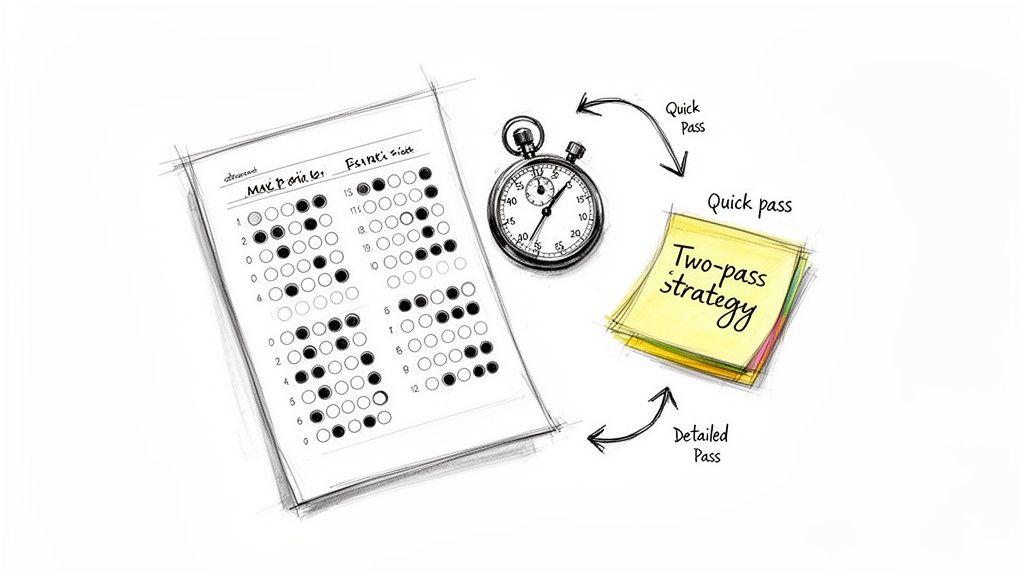
Pacing is everything. You have just over a minute per question, which means getting bogged down is not an option. The single most effective strategy I've seen students use is the two-pass approach.
First Pass (The Easy Wins): Your first mission is to sweep through and answer every question you feel confident about. If a question feels like a major time-sink or just completely stumps you, mark it and move on. The goal is to bank all the easy points first.
Second Pass (The Final Bosses): Once you’ve made it through the entire section, circle back to the questions you marked. With your remaining time, you can now wrestle with these tougher problems without the pressure of leaving easy points on the table.
And when you're truly stuck? It's time to make a smart guess. The AP exam doesn't penalize you for wrong answers, so you should never leave a bubble blank. Work to eliminate any answer choices you know are wrong. You can often get it down to a 50/50 shot, which is way better than a random guess.
Building this kind of test-taking instinct requires practice. A time-saving way to drill these strategies is to turn your class notes into custom practice quizzes. You can check out how Vivora’s AI quiz generator can help you do this, transforming your course content into personalized quizzes that make these tactics second nature by exam day.
Mastering the Synthesis Essay
Let's talk about the synthesis essay. For a lot of students, this is the most intimidating part of the AP Lang exam. It's not just testing what you know; it’s testing how you think on your feet, juggling a half-dozen sources to build an argument of your own. But it’s completely manageable once you have a game plan.
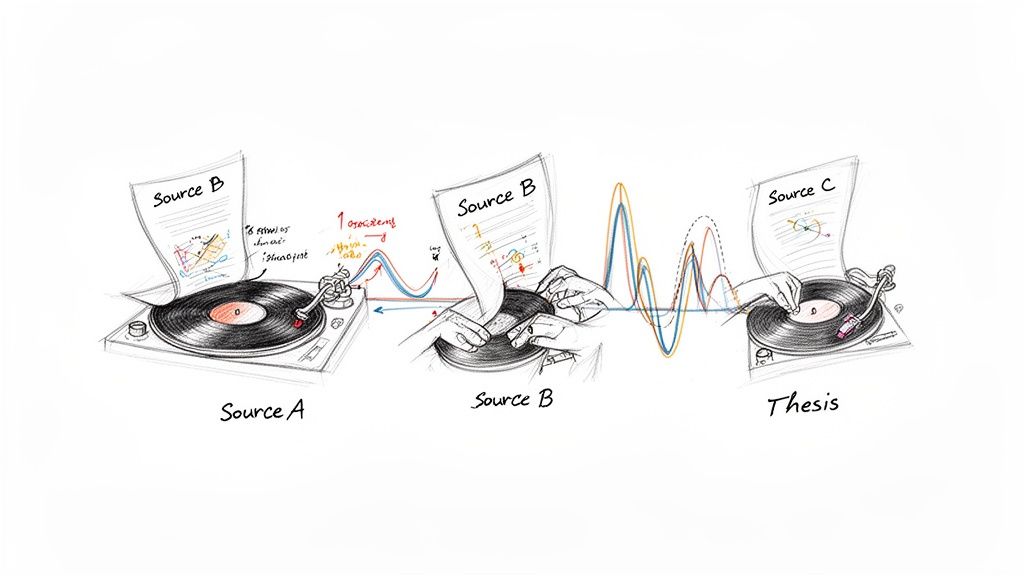
Think of it like being a DJ. The exam gives you a crate of records—these are your sources—each with its own perspective and vibe. Your job is to select at least three of them and mix them into a cohesive argument that gets the AP reader nodding along. You’re not just playing clips from each song; you're creating a new track, with your voice at the center.
The 15-Minute Reading Period Is Your Superpower
Before you write a single word of your essay, you get a dedicated 15-minute reading period. This is not downtime. This is your secret weapon. Using these 15 minutes wisely is what separates a decent essay from a great one.
Your mission is to get through the provided sources, usually about six of them, and figure out what they’re trying to say. The key is to quickly grasp each source's main point and how it fits into the broader conversation. Don't get lost in the details; you're hunting for the big picture.
Here's how to attack it:
One-Sentence Summary: In the margin, scribble down a single sentence summarizing the source’s core argument.
Pick a Side: Label each source. Is it FOR the topic, AGAINST it, or NEUTRAL/COMPLICATED? This simple tag is incredibly helpful.
Map Connections: Start noticing which sources are on the same team and which are in direct conflict. This is the raw material for your argument.
The real point of the synthesis essay isn't to summarize what other people said. It's about you stepping into an ongoing debate, using the sources as evidence to support your own unique take. You're the headliner here.
Crafting a Nuanced Thesis
Once that reading period is up, your first move is to write your thesis. A vague or weak thesis can torpedo your entire essay. You absolutely cannot just rephrase the prompt or state the obvious, like "there are different opinions on this topic." That’s a summary, not an argument.
A strong, defensible thesis takes a clear stand while also acknowledging that the issue is complex. It needs to be specific enough to be the roadmap for your entire essay. For instance, instead of, "GPS has its benefits and drawbacks," go for something with more bite: "While GPS technology offers undeniable convenience, our growing dependence on it threatens to erode critical spatial awareness skills, a societal trade-off we have yet to fully address."
See the difference? That second one shows you’ve wrestled with the sources and have a real argument to prove.
Making the Sources Talk to Each Other
The highest-scoring synthesis essays don't just list what each source says one by one. They make the sources interact, creating a conversation between them. This is where you demonstrate true synthesis.
The trick is to organize your body paragraphs around your ideas, not around the sources.
For example, a strong structure might look like this:
Paragraph 1: Start with one of your claims, like "The main appeal of mapping software is its incredible efficiency." You could then pull in Source A and Source C to back this up, explaining how they both support this specific point.
Paragraph 2: Now, introduce a complication or a counterargument. "However, this convenience often comes at the expense of local businesses and community character." Here, you'd bring in Source D to illustrate this downside.
Paragraph 3: Offer your own, more nuanced perspective that resolves some of this tension. "Ultimately, the issue isn't the technology itself, but our uncritical adoption of it." You could then use Source F to support this final point, tying everything back to your main thesis.
Juggling all these sources, notes, and ideas from your AP Lang exam study guide can feel like a mess. This is where centralizing your practice materials can save you a ton of time.
This screenshot shows how you can easily upload all your practice synthesis sources, class notes, and PDFs into Vivora.
Instead of having files and notes scattered everywhere, Vivora's AI instantly organizes everything for you. It can even help you spot key connections between sources and automatically generate a personalized study guide, helping you see the bigger conversation and craft your arguments much faster.
Writing a Killer Rhetorical Analysis Essay
Of the three AP Lang essays, the rhetorical analysis can feel like the weirdest one. It’s not about arguing your own opinion, and it’s not even really about agreeing or disagreeing with the author. Your job is to become a kind of literary detective.
You’re tasked with dissecting an author's argument to figure out how they built it, piece by piece. It's all about explaining the moves they make—the specific choices in language, structure, and tone—to persuade their audience. This is where you prove to the AP graders that you can think about writing on a whole other level.
It’s All About Choices and Effects
The single biggest mistake students make on this essay is just "device spotting." They'll write something like, "The author uses pathos," and then move on. This is a surefire way to land a low score. The graders already know the author used pathos; they want to know how and, more importantly, why.
Instead of just listing terms, every body paragraph you write should be built on a simple, powerful framework that connects a writer's choice to its intended effect.
Think of it as a three-step sequence:
Identify the Choice: Pinpoint a specific strategy the writer used. Don't just say "diction"; get specific. For example, "the author uses sharp, aggressive diction." Don't just say "ethos"; try, "the author builds credibility by citing her own decades of research."
Provide the Evidence: Pull a short, direct quote from the text that shows this choice in action. This is your proof. It anchors your claim in the text itself.
Explain the Function: This is where the real analysis happens. Explain how that specific choice helps the author achieve their goal. What is it supposed to make the audience think, feel, or believe?
This "Choice-Evidence-Function" model should be the engine driving every single one of your body paragraphs.
A killer rhetorical analysis essay never just summarizes what the author says. Instead, it explains how the author's methods persuade the reader. You’re analyzing the "how," not the "what."
Level Up Your Analysis with Strong Verbs
Want an almost-instant way to make your writing sound more sophisticated? Ditch weak, generic verbs like "says," "uses," or "shows." A powerful analysis verb does half the work for you by embedding interpretation directly into your sentence.
Instead of writing, "The author uses a metaphor to show the problem," try one of these:
"The author frames the problem as a 'ticking time bomb' to..."
"The author minimizes the opposition's claims by..."
"The author juxtaposes the pristine image of nature with the harsh reality of industrial waste to..."
This small change makes your commentary sound less like a checklist and more like genuine insight. It’s a great idea to start a running list of these verbs on your phone; add new ones whenever you read a strong sample essay or an article.
Seeing It in Action
Let’s look at a quick example. Imagine an author is arguing about the dangers of social media.
Weak Analysis: "The author uses a personal story to create pathos." (Okay, but so what? This is just device spotting.)
Strong Analysis: "The author begins with a personal anecdote about his daughter's struggle with cyberbullying. By humanizing the issue with this relatable story, he dismantles the reader's emotional distance and forces them to confront the real-world consequences of online harassment, creating an urgent need for a solution."
See the difference? The strong example names the specific choice (personal anecdote), explains its function (humanizing the issue, dismantling distance), and connects it all back to the author's larger purpose (creating urgency).
Trying to keep track of all these rhetorical devices, powerful verbs, and example essays can be a huge pain. A major time-saver is to centralize everything in one digital space. With Vivora, you can upload a PDF of a practice passage, and its AI can automatically generate a set of digital flashcards for the key terms found in the text. This helps you move from just memorizing definitions to seeing how they work in real arguments. You can learn more about how this can revolutionize your study sessions by checking out our guide on creating AI-powered notes to study smarter. This is the kind of smart prep that makes a huge difference on exam day.
Acing the Argument Essay (AKA The "Come at Me, Bro" Essay)
Alright, let's talk about the AP Lang argument essay. This is the one. No safety net of sources, no pre-packaged texts to analyze—just you, a prompt, and 40 minutes to build a convincing argument out of thin air. For a lot of students, it’s intimidating. But honestly, if you walk in with the right game plan, it can be the most satisfying essay on the entire exam.
The secret isn’t about using big words or crafting some ridiculously complex thesis. The real difference between a good essay and a great one comes down to one thing: concrete, compelling evidence. AP graders read thousands of essays, and they are absolutely tired of seeing the same generic examples about Martin Luther King Jr. or the American Revolution for every prompt imaginable.
A top-tier essay gets remembered because it brings something fresh to the table. It uses specific, thoughtful, and sometimes even surprising evidence to make its point.
Building Your Personal Evidence Library
You can't just cross your fingers and hope the prompt is about the one historical event you know inside and out. The students who ace this essay come prepared with a mental "evidence library" they can draw from for almost any topic. This isn't about memorizing a million random facts; it's about being more intentional about the world around you and organizing what you learn.
Think of it like being a DJ. You don't just have one song; you build a massive library of tracks so you're ready for any vibe. Throughout the year, you need to consciously collect examples from a few key categories:
History: Dig deeper than the obvious stuff. Think about specific turning points—how the invention of the printing press changed society, the ethical questions raised by the Manhattan Project, or the cultural shifts of the Harlem Renaissance.
Science & Tech: How has CRISPR technology forced us to redefine ethics? What are the real-world consequences of social media algorithms on political discourse? Specific breakthroughs, inventions, and controversies are gold here.
Pop Culture & Arts: Don't sleep on this category. A film, a book, or even a song can be incredibly powerful evidence if you analyze it with academic rigor. Think about how a movie like The Truman Show critiques our obsession with surveillance or how an album comments on social justice.
Current Events: What’s happening in the news right now? A recent Supreme Court decision, a major social movement, or a global economic trend can provide evidence that feels immediate and relevant.
Personal Experience: This is the trickiest category, but it can be pure gold when used well. A story about a time you failed, a family tradition that shaped you, or a lesson you learned at a part-time job can add an authentic, powerful voice to your essay. Just make sure it’s a well-told story that directly proves your point.
The goal is to build a diverse arsenal. An essay that can skillfully connect a historical moment, a modern tech trend, and a sharp personal insight shows a level of thinking that's far beyond the average. You're proving you can think across different fields of knowledge.
The table below gives you a framework for how you can start organizing these ideas. Think of it as the blueprint for your own evidence collection.
Your Personal Evidence Library
Evidence Category | Specific Example | Potential Argument Topic |
|---|---|---|
History | The Dust Bowl in the 1930s | The relationship between humanity and the environment |
Science & Tech | The development of GPS technology | The tension between convenience and privacy |
Pop Culture & Arts | The TV show Black Mirror | The unforeseen consequences of technology |
Current Events | The rise of the "gig economy" (e.g., Uber, DoorDash) | The changing definition of work and community |
Personal Experience | A time you learned a skill through failure (e.g., learning an instrument) | The value of embracing imperfection and struggle |
Having these kinds of specific examples ready to go is what separates a student who is writing an essay from a student who is building an argument.
Your Secret Weapon for Organizing Evidence
Let's be real: keeping all these ideas straight is tough. You read a fascinating article, watch a great video essay, or cover something interesting in your history class, and by next week, it’s gone. This is where a tool like an AI-powered study hub becomes your second brain.
Instead of having notes scattered across a dozen different apps and notebooks, you can use Vivora as your central command for building this evidence library. Clipped an article about AI ethics? Save it. Found a YouTube video breaking down a film? Drop the link in. Uploaded your notes from APUSH? They’re all in one place.
This is where the magic happens. You can use the chat feature to instantly find connections and spark ideas. So when you get a practice prompt about the value of failure, you're not staring at a blank page. You can just ask your materials.
Here’s an example of how you could ask Vivora to connect your uploaded notes on different topics to a specific prompt, instantly generating ideas for your essay.
Suddenly, all your scattered class content becomes a powerful, searchable database of evidence, ready for any argument prompt the AP Lang exam can throw at you.
From Evidence to Essay in Minutes
Once you've got your evidence on deck, it all comes down to execution. When that 40-minute timer starts, your first five minutes are absolutely crucial. Do not just jump in and start writing.
Deconstruct the Prompt: What is the real question being asked? Underline the key terms and unpack any nuance in the wording.
Take a Stand: Decide on your position. A nuanced argument is fantastic, but you must have a clear, defensible point of view. No fence-sitting.
Brainstorm Evidence: This is where your library comes in. Quickly jot down 3-4 specific examples that support your stance. Choose the strongest and most interesting ones.
Quick Outline: Structure your essay. Write down your thesis, then map out which piece of evidence will anchor each body paragraph.
This quick planning phase isn't optional; it's a non-negotiable. It's what ensures your essay has a strong line of reasoning—a clear, logical path that guides the reader from your thesis to your conclusion. AP graders are specifically trained to look for this. An organized essay with solid evidence will always, always outscore a beautifully written but rambling one.
The 6-Week AP Lang Study Grind (Without the Burnout)
Feeling that calendar-staring, pit-of-your-stomach dread as the AP Lang exam inches closer? Take a deep breath. You don't need to survive on caffeine and panic for the next month and a half.
This is your week-by-week plan to hit peak performance without the burnout. Think of it as a series of focused, manageable workouts, not one exhausting marathon. We’re going to build your skills piece by piece, starting with the fundamentals and working our way up to a full-blown dress rehearsal for test day.
Weeks 1-2: The Foundation
These first two weeks are all about getting the fundamentals right. Seriously, don't skip this part. A solid foundation makes everything that comes later feel a whole lot less overwhelming. This is your time to really master the mechanics of the test and get a handle on the core concepts you'll lean on for every single section.
MCQ Deep Dive: Get comfortable with the "two-pass" strategy. Your goal is to complete at least two timed MCQ practice sections from old exams. Don't stress about a perfect score yet—the real aim here is to get a feel for the pacing and the kinds of questions they throw at you.
Rhetorical Device Review: Forget trying to memorize a list of 50 obscure Greek terms. Just focus on the heavy hitters: ethos, pathos, logos, juxtaposition, diction, syntax, and tone. For each one, go find an example in a real-world article or speech.
Argument Evidence Brainstorm: This is when you start building that personal "evidence library" we talked about. Open up a document and start dropping in compelling examples from history, science, and even pop culture.
A killer evidence library isn't built overnight. The best ones evolve, pulling from historical turning points and then layering in modern scientific findings and relevant pop culture moments.
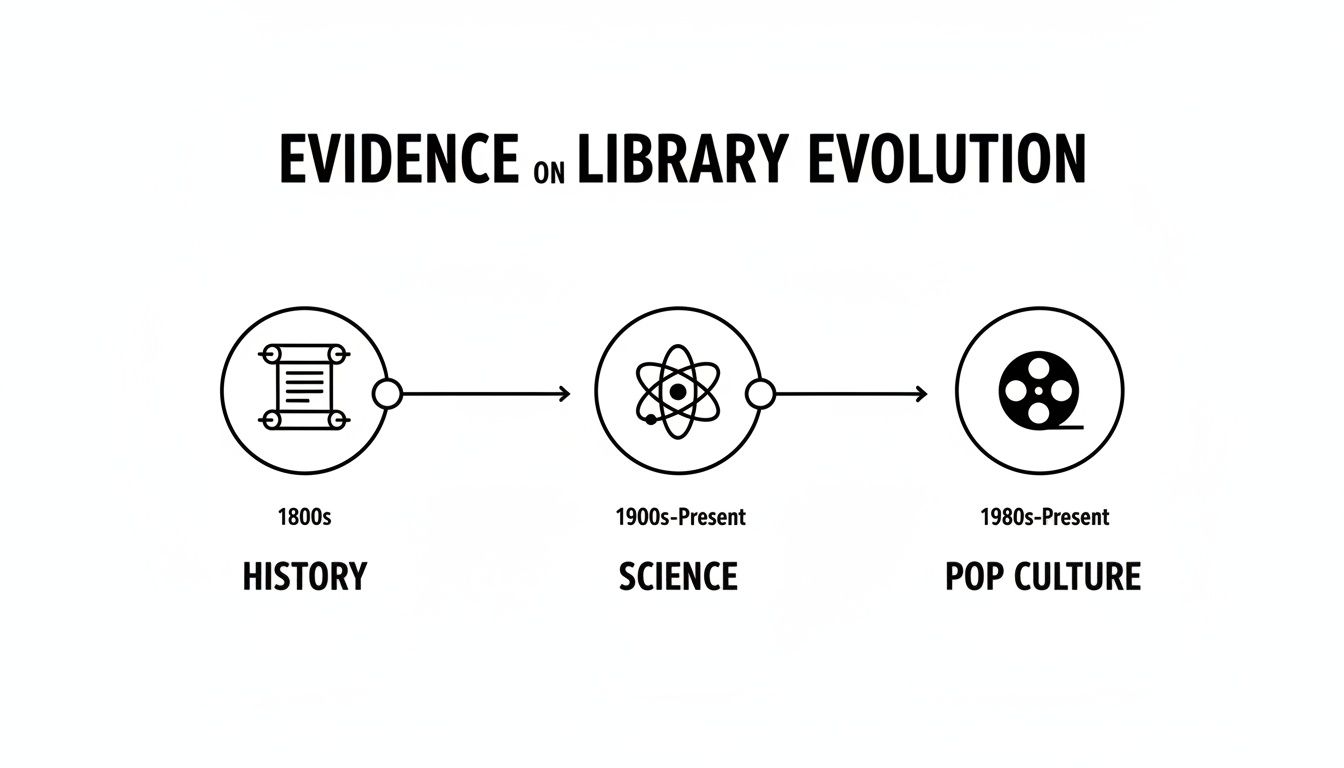
This shows how you can blend timeless knowledge with current examples to build arguments that feel both powerful and fresh.
Weeks 3-4: FRQ Boot Camp
Alright, it’s time to write. The next two weeks are your boot camp for the Free-Response Questions, where the whole goal is to get you outlining and writing timed essays on autopilot. We want that 40-minute window to feel like a routine, not a race against a ticking time bomb.
Your mission is to write one of each essay type (Synthesis, Rhetorical Analysis, Argument) each week, all under timed conditions. That’s six essays total. After each one, read it back and find just ONE thing you can do better next time. Maybe it’s writing a more precise thesis or weaving in quotes more smoothly.
The 5-Minute Outline Rule: For every single practice essay, force yourself to spend the first five minutes just creating a quick outline. Trust me, a solid plan is your number one defense against writer's block when the pressure is on.
Weeks 5-6: Full Dress Rehearsal
With just two weeks left, it’s time to face the final boss: full-length practice tests. This is where it all comes together. You need to simulate the real exam from start to finish. Carve out the time to take at least one complete, timed practice exam.
Yeah, it’s going to be a grind. But it is the single best way to build your mental stamina and pinpoint your final weak spots. Did you totally run out of gas on the last essay? Did your focus drift during the MCQs? Now is the time to figure that out.
The last week is all about smart, targeted review. Don't try to cram new stuff. Instead, focus on locking in what you’ve already learned. This is where Vivora can be an absolute game-changer. Upload all of your practice essays, notes, and evidence from the past five weeks. Then, have its AI generate a custom study guide that transforms your materials into flashcards and quizzes to drill down on your weak spots. Learning more about these AI study guide strategies can give you that final push. It's the perfect way to sharpen your skills so you can walk into that exam room feeling ready and confident.
Frequently Asked Questions About the AP Lang Exam
Let's clear the air on those lingering questions you’re probably Googling at 2 AM. We’ve all been there. Here are the direct, no-fluff answers to what students really want to know before test day.
How Important Is My Handwriting?
Okay, let's be real: there's no official "neatness" score. But if the AP reader can't decipher your brilliant analysis, they can't give you credit for it. It's as simple as that.
Your goal is clarity under pressure. The best way to prep for this is to practice writing timed essays by hand. This builds stamina and ensures your handwriting doesn’t completely fall apart in the final, frantic minutes of the exam.
What's the Best Way to Study Rhetorical Devices?
Please, don't just try to memorize a giant Quizlet list of 50+ terms. That's a huge waste of your precious study time. Instead, focus on the why—how does a device actually help the author achieve their purpose?
Concentrate on the heavy hitters you'll see again and again:
Metaphor and Simile
Rhetorical Questions
Juxtaposition
Parallelism
The most effective way to learn these is to spot them in the wild. Look for them in articles, speeches, or even the ads you watch. Connecting them to the real world makes the concepts stick in a way that rote memorization never will.
A top-scoring essay doesn’t just name-drop devices; it explains their effect. Always ask yourself, "So what?" Why did the author's choice of that specific metaphor actually matter to their argument?
Can I Still Get a Good Score if I Don't Finish an Essay?
This question comes up a lot, and it's a tough one. While it makes getting a high score much harder, it’s not automatically a lost cause. Here's the deal: a fully developed essay, even if it feels a bit rushed, will almost always score higher than a beautifully written but unfinished one.
A blank or barely-started essay is a massive hit to your score for that section. It’s far better to have three complete essays than two perfect ones and one that’s incomplete. This is why time management is everything. Always, always create a quick outline before you start writing.
Juggling all these terms, strategies, and practice essays can feel like a full-time job. This is where using a tool like Vivora really helps centralize everything. You can upload all your notes on rhetorical devices, and it can generate digital flashcards with the term, its function, and a real-world example, making your review sessions way more efficient.
Stop drowning in scattered notes and messy folders. With Vivora, you can turn all your class materials—from lecture slides to YouTube links—into organized study guides, flashcards, and practice quizzes in seconds. Study smarter, not harder, and get your free trial today.