Ace Your Bio Exam Without the All-Nighters: The Ultimate Guide to Biology Flash Cards
Mar 11, 2026
Let's be real, biology lectures can feel like trying to drink from a firehose. One minute you're deep in cellular respiration, the next you're untangling Mendelian genetics. A solid set of biology flash cards is clutch for keeping your head above water, but making them the old-school way is a massive, soul-crushing time-sink.
Why the Old Way of Making Flashcards Is So Extra
You know the vibe. You've got chaotic lecture slides open in one tab, a half-finished Google Doc in another, and a 40-minute YouTube video you have to get through before tomorrow's quiz. The traditional way means spending hours manually typing everything, trying to guess what’s actually important, and ending up with a disorganized mess that gives you major anxiety.
This method isn't just slow—it's incredibly inefficient. You burn precious study time on the busywork of copying notes instead of what actually moves the needle: learning the material. When you're tackling dense topics like the Krebs cycle or DNA replication, where every detail matters, this is a recipe for disaster.
The Real Problem With Traditional Studying
The biggest L is how fragmented everything is. Your knowledge is scattered across different formats and platforms, making it almost impossible to get the big picture. This chaos inevitably leads to:
Wasted Hours: Manually writing or typing hundreds of cards from slides, notes, and textbook chapters is a grind. That's time you could be spending on active recall, which is what actually cements information in your memory.
Information Overload: Without a smart way to pinpoint key concepts, you end up with a mountain of cards. Many of them are redundant or focus on low-impact details, making you feel overwhelmed.
Total Disorganization: Physical cards get lost or jumbled. A digital folder stuffed with random files isn't much of an improvement. It’s a mess.
The truth is, the study grind is changing because it has to. The flashcard market is projected to hit USD 2.5 billion and grow at 5.50% through 2030, a shift driven almost entirely by the demand for smarter, more efficient digital tools. You can dig into the specifics in recent market research.
A Smarter Workflow for Biology Flash Cards
Now, imagine taking all those scattered materials—your lecture slides, messy notes, and even those long YouTube videos—and turning them into a clean, organized set of Q&A flashcards in minutes. This is where AI-powered study tools like Vivora are a total game-changer. Instead of manually creating every single card, you just upload your course content and let the AI handle the grunt work.
It's a huge time-saver. Let's look at a quick comparison for a typical biology chapter.
Old vs New Way of Making Biology Flash Cards
Task | Traditional Method (Hours) | AI-Powered Method (Minutes) |
|---|---|---|
Reviewing & Identifying Key Concepts | 1-2 hours | 2-3 minutes |
Manually Creating 100 Flashcards | 2-3 hours | 5-10 minutes |
Organizing & Tagging Cards | 30-60 minutes | Automatic |
Total Time | 3.5 - 6 hours | 7 - 13 minutes |
The difference is staggering. This isn't just about saving a few minutes; it's about reclaiming hours of your life.
Vivora scans everything you give it, pinpoints the most important concepts, terms, and processes, and generates a personalized study guide for you. In the time it takes to make a cup of coffee, you can transform a whole semester's worth of chaotic material into a focused set of biology flash cards. This lets you jump straight to what really matters: acing the content for your exams.
Turn Any Course Material into Perfect Flash Cards
Alright, you’ve got the raw materials: lecture slides, textbook chapters, maybe even a few chaotic docs you've cobbled together. Now comes the hard part, right? Turning that mountain of info into something you can actually use to study.
This is where most students get bogged down in busywork, spending hours manually retyping notes. But there's a much smarter way to build a high-powered study tool.
The move is to gather all your course materials—from PowerPoints and PDFs to study guides and YouTube links—into a single place and let an AI do the heavy lifting. Platforms like Vivora are designed specifically for this. You can sync it with your class files or just drag and drop everything you have for a course.
From Content Dump to Smart Study Deck
Let's say you're staring at a dense, 50-slide presentation on photosynthesis. The old way would involve painstakingly creating a card for every single definition and process. It's tedious, and you'd probably give up halfway through.
Instead, you can just upload the file. Vivora’s AI will scan the entire document, pinpointing the crucial concepts, definitions, and processes. Then, it breaks everything down into clean, digestible questions and answers.
That intimidating slide deck is suddenly transformed into a structured set of biology flash cards you can start studying with immediately.
Key Terms: The AI will grab essential vocabulary like "ATP synthase" or "Calvin cycle" and turn them into straightforward definition cards.
Processes: It can deconstruct complex sequences, like the stages of light-dependent reactions, into a logical, step-by-step Q&A format.
Concepts: It tackles broader ideas, like the difference between C3 and C4 plants, by framing them as direct questions.
This isn't about skipping the work; it's about focusing on the right kind of work. You get a rock-solid foundation for every exam without losing hours to manual transcription.
The real power move is letting AI handle the heavy lifting. It’s not about replacing your brain; it’s about giving it a perfectly organized set of materials so you can focus on the important part—learning.
Visualize the AI Workflow
This whole workflow is pretty simple when you see it laid out. You take your messy, scattered materials and feed them into a system that gives you clean, effective study tools.
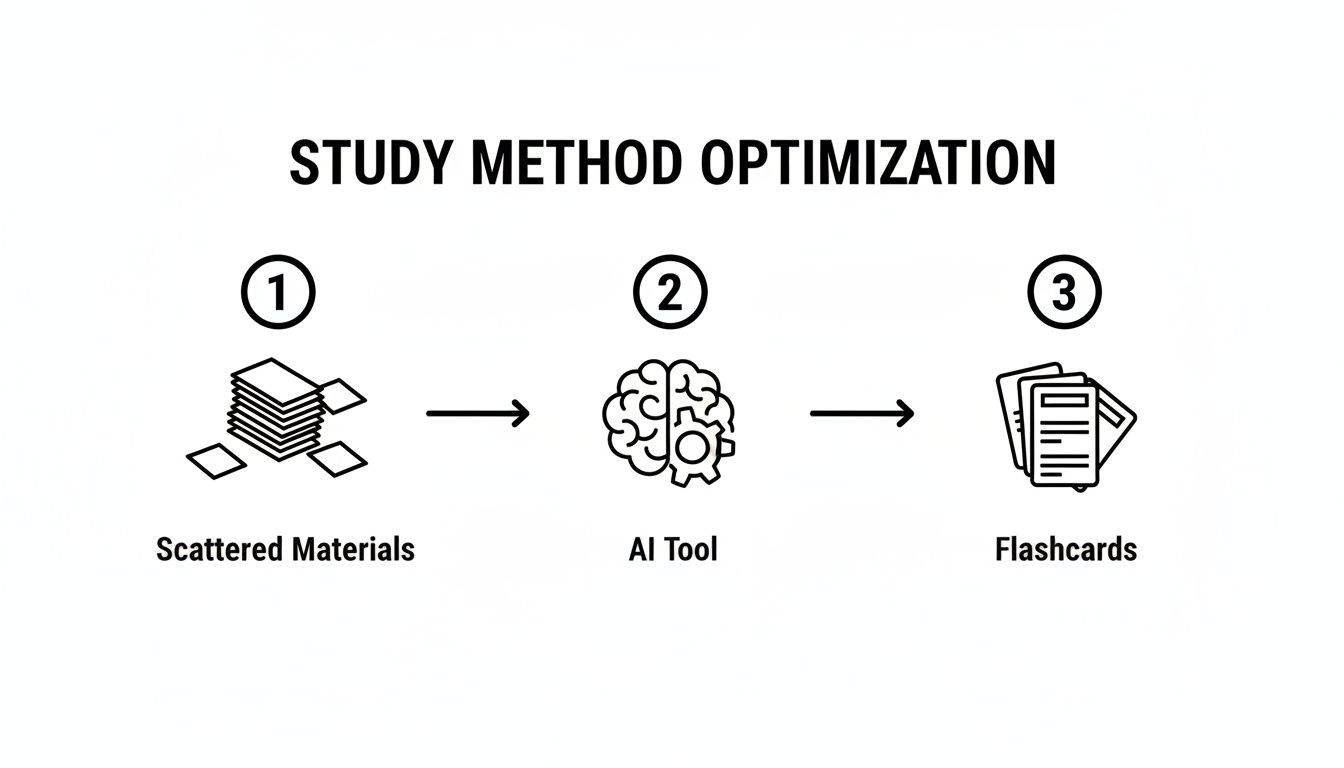
The image above really gets to the heart of it: you provide the raw content, and the AI outputs an organized deck of biology flash cards that are ready to go.
The biggest advantage here is that it removes all the guesswork. The AI is trained to recognize what's important and testable based on the content your professor gives you. You no longer have to agonize over what to put on each card.
If you want to dig deeper into the art of card creation, we have a whole guide on how to make flashcards online. By letting technology handle the creation phase, you can dive straight into the active recall and practice quizzing that actually builds lasting knowledge.
Organize Your Study Decks for Maximum Brainpower
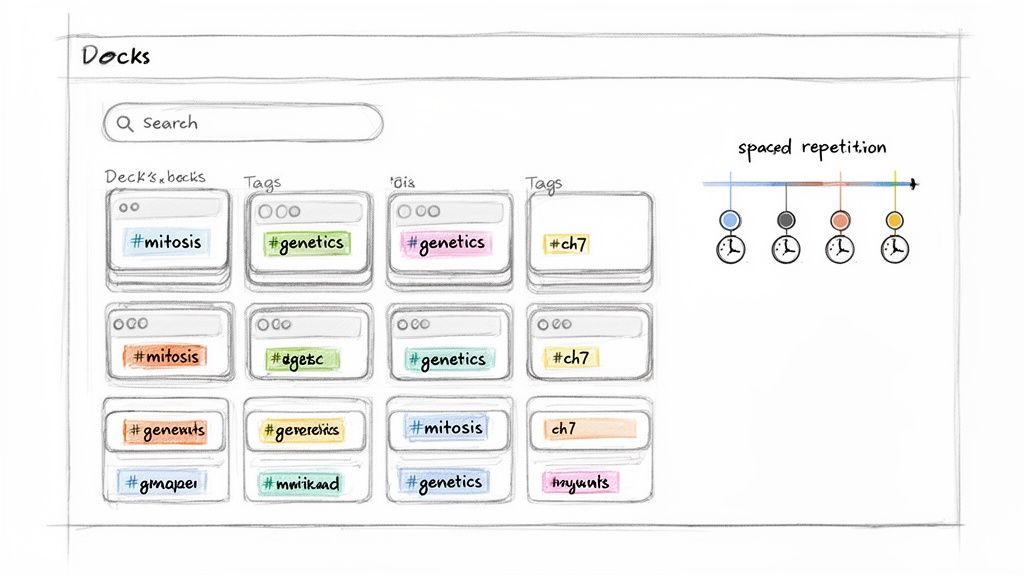
So you did it. You fed your chaotic lecture notes and slides into an AI, and now you have a massive deck of biology flash cards. Huge first step. But staring at a single, thousand-card deck can feel just as overwhelming as staring at a blank page.
Having the cards isn't the final move. The real secret weapon is organizing them so you can study exactly what you need, when you need it. A smart system is what separates students who feel in control from those who feel buried under a mountain of digital index cards.
The Game-Changing Habit of Smart Tagging
This is where you start working smarter, not harder. The most effective way to wrangle your digital flashcards is by using tags. Think of them as super-powered keywords for your course material.
By getting into the habit of tagging each card, you're building a searchable, personal database of your entire biology class. As Vivora’s AI creates the cards, it can automatically tag them, or you can add your own:
Topics: Be specific. Use tags like
#mitosis,#genetics, or#enzyme-kinetics.Chapters: Keep everything sorted by source. A simple
#ch7or#unit3works wonders.Exams: Tag cards relevant to major tests, like
#midterm1or#final-exam.
This tiny habit pays off big time. When a quiz on cellular respiration pops up, you just filter for #cellular-respiration. Instantly, you have a custom study deck. No more frantic scrolling minutes before the test. It’s all right there.
Build Custom Decks for Targeted Review
With your tags in place, you can now build surgical study sessions on the fly. Let's say your professor announces the next exam will cover chapters 5 and 6. You can instantly filter for #ch5 and #ch6 to create a temporary deck with just that material. This is something you simply can't do with a stack of physical cards without a ton of manual sorting.
The goal is to make your study sessions ridiculously efficient. By organizing with tags, you can spend less time looking for information and more time actually learning it. You’re building a personalized knowledge base you can tap into anytime.
This approach lets you be laser-focused. Instead of trying to review everything at once, you can target specific weak areas or upcoming topics, which is way more effective for building strong, lasting recall.
Lock It In With Spaced Repetition
Okay, you've made the cards and organized them beautifully. Now for the magic that makes sure you don't forget it all a week later: spaced repetition. It’s a science-backed study method that prompts you to review info right before your brain is about to let it slip away. It's the ultimate antidote to last-minute cramming.
Modern platforms like Vivora completely automate this. The software keeps track of your performance on every single card. Get one wrong? You'll see it again soon. Ace a concept? The system will push it further out into the future.
This process is designed to systematically move knowledge from your short-term to your long-term memory, which is the whole point of studying for cumulative finals. To really get into the weeds of this powerful technique, check out our guide on the spaced repetition study method.
When you combine smart tagging with automated spaced repetition, you create a powerful, self-improving study system that practically runs itself.
Go Beyond Memorization With AI Quizzes and Chat
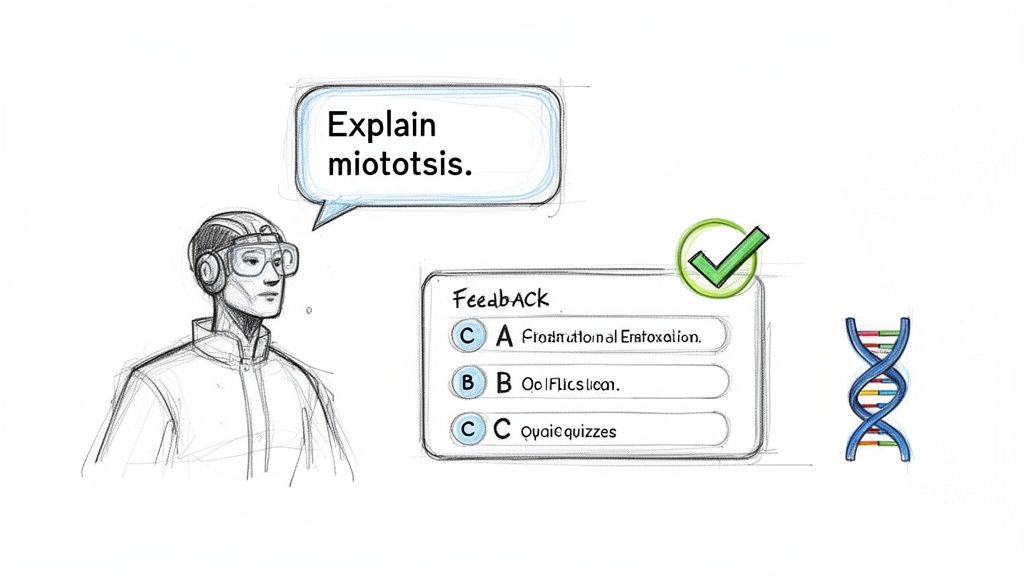
Okay, you've got a solid stack of organized biology flash cards. Flipping through them is a good first step, but let's be real—true mastery isn't about just recognizing a term. It's about deeply understanding the why behind it, the kind of understanding that lands you an A on the midterm.
To get there, you have to move past passively reviewing your cards. You need to actively test yourself and simulate real exam conditions. This is where you can seriously level up your study game, and you don't have to wait for your professor to drop a practice test.
Test Yourself With AI-Generated Quizzes
Instead of just flipping cards one by one, imagine turning that whole deck into a practice quiz on demand. This is exactly what a platform like Vivora is built for. Since its AI has already processed all your course materials, it can generate tests that actually feel like the ones you'll face in class.
You can instantly create different types of questions to keep your brain engaged and attack the material from all angles:
Multiple-Choice: Perfect for rapid-fire recall of key terms and definitions.
True/False: Surprisingly effective for tackling common misconceptions about complex processes like glycolysis or protein synthesis.
Short-Answer Prompts: These are absolute gold. They force you to explain concepts in your own words, which is a far more powerful learning tool than simply recognizing an answer.
This kind of constant, low-stakes testing is what builds real confidence. It shines a spotlight on your weak spots long before the exam does. It’s the difference between hoping you know the material and knowing you know it.
Close Knowledge Gaps With an AI Chat Assistant
So, what happens when a quiz question stumps you and you genuinely don't get it? The old way was to dive down a confusing YouTube or Google rabbit hole, wasting precious time trying to find an explanation that actually matches what your professor taught.
This is where an integrated AI chat tool becomes your secret weapon. Instead of searching the wild west of the internet, you can ask questions directly related to your course materials. Vivora’s AI has the complete context of your lectures, PowerPoints, and notes.
It’s like having a TA on call 24/7 who has already read all your class materials. You can ask for a simpler explanation of a complex topic or clarification on a specific slide, and you'll get answers grounded in the content you'll actually be graded on.
Think about how much faster you can clear up confusion with prompts like these:
"Explain the difference between mitosis and meiosis using my lecture notes."
"Find the exact slide where my professor talked about the Krebs cycle."
"Give me a simple analogy for how an enzyme and substrate work, based on chapter 4 of my textbook."
This creates an immediate, powerful feedback loop that closes knowledge gaps in minutes, not hours. By combining practice quizzes with a smart AI study assistant, you create a powerful cycle: test your knowledge, identify a weakness, and get instant, contextual clarification. This is how you finally stop just memorizing and truly start understanding.
Your Winning Game Plan for Midterms and Finals
Exam season is a special kind of chaos. We’ve all been there—the frantic all-nighters, the mounting anxiety, and the last-ditch cram sessions that leave you more exhausted than prepared. It’s a brutal cycle. But this is exactly where your consistent effort with biology flash cards starts to pay off in a big way.
Instead of spiraling, you can walk into your midterms and finals with a solid strategy. This isn't about magically finding more hours to study. It’s about making the hours you do have incredibly efficient. With your entire semester's worth of material already converted into neat, tagged cards in a tool like Vivora, you’re not just studying—you're strategically preparing.
Filter and Focus Your Efforts
First, let's build your main study weapon. About two weeks before an exam, create a single, comprehensive deck just for that test. This is where the tagging system you've been using all semester becomes a total game-changer.
Just filter your entire collection for the tag #midterm1. In an instant, every single card relevant to that exam is pulled into one focused stack. No more flipping through disorganized notes or trying to guess which chapter a topic was in. This move alone will save you hours of panicked searching.
Once you have that master midterm deck, the next move is to figure out where your weak spots are. The fastest way to get an honest look is by using an AI quiz feature to generate a practice test from your deck. This gives you a quick, objective diagnostic of what you actually know versus what you think you know.
Create Targeted Decks for Weak Spots
The results from that practice quiz are pure gold. They give you a data-driven roadmap showing you exactly where to invest your time. Bombed all the questions on enzyme kinetics? Perfect. Now you know what to drill.
Using those results, you can create smaller, highly-targeted "micro-decks" for your trickiest subjects. Just pull all the cards tagged with #enzyme-kinetics or #dna-replication into their own separate stacks. These are the decks you'll want to hit hard and often. Instead of wasting precious time reviewing concepts you've already got down cold, you can pour all your energy into shoring up your weaknesses.
This strategic approach is the difference between blindly studying and training with purpose. You’re not just hoping you cover the right material; you're systematically identifying and eliminating every knowledge gap you have before the test.
Here’s how a typical week leading up to the exam might look:
Monday & Wednesday: Review the main
#midterm1deck. This keeps the big-picture concepts fresh and reinforces connections between topics.Tuesday & Thursday: Use the AI quiz and spaced repetition features to drill older material. This is crucial for preventing the "forgetting curve" from sabotaging you on stuff you learned early in the semester.
Friday: Dedicate this day entirely to your "weak spot" decks. Go hard on those tough topics until they finally click.
A day or two before the exam, run one last full-length practice test generated from the entire midterm deck. Think of it as your final dress rehearsal. By this point, you've systematically worked on your weaknesses and reinforced your strengths. You're not just hoping for a good grade—you've built a system to earn it.
Got Questions About Using AI to Study?
Whenever AI for studying biology comes up, the same questions always pop up. It's a big shift from the highlighters and index cards we all grew up with, so a little skepticism is healthy. Let's tackle some of the most common concerns students have when they're thinking about moving to a smarter, AI-powered workflow for biology flash cards.
Can I Really Trust an AI to Make My Flashcards?
For sure, but it’s more of a partnership than a hand-off. Think of an AI tool like Vivora as a brilliant, incredibly fast research assistant. It's designed to comb through your specific course materials—your professor’s slides, the textbook PDFs, your own messy notes.
This means the flashcards it creates are pulled directly from the information you'll actually be tested on, not some generic definitions from the web. The AI is a master at spotting key terms, processes, and concepts, which saves you hours of mind-numbing manual work. Your job is to be the expert—review the cards, maybe tweak a few to fit your own thinking, and then use the system to actively learn.
It’s the perfect blend of high-tech speed and your own brainpower.
Is This Only for Tech-Savvy Students?
Not even close. Platforms like Vivora are built with the average, often overwhelmed, student in mind. The goal is to make studying less complicated, not more.
Honestly, the process is as simple as uploading a file or pasting a link. If you can drag-and-drop a PDF or share a video from class, you have all the technical skill you need. The AI does all the heavy lifting behind the scenes.
Most students get their first personalized study guide up and running in just a few minutes.
The big shift isn't about becoming a tech whiz; it's about automating the most boring part of studying. You get to skip the tedious card-making and jump straight into the quizzing and reviewing that actually builds knowledge.
How Is This Different from Other Digital Flashcard Apps?
The huge difference is the automated creation and deep integration. Most apps are just digital versions of paper cards. You still have to do all the work—typing out every single question and answer yourself. It’s a massive time-sink.
An AI platform like Vivora completely eliminates that step by generating the cards for you, from your existing materials. But it’s more than just a flashcard maker; it's an entire study hub. It unifies your documents, videos, and notes into one place and then creates everything from that central source:
Flashcards: Instantly generated from your lecture notes and readings.
Practice Quizzes: To test what you know in different formats.
AI Chat Assistant: An assistant that actually understands the full context of your class to answer specific questions.
Having this all connected saves an insane amount of time and keeps you from jumping between a dozen different apps and documents.
What if My Professor's Lectures Are Mostly Videos?
That’s honestly one of the best use cases for this kind of tech. We've all been there—trying to make notes from a video lecture is a nightmare. It’s a constant cycle of pausing, rewinding, and frantically typing, and you always feel like you’re missing something important.
With a tool like Vivora, you just drop in the YouTube link or upload the video file. The AI transcribes the entire lecture and then generates biology flash cards on all the key topics and concepts discussed.
It turns a one-hour lecture into a summarized, study-ready deck of cards in minutes. It's a game-changer for reviewing classes you missed or just reinforcing a tricky topic.
Ready to stop wasting time on busywork and start studying smarter? Vivora transforms your scattered class content into the personalized study guides you need to ace your exams. Create your first AI-powered study guide for free and see the difference in minutes. Get started at https://vivora.ai.