The Spaced Repetition Study Method: Your Brain's Ultimate Study Hack
Mar 7, 2026
The spaced repetition study method is a science-backed technique that helps you actually remember what you study. Instead of cramming, you review info at increasing intervals over time, hitting concepts right before you forget them. This makes your memory stronger and studying way more efficient.
Escape The Cramming Cycle For Good
We’ve all been there. It’s 2 AM, the final is in six hours, and you’re staring at a mountain of notes, fueled by energy drinks and sheer panic. You pull an all-nighter, somehow pass, and then a week later… it’s like the info just vanished from your brain. Sound familiar?
This frustrating cram-and-forget cycle is a classic student horror story, and honestly, it’s a massive waste of your time. The truth is, cramming doesn't lead to real, lasting learning. It just shoves information into your short-term memory, which your brain is designed to clear out quickly to make space for new things.
But what if there was a way to study smarter, not harder? A way to actually remember what you learn for the long haul, without all the last-minute stress?
Your Brain's Secret Weapon
Enter the spaced repetition study method. Think of it as the ultimate cheat code for your brain. It’s not about studying for more hours; it’s a power-move that works with your brain's natural "forgetting curve" instead of fighting against it.
Here’s the basic idea:
You learn a new concept (like a key term for your psych class).
You review it a day or so later.
Then, you review it again after a few more days.
Next, you might wait a week, then a few weeks, and so on.
Each time you successfully recall the info, you extend the time until your next review. You’re strategically interrupting the forgetting process, signaling to your brain, "Hey, this is important—keep it!" This simple act of timed recall moves knowledge from fragile, short-term memory to solid, long-term mastery.
Imagine trying to build a path in the sand. A single pass is easily washed away. But if you keep retracing the path just before it disappears, it gets deeper and more permanent. That's exactly what spaced repetition does for your memories.
This method is clutch for students who want better grades with way less stress. Instead of spending hours re-reading chapters, you can focus on short, targeted review sessions that actually stick. And let's be real, who has time for anything else?
Modern tools have made this almost effortless. With an AI-powered platform like Vivora, you don't even have to track the schedule yourself. Just upload your class content—notes, slides, lecture videos—and it automatically turns it all into a personalized study guide. Vivora’s AI then creates flashcards and quizzes and schedules them for you using a built-in spaced repetition system, making sure you review the right things at the perfect time. It’s your secret weapon to finally stop cramming and start learning for keeps.
Why Your Brain Forgets And How To Stop It
Ever feel like your brain is a leaky bucket, especially during finals week? You pour in hours of studying, only to have key facts and formulas spill out the moment you need them. It’s incredibly frustrating, but it’s not your fault—your brain is actually designed to forget.
It sounds backward, I know. But your brain constantly purges information it considers non-essential to stay efficient and avoid overload. Think of it like your phone automatically clearing its cache to run faster. A new memory is like a path freshly drawn in the sand; the tide of time starts washing it away almost immediately. This natural decay is known as the “Forgetting Curve.”
This whole idea dates back to 1885, when a psychologist named Hermann Ebbinghaus discovered just how quickly our memory drops off a cliff after learning something. He found we forget about 50% of new information within an hour and a mind-boggling 70% within just 24 hours. The good news? Over a century of research has shown this is a problem you can solve. You can get a deeper look at the science behind this on SnitchNotes.com.
Hacking Your Brain's Clean-Up System
This is where the spaced repetition study method becomes your secret weapon. It’s a way to work with this natural forgetting process instead of fighting it. By strategically reviewing information right at the moment you’re about to forget it, you send a powerful signal to your brain: “Hey, this stuff is important. Keep it.”
Each time you successfully recall a piece of information, you’re basically telling your brain to strengthen that memory. It’s like tracing over that path in the sand just before the waves can wash it away. With each review, the path gets deeper and more permanent until it’s a solid fixture in your long-term memory.
The goal isn't to fight against forgetting; it's to work with it. Spaced repetition turns your brain’s clean-up process into a powerful tool for building strong, lasting knowledge. You’re simply reminding your brain what’s worth keeping.
This is the real difference between studying smart and just cramming. Cramming is like trying to frantically fill that leaky bucket all at once—it’s exhausting and most of it just spills out anyway. Spaced repetition is like methodically patching the leaks, one by one, until the bucket holds water for good.
Cramming vs. Spaced Repetition: A Visual
The chart below really drives the point home, showing how your knowledge holds up over time when you cram versus when you use spaced repetition.
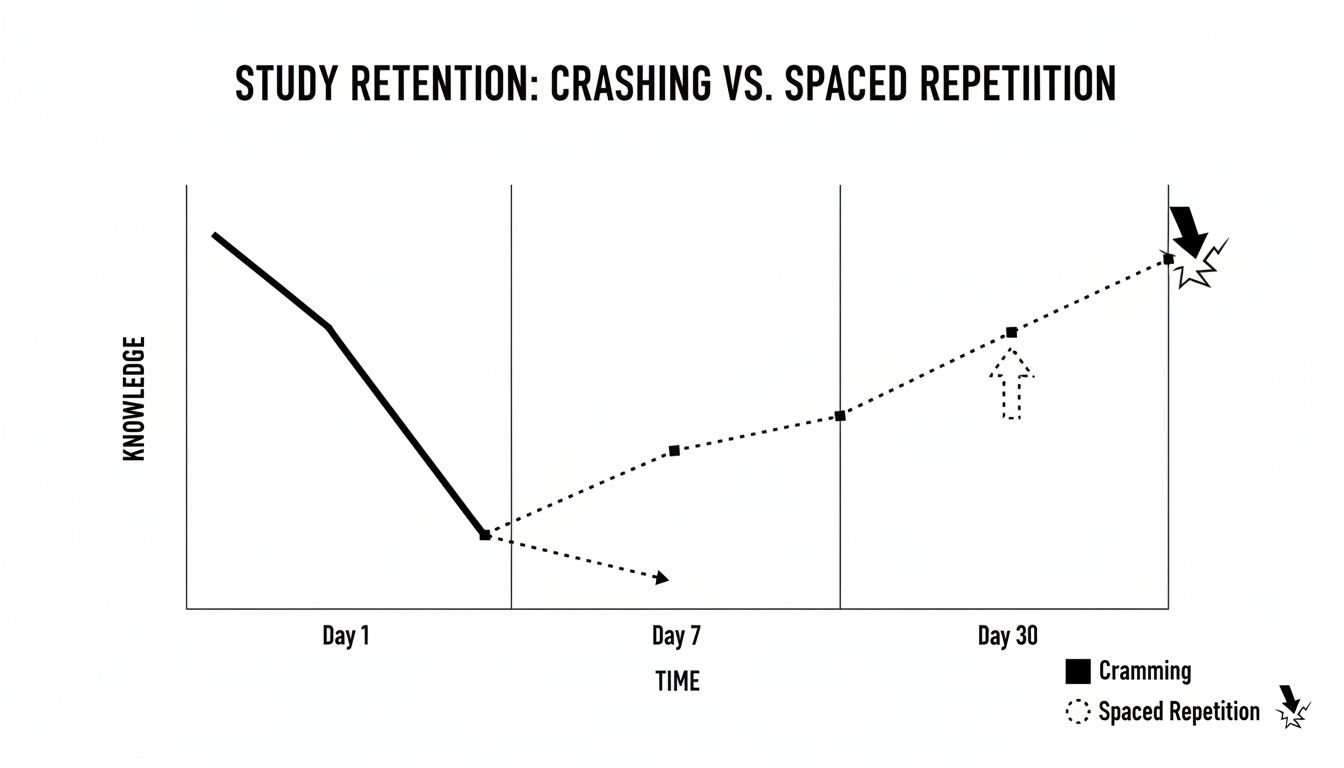
As you can see, cramming gives you a short-term spike followed by a massive drop-off. Spaced repetition, on the other hand, builds your knowledge base steadily and permanently.
This is exactly why tools that automate the process are such a game-changer. Let's be real, manually tracking when to review every single concept for every class would be a total nightmare. An AI-powered tool like Vivora handles all the boring logistics for you.
Here’s the simple breakdown of how it works:
You upload your class content—notes, slides, even lecture links.
Vivora's AI gets to work, generating flashcards and quizzes for you.
As you practice, it keeps track of what you get right and what you struggle with.
It then automatically schedules your reviews based on the spaced repetition algorithm, showing you tricky concepts more often and the stuff you’ve mastered less frequently.
It completely takes the guesswork out of the equation. Instead of wasting mental energy worrying about what to study and when, you can just log in and trust the system to feed you the right material at the perfect time to make it stick for good.
Building Your Spaced Repetition System
Okay, so the science behind the spaced repetition study method is solid. But how do you actually do it without turning your study space into a chaotic mess of flashcards and confusing schedules? Let's get practical.
Putting a system together isn't as intimidating as it sounds. You’ve got options, from old-school methods to smart AI tools that do the heavy lifting for you. The trick is to find an approach that actually fits your life and study habits.
The Old-School Way: The Leitner System
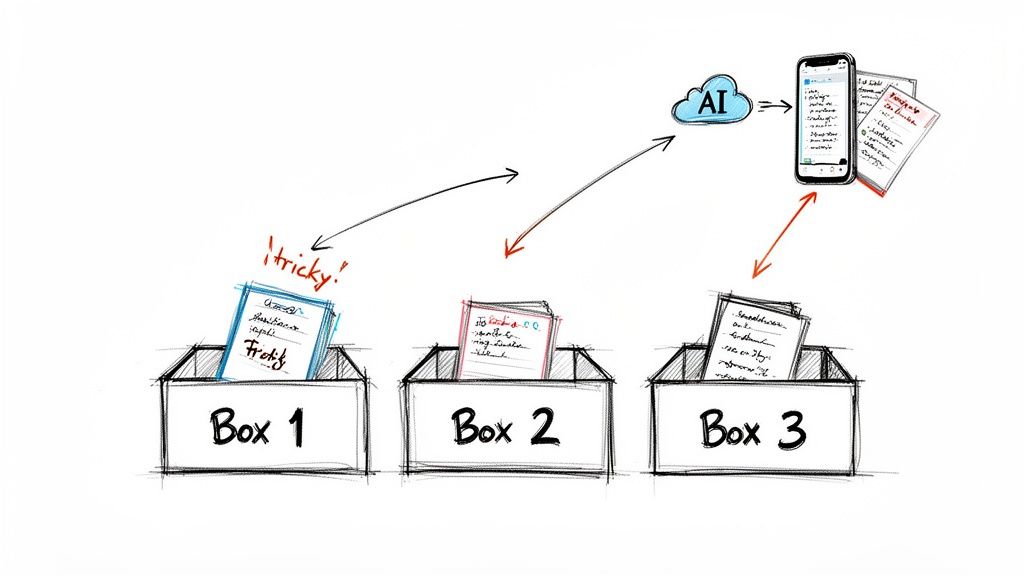
Before apps were on everyone's phone, students had a clever way to manage spaced repetition with physical flashcards. It's called the Leitner System, and it's a surprisingly effective technique you can set up with just some index cards and a few boxes.
Think of it like leveling up in a video game, but for your flashcards.
Here's the rundown:
Get three to five boxes. Label them based on review frequency: Box 1 (Review Daily), Box 2 (Review Every 3 Days), Box 3 (Review Weekly), and so on.
Make your flashcards. All new cards start their journey in Box 1.
Start your daily review. Go through the cards in Box 1. For every card you get right, it "levels up" and moves to Box 2.
If you get it wrong, it gets demoted. Any card you miss, no matter which box it's in, goes straight back to the beginning—Box 1.
This simple process automatically makes you see the tough concepts more often while giving you space from the material you already know well. It’s a brilliant, low-tech way to put spaced repetition into action. The main drawback? It demands a lot of manual sorting, physical space, and the discipline to stick to the schedule.
The Modern Way: Spaced Repetition Software (SRS)
This is where technology steps in to put the entire Leitner System on autopilot. Spaced Repetition Software (SRS) is a whole category of apps and platforms built specifically to automate the review process.
These digital tools use algorithms to track how you perform on each card. Get one right? The app schedules it for a later date. Get it wrong? You'll see it again much sooner. You don't have to think about sorting cards or which box to pull from; the software handles all the logic. You just open the app and it tells you exactly what to review today.
SRS apps are basically a digital Leitner System, but with a super-smart assistant doing all the tedious organizing for you. This frees you up to focus on what really matters: learning the material.
Popular apps like Anki have been a go-to for dedicated students for years, but they can have a pretty steep learning curve. You also still have to create every single flashcard by hand, which can feel like a full-time job when you're juggling multiple classes.
The Smartest Way: AI-Powered Study Tools
Now we get to the real game-changer: AI-powered platforms like Vivora. This is where the spaced repetition study method stops being a separate task and becomes a seamless part of your study workflow.
Instead of just managing a deck of cards you made, Vivora transforms all of your course material—notes, slides, readings—into a personalized study engine. Forget spending hours typing up concepts one by one.
With an AI tool like Vivora, the process is dead simple:
Upload everything: Just drop in your lecture slides, PDFs, class notes, or even links to relevant YouTube videos.
Let AI do the work: The platform instantly analyzes the content and automatically generates flashcards and practice quizzes based on the most important concepts.
Study smart: As you work through the quizzes, the AI tracks your performance, learning what you know and where you're struggling.
Automated scheduling: The built-in spaced repetition algorithm then takes over, scheduling your reviews perfectly. It brings back the concepts you’re weak on more often and pushes the ones you've nailed further into the future.
It's like having a personal AI tutor that has read all your textbooks and knows exactly what you need to review, and when. This approach doesn't just save a massive amount of time on admin work; it makes the spaced repetition study method an effortless and highly effective part of your daily routine.
Spaced Repetition Methods Compared
To see the difference clearly, let's compare the manual Leitner System with a modern AI-powered tool like Vivora. While both are built on the same cognitive science principles, the user experience and efficiency are worlds apart.
Feature | Leitner System (Manual Flashcards) | Vivora AI Study Platform |
|---|---|---|
Card Creation | 100% manual. You write out every card by hand. | Automatic. AI generates cards from your uploaded notes, slides, and PDFs. |
Scheduling | Manual. You have to sort cards and remember the review schedule for each box. | Automatic & Adaptive. The algorithm tracks your performance and schedules each review for you. |
Personalization | Basic. You decide which cards are hard or easy. | Advanced. AI identifies your specific weak spots and adjusts question difficulty. |
Time Investment | High. Requires significant time for creation, sorting, and management. | Low. The AI handles nearly all the setup and organization. |
Portability | Low. Limited by the physical size of your card boxes. | High. Access your entire study library from any device. |
Feedback | None. You only know if you were right or wrong. | Instant & Detailed. Get explanations for answers and track your progress over time. |
Ultimately, the best system is the one you'll actually use. The Leitner System is a great starting point if you enjoy a hands-on approach. But for students looking to maximize their study efficiency and get deeper insights into their learning, AI-powered tools like Vivora, which combine automatic flashcard creation with intelligent scheduling, offer a clear advantage.
Creating Your Spaced Repetition Study Schedule
Okay, let's move from theory to a real-world game plan. Knowing why the spaced repetition study method works is one thing, but knowing how to use it to ace your midterms without losing your mind is what really matters. The secret sauce is all in the timing of your reviews.
Forget those frantic, all-night study sessions that leave you exhausted and confused. We’re building a calm, strategic approach that actually fits into your life. Below are two simple, battle-tested schedules: one for staying on top of your classes all semester, and another for crushing that big exam that's just a few weeks away.
The Semester Saver Schedule
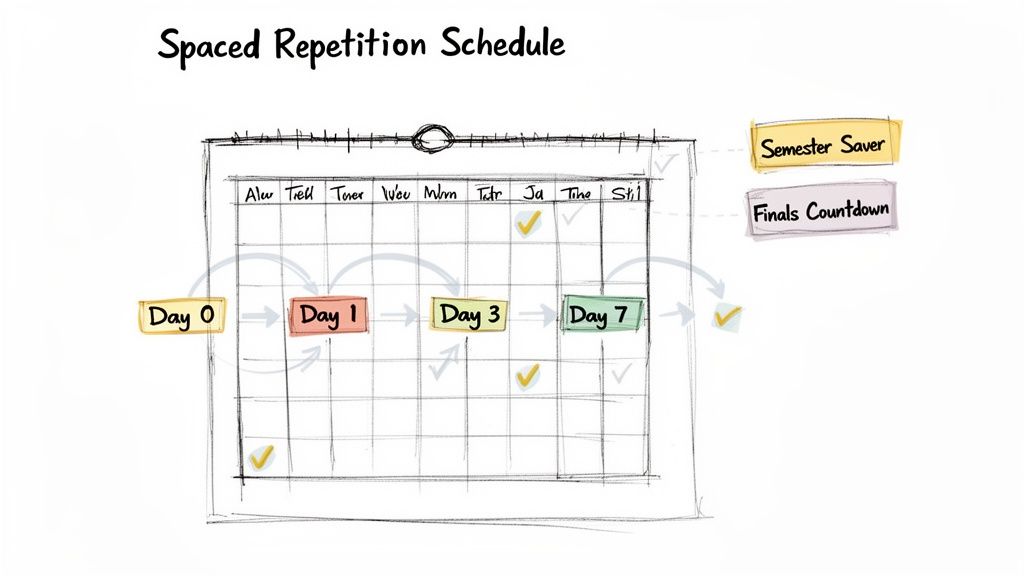
Think of this schedule as your secret weapon for avoiding that end-of-semester panic. It’s built for staying on top of new material as you learn it, week by week, keeping information fresh so you're not re-learning an entire course in the last 72 hours before the final.
Here’s a basic interval plan to follow after you first learn something new in class:
Review 1: After 1 day (This is your first strike against the forgetting curve.)
Review 2: After 3-4 days (You're strengthening the memory just before it starts to fade.)
Review 3: After 7-9 days (Now you're starting to lock it into long-term storage.)
Review 4: After 14-16 days (This is where the knowledge really starts to feel solid.)
Review 5: After 30-35 days (A final check-in to make it stick for good.)
This doesn't mean you need to schedule long, drawn-out study sessions. Each review should be quick—just a few minutes to actively pull the information from your brain. It's the consistency that builds those powerful, lasting memory pathways.
This structured timing isn't just a random guess; it's backed by research. Early experiments found that for a third repetition, a 7-day interval was optimal. For the fourth, 16 days was best, and for the fifth, around 35 days provided the ideal balance. Following this methodical approach helped learners achieve approximately 80% retention. You can dive into the historical data behind these optimal review timings for more details.
The Finals Countdown Schedule
So, maybe the semester got a little wild, and now you have a major exam looming in just 2-4 weeks. Don't panic and fall back on cramming! You can still use a compressed spaced repetition schedule to get the best score possible.
This approach is more aggressive, but it's still light-years more effective than an all-nighter.
If you have 2 weeks until your exam:
Days 1-3: Focus on learning and reviewing the most important half of the course material. Use a compressed interval: Day 0 (learn it), Day 1 (review), Day 3 (review again).
Days 4-6: Do the exact same thing for the second half of the material.
Days 7-14: Now, review all the material, but zero in on your weak spots. Your review intervals might look something like this: Review at 2 days, then 4 days, with a final quick review the day before the exam.
The goal here is triage. You’re strategically hitting the most critical information at intervals that give your brain the best shot at holding onto it under pressure.
Let AI Handle The Calendar
Let's be real: trying to manually manage these schedules for every single concept in every class is a total nightmare. This is exactly where an AI-powered tool like Vivora becomes your secret weapon. You don't need a complex calendar or spreadsheet; the platform handles it all for you.
When you feed it your class content, Vivora automatically generates personalized study materials. As you practice, its AI keeps tabs on your performance on every concept. From there, it uses a built-in spaced repetition algorithm to schedule your reviews perfectly, making sure you see the right information at the exact moment you need it most. It’s the ultimate time-saver, turning your scattered notes into a powerful, automated study plan. If you're looking to build even better study habits, you can find more tips in our guide on AI study guide strategies.
How To Supercharge Your Studying With Vivora
Okay, so we’ve covered the brain science behind the spaced repetition study method and even laid out some schedules. Now for the best part: making it so easy you’ll actually do it.
Let's be real. The idea of manually making hundreds of flashcards and then tracking review dates in a calendar for every single class is a recipe for giving up before you even start. That's a ton of admin work piled on top of your actual studying.
This is where you stop being a study-logistics manager and start being a learner again. An AI-powered tool like Vivora is built to handle all that tedious organization, letting you tap into this powerful method with almost zero friction.
A Simple Workflow For Better Grades
Ready to see just how seamless this can be? Here’s a step-by-step look at how you can use Vivora to turn that mountain of course material into a smart, automated study plan. It’s a simple process that takes all the guesswork out of studying effectively.
Upload Your Brain Dump: First, gather up all your course materials. We're talking about those lecture slides, your messy Google Doc notes, the required reading PDFs, and even links to YouTube lectures your professor shared. Just upload everything you have into Vivora. Getting it all in one place is the first step to feeling in control.
Get Your Instant Study Guide: The moment your files are uploaded, Vivora's AI gets to work. It reads and understands everything, then instantly generates a personalized study guide. This isn't just a digital folder—it's a complete toolkit with organized notes, practice quizzes, and, most importantly for our purposes, a full deck of digital flashcards.
This is what your dashboard looks like inside Vivora. It transforms that chaotic pile of files into a clean, interactive study hub.
As you can see, all your materials are neatly organized, with AI-generated notes, flashcards, and quizzes ready for you to dive in.
Let The AI Handle The Schedule
This is where the real magic happens. Once your materials are in Vivora, the system becomes an active, adaptive learning partner built on the core principles of spaced repetition.
Track Your Performance: As you review your flashcards and take the practice quizzes, Vivora is paying close attention. It tracks every correct and incorrect answer, building a detailed profile of your personal strengths and weaknesses for every single concept.
Automate Your Reviews: Based on how you're doing, Vivora’s algorithm automatically schedules the next review for each topic. It uses the spaced repetition study method to bring back the ideas you're struggling with more frequently while pushing back the concepts you've clearly mastered.
You never have to ask, "What should I study today?" The platform surfaces the right information at the right time, making sure you review concepts at the optimal moment to lock them into your long-term memory. It completely removes the burden of managing a complex study schedule.
The data on this is crystal clear. A landmark 2024 study with over 26,000 participants found that using spaced repetition led to significantly better results. The group using the method achieved 58.03% accuracy, while the group that didn't only scored 43.20%. For students using a tool like Vivora to automate this, that suggests a potential performance boost of 15 percentage points or more on exams. You can read the full research on how spaced repetition improves accuracy to see the numbers for yourself.
By automating the entire workflow—from creating the study materials to scheduling your reviews—you're not just studying; you're using a scientifically-proven system to learn more deeply. This frees you up to spend your time actually engaging with the content, not just trying to manage it.
The result? Better grades, less stress, and more time back in your day. An AI study assistant can be a true game-changer for your academic success.
Spaced Repetition Study Method FAQ
Diving into a new study method like spaced repetition always brings up a few questions. It’s totally normal to wonder if it will fit your schedule, your subjects, and your life.
I hear the same concerns from students all the time. Let's tackle the biggest ones head-on so you can feel confident trying this out.
How Much Time Does This Actually Take Every Day?
This is the best part: it takes way less time than you’d expect. Spaced repetition isn't about marathon study sessions. It’s about short, sharp, and incredibly efficient reviews.
For most students, a dedicated 15-25 minutes per day, per subject, is all it takes to see a massive difference. A quick daily review is so much more powerful than a frantic three-hour cram session.
The real magic is that the system focuses your attention only on the things you're on the verge of forgetting. You stop wasting time going over concepts you already know inside and out.
Can I Use This For Subjects Like Math Or Philosophy?
Totally. This method is incredibly versatile, but you have to adapt your "cards" to force a deeper level of thinking.
For concept-heavy subjects like Philosophy or History: Don't just ask for a definition. Prompt yourself with a question that requires a real explanation. For example, "Explain Kant's Categorical Imperative in your own words." The act of actually formulating that answer is where the real learning happens.
For problem-solving subjects like Math or Chemistry: Put a practice problem on the front and the detailed, step-by-step solution on the back. Your goal isn't just to check if you got the right answer, but to actively recall the entire process of solving it.
This is where a tool like Vivora really comes in handy. Its AI can scan your lecture notes and automatically generate these kinds of conceptual questions and practice problems, pushing you to master the "how" and "why," not just the "what."
What Happens If I Miss A Day Of Reviews?
Honestly? Not much. Don't sweat it. Life gets in the way, and missing a day or two won't ruin your progress. The goal isn't a perfect streak—it's consistent effort over the long haul.
The real power of spaced repetition comes from the overall pattern of reviewing material over time. A single missed day is just a tiny blip on the radar of a much bigger, more effective strategy.
Modern SRS apps are built for this. If you miss a review session in Vivora, the algorithm simply shuffles those overdue cards into your queue for the next day. The most important thing is to just show up the next day and get back into the rhythm.
Is It Too Late To Start If My Exam Is In Two Weeks?
It's never too late to study smarter. Of course, using the spaced repetition study method for the whole semester is the gold standard for deep, long-term learning. But you can still get a huge leg up by using it for last-minute exam prep.
A compressed review schedule—say, reviewing new material after 1 day, then 3 days, then 5 days—is infinitely better than a desperate all-nighter. Even with just a couple of weeks, strategically spacing out your reviews will beat cramming every single time.
Just upload your materials to Vivora. It will help you quickly zero in on the most critical concepts to maximize your score, so you can walk into that exam feeling prepared and confident.
Ready to stop cramming and start remembering? Vivora turns your chaotic class content into a personalized, automated study guide using the power of spaced repetition. Upload your notes and see how our AI can supercharge your learning. Try Vivora for free today!