What's the Best Way to Study? (The Real Answer)
Mar 8, 2026
Let's be real. We've all been there: staring at a textbook until the words blur, convinced that if you just stare hard enough, the info will magically teleport into your brain. Spoiler alert: that’s not a study strat—it's a recipe for burnout.
The secret to acing your exams isn't about pulling more all-nighters. It's about using smarter techniques that actually vibe with your brain's wiring. This means finally ditching those outdated habits and using methods proven to make information stick. It's time to study smarter, not harder.
Your Brain Isn't a Sponge, It's a Muscle
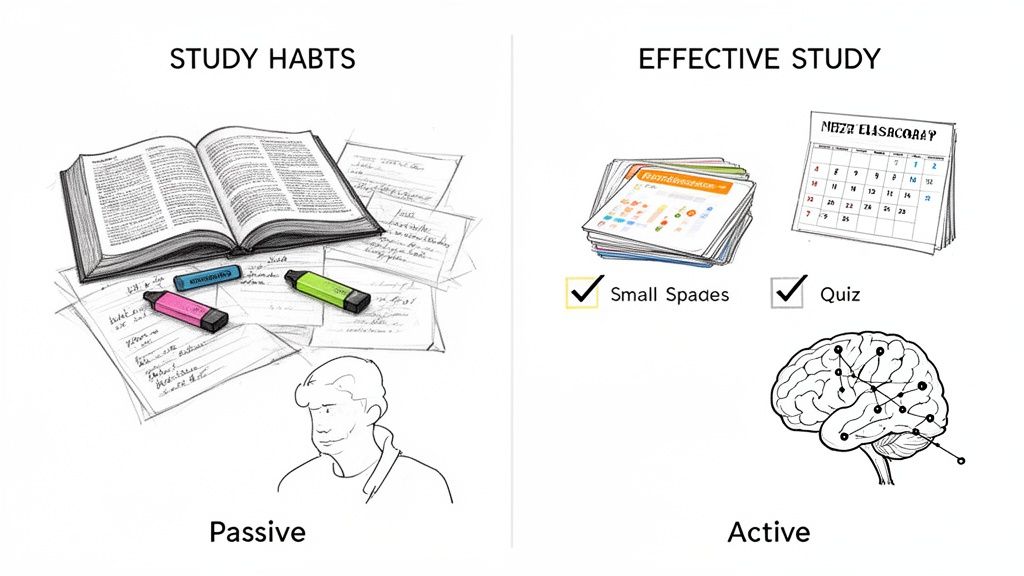
If you've ever crammed all night only to completely blank out on the exam, you've met the enemy: passive learning. Highlighting everything, rereading your notes until you’re bored to tears—it feels productive, but science says it’s one of the least effective ways to learn. Low-key, it's a waste of your precious time.
Your brain isn't a sponge that just soaks up facts. It's a muscle. To get gains, you have to actively work it out. This is where a total game-changer called Active Recall comes in. Instead of just reviewing stuff, you force your brain to pull it out of memory from scratch.
A landmark University of California study found that students using active recall retained 50% more information after one week than those who just reread their notes. This "testing effect" strengthens the neural pathways that store memories, making them way easier to access later.
This simple switch from passive input to active output is the core of a successful study sesh. If you want to dive deeper into the science, check out the research behind these powerful study strategies on Med School Insiders.
Outdated Study Habits vs. Smart Study Methods
The biggest problem is that we’re taught to study in ways that are super inefficient. We mistake the comfy feeling of familiarity for actual understanding. It’s time to trade in those time-wasting habits for something that actually moves the needle on your grades.
Here’s a quick breakdown of why common study habits flop and how science-backed methods give you a serious advantage.
Outdated Habit | Why It Fails | Smart Method |
|---|---|---|
Mindless Rereading | Creates an "illusion of competence"—you recognize it but can't explain it. | Active Recall |
Highlighting Everything | A page full of neon doesn't help you prioritize or remember. It just looks busy. | The Feynman Technique |
Long, Unfocused Study Marathons | Your brain's focus fades fast, leading to burnout and bad retention. | Spaced Repetition |
Summarizing Passively | Just rephrasing text doesn't force your brain to retrieve the main ideas. | Practice Questions |
By swapping the old habits on the left for the smart methods on the right, you're not just studying differently—you're learning more effectively in less time.
The Smart Way to Put Active Recall into Practice
So, how do you make your brain work for the information without spending hours making your own quizzes? This is where modern tools give you a massive leg up.
Imagine uploading all your chaotic lecture slides, PDFs, and scribbled notes and having an AI instantly generate a full set of flashcards and practice questions from that content.
This is exactly what Vivora does. It transforms your disorganized class material into a personalized study guide, letting you jump straight into high-impact activities like active recall. Forget the manual labor of making study guides; let AI handle the prep so you can focus your energy on actually learning.
The Two Most Powerful Study Methods, Period.
If you only take two things away from this guide, make it these two legends of learning science: Active Recall and Spaced Repetition.
Seriously, these aren't just trendy "study hacks." They're the undefeated champs for anyone wondering how to actually make information stick. Let's break down why they're such a big deal and how they team up to lock knowledge into your long-term memory for good.
Active Recall Is Your Brain's Workout
Think of active recall as pulling info out of your brain instead of just passively trying to cram it in. It’s the difference between quizzing yourself and rereading your notes for the tenth time. Rereading feels productive, but the real learning happens when you have to struggle a little to remember something.
Imagine your memory of a concept is a faint trail in a forest.
Passive Review (like rereading): This is like glancing at a map of the trail. You recognize it, sure, but you haven't walked it. You have no real feel for the terrain.
Active Recall (like quizzing yourself): This is like dropping the map and forcing yourself to find the way. The first few times might be tough, but each time you find the path, you carve it deeper, making it impossible to miss.
That "struggle" is what builds strong, durable memories. It’s like a rep at the gym—the effort is what creates strength. This is why making your own practice questions and flashcards is so effective. If you want to get that process down to a science, check out our guide on how to create flashcards that help you remember everything.
Spaced Repetition Beats the Forgetting Curve
Now, let's talk about timing. Spaced repetition is all about being strategic with when you review. Instead of cramming for eight hours straight before a final, you review the material in short bursts over a longer period, with the time between each session gradually getting wider.
Ever wonder why you can master a topic one day but draw a complete blank a week later? You can thank the "Ebbinghaus Forgetting Curve." This principle shows that we forget a huge amount of new information—up to 70%—within just 24 hours if we don't revisit it. Yikes.
On the flip side, one study found that spacing out study sessions can boost long-term retention by as much as 200-300% compared to last-minute cramming. You can read more about how top students use this method on SSBM Geneva's blog.
The magic combo: Active Recall is what you do (quiz yourself), and Spaced Repetition is when you do it (at strategic intervals). When you combine them, you're not just learning—you're telling your brain, "Hey, this is important, save it for the long haul!"
This is where an AI-powered tool like Vivora becomes your secret weapon. It takes all your class content—lecture slides, PDFs, even messy notes—and automatically generates personalized flashcards and quizzes for you. No more busywork.
Build Your Personalized Study Engine
Knowing the theory is great, but let's be real—putting it into practice is where things usually fall apart. It's time to get practical and build a study workflow that actually works for you, without the usual headaches and wasted hours.
First things first: conquer the chaos. You know what I'm talking about—that one desktop folder overflowing with random PDFs, lecture slides, half-finished Google Docs, and a bunch of bookmarked YouTube videos. It's a digital mess that makes finding anything feel like a full-blown scavenger hunt.
From Chaos to Central Command
The best way to study starts with having everything in one place. Instead of jumping between ten different tabs and folders, you need a single source of truth for each class. This is non-negotiable. It stops the frantic searching and lets you see the whole picture of what you need to learn.
Think of it like building a complex LEGO set. It’s basically impossible if your pieces are scattered all over the house. But once you gather all the bricks in one pile, you can actually start building something awesome.
Organizing your materials is the foundation of an effective study system. Once everything is in one spot, you can move on to the next, much more powerful step: turning all that raw content into assets that help you actually learn.
Transform Content into Study Gold
This next part is where you can literally reclaim hours of your life. Manually making your own flashcards and practice quizzes from your notes is a serious grind. It's tedious, time-consuming, and frankly, it's the main reason most students give up on active recall before they even get to the good part.
But what if you could just... skip that whole step? This is where an AI study tool can give you a massive shortcut.
An AI study tool acts as your personal assistant. It does all the boring prep work so you can jump straight to the high-impact learning. It takes your raw content—slides, notes, and readings—and turns it into ready-to-use study materials in minutes, not hours.
Imagine uploading your course materials and having a complete study guide, with flashcards and quizzes, generated for you almost instantly. That’s the kind of power we're talking about.
This whole process follows a simple but powerful learning cycle.
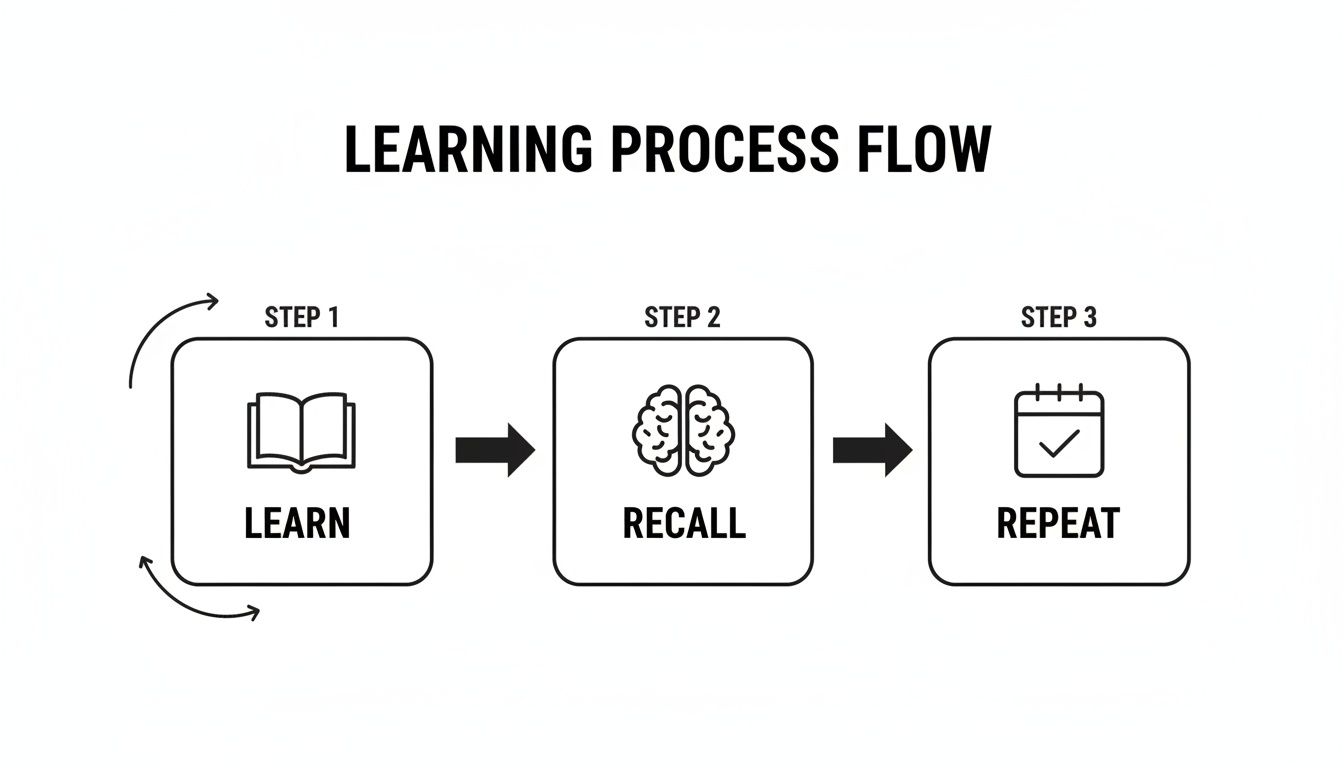
This visual breaks it all down into three core actions: you learn the material, you actively recall it, and you repeat that process over time. This simple loop is the engine that drives long-term memory.
Your AI-Powered Study Shortcut
This is where a tool like Vivora steps in to automate this entire workflow. Instead of spending your weekend manually making hundreds of flashcards, you can let AI handle the heavy lifting.
Here’s how you can go from a digital mess to a personalized, ready-to-use study guide in a few clicks:
Centralize Everything Instantly: Forget downloading and re-uploading files. Sync your Canvas account with Vivora, and it'll automatically pull in all your course content—lecture slides, readings, announcements—the moment your professor posts them. You can also toss in other materials like PDFs, your notes, or even YouTube links.
Let the AI Get to Work: Once your content is in one place, Vivora’s AI analyzes everything. It reads your slides, scans your PDFs, and understands the key concepts from all your different materials.
Get Your Personalized Study Guide: Within minutes, Vivora generates custom flashcards and quizzes tailored specifically to your course content. No more generic questions from a textbook publisher. These are designed to test you on the exact info you need for your exams.
This process turns hours of painful prep work into a few simple clicks. You get all the benefits of active recall without the manual labor, freeing you up to spend your time actually learning. If you're curious, you can learn more about how an AI study assistant like Vivora can build your personalized study engine for you.
By automating the creation of study materials, you're not just saving time; you're making the best way to study the easiest way, too. This removes the biggest barrier to using powerful techniques like active recall and spaced repetition. You no longer have to choose between studying effectively and having a life—you can finally do both.
Copy-Paste Study Plans for Any Situation
Let's be real: studying for a massive final is a completely different vibe from just keeping up with weekly readings. And scrambling to catch up after being sick? That’s another beast entirely. The best students don't have one magic study method; they adapt their strategy to fit the situation.
So, let's get practical. Here are three battle-tested study templates for the most common scenarios you'll run into. Each one lays out a clear plan, points you to the right techniques, and shows you how a tool like Vivora can make the whole process faster and way less stressful.
The Final Exam Gauntlet
This two-week plan is your all-out assault on finals. The mission: find what matters most, hammer it home with active recall, and walk into the exam knowing you focused on the right things. Forget trying to re-learn everything—we're going for maximum impact with minimum wasted effort.
Your Two-Week Game Plan:
Week 1, Days 1-3 (Triage & Organize): First, gather every single piece of material for the course—lecture slides, your notes, PDFs, anything. Dump it all into Vivora. The AI will instantly create a single, unified study guide. Your only job is to scan it and identify the big-ticket topics you know will be on the exam.
Week 1, Days 4-7 (First Pass with Active Recall): Now, start hitting the flashcards and quizzes Vivora automatically generated. This is your first real test of active recall. Don't stress about getting everything right. The goal is to find out what you don't know.
Week 2, Days 8-11 (Targeted Review): Time to zoom in. Focus only on the flashcards and concepts you struggled with. Use Vivora’s AI chat as your personal tutor. Ask it things like, "Explain the Krebs cycle like I'm five," or "Give me a real-world example of cognitive dissonance from this lecture."
Week 2, Days 12-14 (Full Practice & Review): Take the full-length practice quizzes generated by Vivora. Set a timer to get used to the real exam pressure. The day before, do one last, quick run-through of all the flashcards to refresh your memory.
The 80/20 Rule of Finals: You'll likely get 80% of your grade from just 20% of the course material. The key is using a tool like Vivora to pinpoint that high-value 20% so you can pour your energy where it actually counts.
The Weekly Grind
This is your secret weapon for a low-stress semester. It’s a sustainable routine designed to keep you on top of your classes, using consistency and spaced repetition to make sure you never have to cram again. A little smart work each week makes a huge difference.
Sunday Prep (30 mins): Sync Vivora with your Canvas. When your professor posts materials for the week, Vivora will automatically organize them and generate flashcards and quizzes. Skim the topics so you know what's coming.
Mid-Week Review (15-20 mins per class): After each lecture, do a quick run-through of the flashcards Vivora made from that day’s content. This simple active recall session interrupts the "forgetting curve" and helps lock in what you just learned.
End-of-Week Consolidation (45-60 mins): On Friday or Saturday, take a combined quiz that pulls questions from the entire week's material. This forces your brain to connect concepts from different lectures. For a deeper dive, see how to plan weekend study sessions for maximum results.
This simple weekly rhythm turns studying from a dreaded chore into a manageable habit.
The Catch-Up Mission
Okay, it happens. You missed a class or two and now you feel like you're falling behind. Don't panic. The goal isn't to perfectly re-live every missed minute; it's to strategically grasp the most important stuff ASAP so you can walk into the next class feeling prepared.
Your Triage Strategy:
Step 1: Identify Key Concepts (5 mins): Upload the lecture slides you missed into Vivora. The first thing to do is ask the AI chat: "What are the three most important concepts from this lecture?" This instantly gives you a laser-focused target.
Step 2: Master the Core Ideas (25-30 mins): Now, use the flashcards and quizzes Vivora generated, but only focus on those key concepts the AI just gave you. This is your high-speed, targeted active recall session.
Step 3: Fill in the Gaps (15-20 mins): Once you have a handle on the main ideas, use the AI to see how they fit into the bigger picture. Ask it things like, "How does 'supply and demand' from this lecture connect to last week's topic on 'market equilibrium'?"
This catch-up method is about smart prioritization. By having an AI tool pinpoint what’s critical, you can get back on track in under an hour and feel confident for what's next.
Find Your Vibe and Personalize Your Study Method
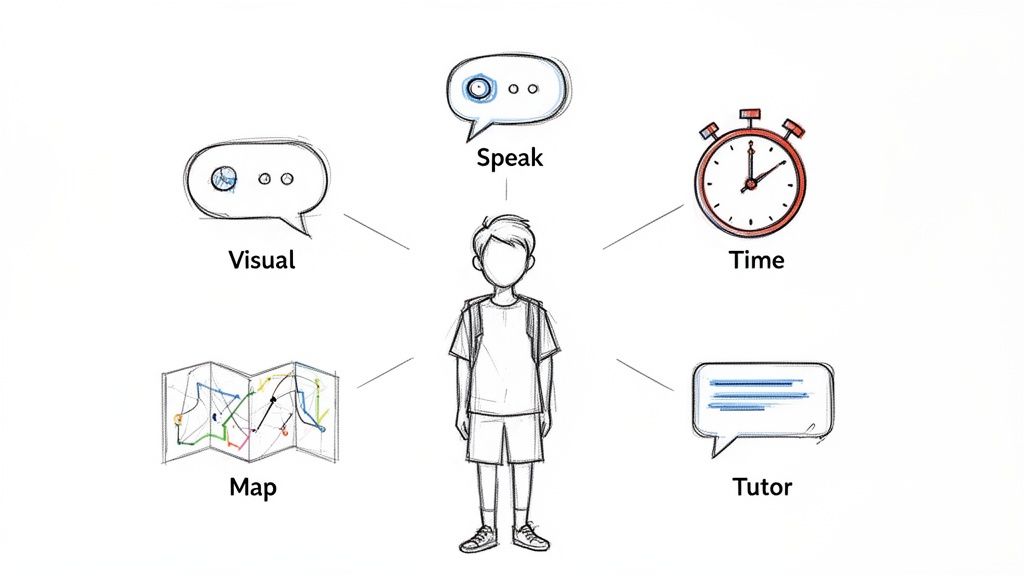
So, we've established that Active Recall and Spaced Repetition are the non-negotiable GOATs of studying. Think of them as the engine in your car—they provide the horsepower. But you still get to choose the car and decide how you want to drive it. This is where you make the science work for you.
The truth is, the "best" study method isn't some rigid formula. It’s a personalized system you build and tweak. What works for your roommate who needs total silence might be a disaster for you if you learn best by pacing around and talking to yourself.
The goal is to move past just following advice and start creating a routine that actually feels good and gets results. It's about building a study habit you can stick with because it clicks with how your brain is already wired.
Find Your Personal Study Style
Everyone's brain processes info a little differently. Some of us need to see concepts mapped out, while others have to say something out loud for it to sink in. The trick is to layer your preferred activities on top of the core principles.
Here's how you can blend different approaches with active recall and spaced repetition:
For the Visual Learner: Are you the one who doodles in the margins and thinks in pictures? Don't just flip through text-only flashcards. Take the material your AI generates and turn it into mind maps or flowcharts. Drawing the connections between ideas adds a powerful visual layer to your memory.
For the Auditory & Verbal Learner: Do you find yourself reading your notes out loud or needing to talk through a problem? Use Vivora's AI chat as your 24/7 study partner. Try to explain a complex topic to it or challenge it to a debate. The AI can poke holes in your logic and ask follow-up questions—a fantastic and surprisingly effective form of active recall.
For the Organized Planner: If you live by your to-do lists and thrive on structure, the Pomodoro Technique could be your secret weapon. This involves studying in hyper-focused 25-minute sprints, followed by a 5-minute break. It's brilliant for staying on task and preventing that drained, burnt-out feeling.
Finding your style isn't about taking a quiz and getting a label. It's about being a scientist in your own study lab and seeing what actually works.
The 'Study Style' Experiment
The only way to figure out what truly works for you is to test things out. You don't need a complicated research project—just a quick experiment to see what feels right.
Don’t be afraid to experiment. The most effective study systems are discovered, not assigned. Your goal is to find a routine that you not only see results from but that you can also stick to without feeling drained.
Try this simple experiment for one week. Pick one class and one new technique.
Choose Your Method: Pick something new. Maybe it's trying the Feynman Technique (explaining something simply) with Vivora’s AI chat. Or maybe it's committing to a strict Pomodoro schedule.
Run the Test: For one week, apply that single technique to that one class. Stick with it, even if it feels a bit awkward at first. You're just gathering data.
Check In and Reflect: At the end of the week, ask yourself: Did I feel more focused? Did I understand the material better? And the big one: Could I see myself doing this again without dreading it?
This simple process helps you build a study system based on your own evidence. You're no longer just following someone else's rules but creating a method that makes you feel confident and in control. When you combine the science of learning with your personal style, you'll finally have an answer to "what is the best way to study?" that is uniquely your own.
Your Questions on How to Study Better, Answered
Staring at a mountain of coursework can feel overwhelming, and it's easy to get lost in all the conflicting advice out there. Let's cut through the noise and tackle some of the biggest questions students have about studying smarter.
How Many Hours a Day Should I Study?
Honestly, this is the wrong question. The real game-changer isn't the number of hours you log, but the quality of that time.
Think about it: two hours of mindlessly re-reading a textbook is a total waste. But 30 minutes of focused active recall? That's where the magic happens. Instead of burnout-inducing marathons, try the Pomodoro Technique. Study hard for 25 minutes, then take a 5-minute break. It keeps your mind sharp and makes the process feel way more manageable.
Is It Better to Study Alone or in a Group?
The best answer? A smart mix of both. Each has a specific, powerful purpose.
Fly solo when you first need to get your head around new material. This is your deep focus time to absorb the core concepts. It's the perfect time to use Vivora to build that foundational understanding from your class materials.
Then, bring that knowledge to a study group. The goal here isn't to re-learn, but to explain concepts to each other. This is active recall on steroids—if you can teach it, you truly know it. You can even use Vivora to find your weak spots before the session, so you walk in knowing exactly what to ask.
How Do I Manage This for All My Classes?
Trying to use a different system for every class is a fast track to chaos and burnout. The secret isn't more effort; it’s a better, more unified system.
You need one central hub for everything. A platform like Vivora is designed for this, letting you sync all your classes directly from Canvas automatically. All your lecture notes, slides, and readings live in one place.
The AI then gets to work, generating custom study materials for each course. This lets you apply powerful techniques like active recall across your entire workload without juggling a dozen different apps. It’s about making your study routine consistent and simple.
The secret to staying on top of multiple classes isn't more effort; it's a better system. Centralizing your materials means you spend your energy learning, not just trying to find things.
How Do I Stay Motivated to Study?
Here’s a truth most people miss: motivation doesn't just show up. It's a result of action, not the cause of it. You don't wait to feel motivated; you get motivated by starting.
The best way to build momentum is to see proof that your effort is working. When you start using effective methods and see your quiz scores improve, it creates a positive feedback loop. You start to want to study because you can feel yourself getting smarter.
Start small. Celebrate the small wins. Use tools that make studying feel less like a chore. Seeing your AI-generated flashcards turn green gives you a little dopamine hit—proof that you're making progress. It turns studying from a grind into a game you can actually win.
Ready to stop guessing and start building a study system that actually works? Vivora transforms your messy class content into personalized study guides with AI-generated flashcards and quizzes. Sync your courses in minutes and see the difference for yourself. Try it free at https://vivora.ai.