
How to Study for APUSH and Actually Score a 5
Mar 9, 2026
Figuring out how to study for APUSH comes down to one simple idea: working smarter, not harder. The secret isn't cramming a million random facts but building a consistent, focused review plan that connects the dots across centuries. Forget those late-night panic sessions—a smart game plan is your ticket to a 5.
Your Smart APUSH Game Plan
Let's be real, APUSH is a beast. With a timeline that stretches from 1491 to the present day, it can feel less like a history class and more like a historical marathon you never signed up for. The sheer volume of names, dates, and events is enough to make anyone feel overwhelmed.
But here’s the secret the top-scoring students know: acing this exam isn't about memorizing every single detail in your AMSCO book. It's about grasping the big picture—the major themes and historical thinking skills the College Board actually tests, like causation, comparison, and change over time.
Ditch the Digital Chaos
Think about your current study setup for a second. You probably have lecture slides saved in one folder, class notes in a Google Doc, a random Heimler's History video bookmarked, and a dozen textbook PDFs scattered across your desktop. This digital mess is a massive time-waster.
A much smarter approach is to bring everything into one central hub. Instead of losing 20 minutes just finding what you need, imagine having all your materials in one place. This is where an AI study assistant can make a huge difference. With a tool like Vivora, you can upload all those chaotic files—slides, notes, even YouTube links—and it instantly transforms your class content into a personalized study guide. No more frantic searching before a test.
The Bottom Line: An organized study system is your first and best defense against feeling overwhelmed. Centralizing your notes, slides, and videos saves time and mental energy, letting you focus on actual learning instead of digital housekeeping.
Why a Smart Strategy Matters
The numbers don't lie—APUSH is a tough exam. To put it in perspective, let's look at a recent score breakdown and what it takes to land in each tier.
APUSH Score Breakdown and What It Takes
Here's a look at recent APUSH score distributions and the study habits that correlate with each score level, helping you set a realistic goal.
AP Score | Percentage of Students (2026) | Common Study Habit | Your Target Strategy |
|---|---|---|---|
5 | 14.2% | Consistent, theme-based review; regular writing practice. | Focus on thematic connections and weekly timed writing drills. |
4 | 23.5% | Solid content knowledge; some practice with FRQs. | Master the content and start incorporating timed DBQ/LEQ practice. |
3 | 36.3% | Surface-level content review; last-minute cramming. | Move beyond memorization to understanding cause-and-effect. |
2 | 17.7% | Inconsistent studying; minimal writing practice. | Establish a daily review routine, even if it's just for 15 minutes. |
1 | 8.3% | Little to no structured studying. | Start by organizing your materials and identifying key periods. |
As you can see, while 74% of students earned a 3 or higher, those top scores are reserved for students with a solid plan. College Board data consistently shows that daily, focused review boosts scores far more effectively than cramming. This course isn't a sprint; it's a marathon that starts on day one.
So, what does a "smart" strategy actually look like in practice? It means putting your energy where it counts most.
Focus on Themes, Not Just Facts: Instead of just memorizing "The Compromise of 1850," truly understand the theme of sectionalism. How did that one event connect to earlier tensions over slavery and set the stage for later conflicts? That's the kind of thinking that gets you points.
Practice Active Recall: Don't just re-read your notes—that's one of the least effective ways to study. Instead, quiz yourself. Explain a concept out loud to a friend (or your dog). Try to make connections between different historical periods without looking at your materials.
Turn Chaos into Coherence: This is where modern tools shine. When an AI-powered study tool like Vivora transforms your lecture slides on the Great Depression and a textbook chapter on the New Deal into a single, unified study guide, you start to see the web of connections that makes up American history. You're learning way more efficiently.
This guide will give you that exact roadmap. We'll show you how to build a routine that works, master the content without memorizing every single date, and walk into that exam room ready to earn the score you deserve.
Building a Study Routine That Actually Works
Let's be honest: procrastinating on APUSH is a recipe for disaster. You can’t cram 400+ years of American history the week before the exam and hope for a 5. Acing this test isn't about pulling all-nighters; it's about building a smart, consistent study routine that starts on day one and carries you all the way to May.
The whole point is to avoid that classic rookie mistake: completely forgetting what you learned about the Chesapeake colonies by the time your class hits the Gilded Age. The goal isn't to live in your textbook. It's to create a manageable system that keeps old information fresh while you tackle the new stuff.
The 15-30-15 Daily Method
Here’s a simple but incredibly effective daily structure I recommend, called the 15-30-15 method. It’s designed to fit into even the busiest schedule and only takes about an hour.
15 Mins - Review Old Content: Start with a quick, active review of past material. Don't just reread your notes. Use flashcards, or better yet, try to explain the causes of the War of 1812 out loud without looking at anything. This forces active recall and keeps old info from fading.
30 Mins - Learn New Material: This is your main study block. Focus on whatever chapter or topic your class is covering right now. Take notes during your teacher's lecture, read the assigned pages, or watch a relevant video.
15 Mins - Practice & Connect: Use the last chunk of time to immediately apply what you just learned. Try a few multiple-choice questions or—and this is a big one—write a quick thesis statement for a potential essay prompt on the day's topic. This immediately solidifies the new information.
This daily habit of reviewing, learning, and applying is way more powerful than a frantic five-hour cram session on a Sunday night.
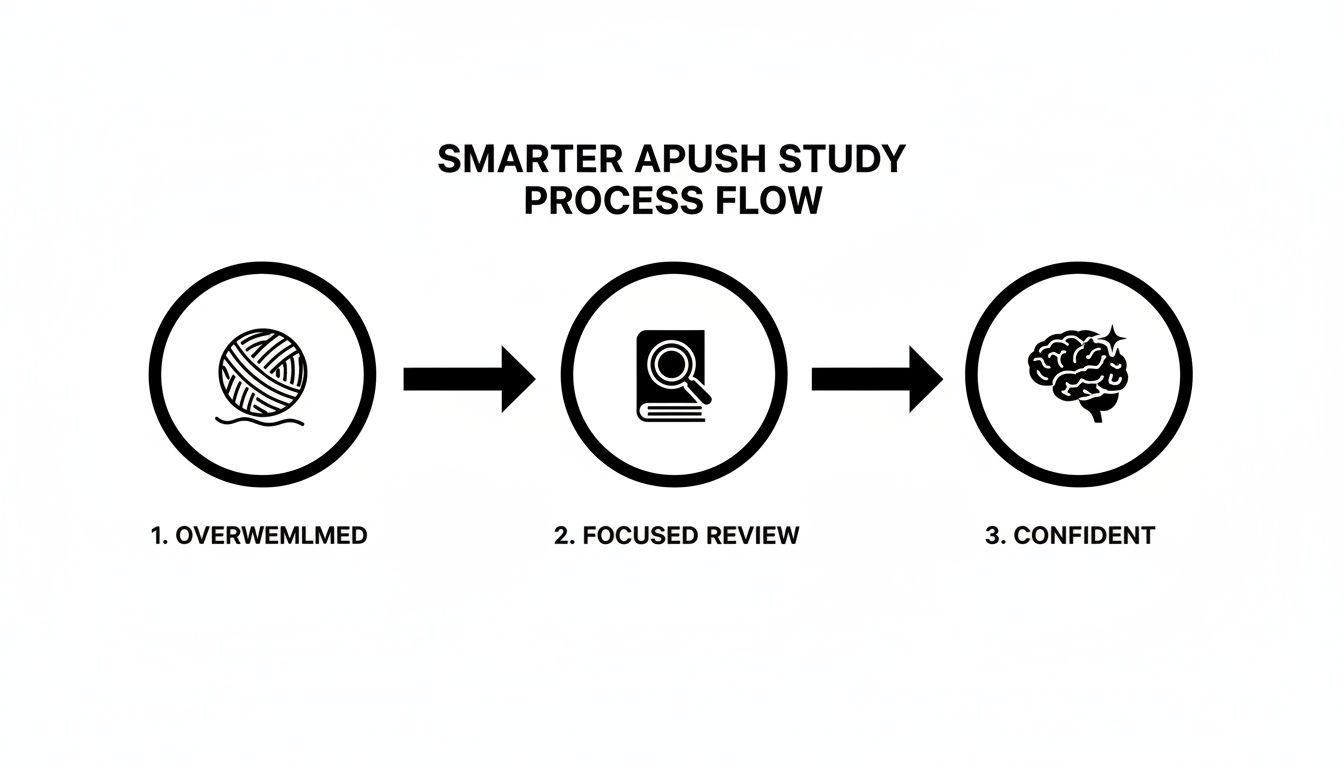
As you can see, the path from feeling overwhelmed to walking in confident is all about focused, strategic review—not just putting in more hours.
Creating a Single Source of Truth
One of the biggest time-wasters I see is students having their materials scattered everywhere. Your class notes are in a Google Doc, the teacher's slides are on the school portal, and you've got a dozen Heimler's History videos bookmarked somewhere. This digital chaos is the enemy of an efficient study routine.
Imagine having a single, organized hub for everything. That's what we call a "single source of truth." When you centralize all your materials, you stop wasting precious time just trying to find things and spend more time actually learning.
This is where a smart study platform can be a total game-changer. With a tool like Vivora, you can dump all those scattered files—slides, notes, textbook PDFs, even video links—into one place. Its AI then automatically transforms all your class content into an organized, personalized study guide.
It takes that digital mess and turns it into a coherent system. The platform can generate flashcards and practice quizzes based on your actual class content. This makes the 15-30-15 method way easier to manage because your review, learning, and practice materials are all organized and ready to go. No more digital scavenger hunts before you can even begin.
Pacing Yourself Through the Nine Periods
The nine APUSH historical periods can feel intimidating, but you can absolutely conquer them with a simple semester-by-semester plan.
First Semester (August to December): Periods 1-5 Your mission for the first semester is to get through the Civil War and Reconstruction by winter break. This stretch covers the foundational eras, from early colonization (1491) all the way to the end of Reconstruction (1877).
Second Semester (January to April): Periods 6-9 This half of the year is a sprint, taking you from the Gilded Age to the present day. The content is dense—we're talking industrialization, two World Wars, the Cold War, and modern America. Sticking to your daily routine here is absolutely critical to avoid falling behind.
Make your weekends count. Instead of just playing catch-up on reading, dedicate an hour to timed writing practice. Grab a past exam and work on a DBQ or an LEQ. If you need some pointers on how to organize these sessions, check out our guide on how to plan weekend study sessions for maximum results. This consistent writing practice builds the skills and stamina you need to dominate the high-stakes FRQ section on exam day.
How to Master Content Without Memorizing Every Date
Let’s be real for a second: if you think acing APUSH means memorizing every single date in American history, you're in for a miserable time. The good news? That's not how the exam works.
APUSH isn't a trivia contest. It’s about understanding the story of America—the web of cause and effect, the competing ideas, and the patterns that connect events across centuries. This is where we move past passively rereading your textbook and start using active strategies that make the big picture click.
Go Beyond Basic Flashcards
Traditional flashcards are fine for remembering a key term or two, but they totally miss the mark for a class like APUSH. A card that says "Civil War" on the front and "1861" on the back does nothing to help you explain why the war started. It’s time to level up.
Instead of just definitions, you need to create concept-based flashcards. Think of them as mini-essay prompts.
Front: What were the three main causes of the Civil War?
Back:
Economic: Industrial North vs. Agrarian South.
Political: Fierce debates over states' rights and federal power.
Social: The moral and ethical conflict over the institution of slavery.
This small shift forces your brain to think in connections, which is precisely what the APUSH exam rewards. You’re moving from the "what" to the "why" and "how"—the real meat of the course.
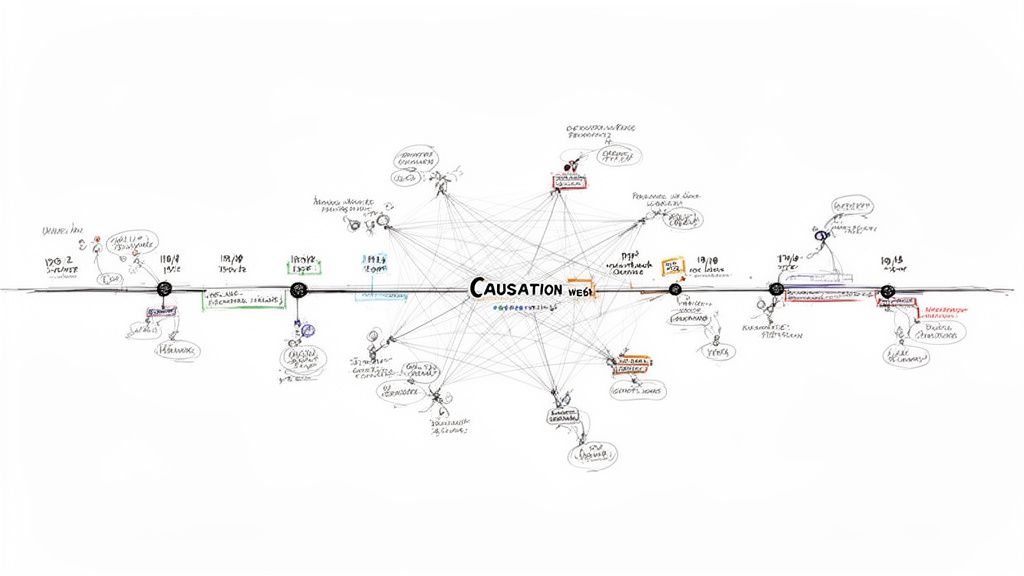
Build Thematic Timelines and Causation Webs
A standard timeline is just a boring list of dates. A thematic timeline, on the other hand, is a game-changer. It’s a visual tool that groups events by one of the course's major themes, helping you see development over time.
For example, make a timeline just for the theme of "America in the World." On it, you’d plot the Monroe Doctrine, the Spanish-American War, World War I, the Cold War, and post-9/11 foreign policy. All of a sudden, you're not just looking at isolated events—you're seeing the entire evolution of American foreign policy from isolationism to global interventionism.
Causation webs take this even deeper. Slap a major event like "The Great Depression" in the middle of a blank page. Then, draw branches out to its causes (stock market crash, widespread bank failures, the Hawley-Smoot Tariff) and its effects (the New Deal, the rise of the welfare state, mass internal migration). This visual map will cement those crucial relationships in your mind.
Pro Tip: Don't just do this for massive events. Try making a causation web for a smaller connection, like how the First Red Scare in the 1920s directly led to the Palmer Raids. This practice is gold for training your brain to find the specific "evidence and reasoning" points you need for essays.
Use Spaced Repetition for Maximum Retention
Your brain is built to forget things it doesn't see often. Spaced repetition is a study method that works with this fact, not against it. By reviewing information at increasing intervals—seeing it again right before you're about to forget it—you can lock it into your long-term memory far more effectively than cramming.
The data backs this up. While the APUSH pass rate is decent—around 74% of students score a 3 or higher—the top scores are much harder to get. Typically, only 10-15% of test-takers earn a 5 each year. Research shows that last-minute cramming fails most students, but spaced repetition can boost retention by as much as 50%. By intelligently spacing out your review, you're playing the game on easy mode. For a deeper look at what these scores mean, check out this in-depth analysis of AP score distributions.
Of course, trying to manage this with paper flashcards is a nightmare. This is where digital tools shine, automating the whole process so you’re always reviewing the right concept at the right time.
Unify Your Materials for Smarter Studying
Let’s face it: your study materials are probably a mess. Your lecture slides are on one platform, your textbook PDF is on your laptop, and you’ve got a dozen TikTok explainers saved on your phone. How can you expect to see the connections when your resources aren't even connected?
This is where a modern study hub becomes your best friend. Imagine dumping all those scattered files—PowerPoints, PDFs, notes, and links—into one central place. With an AI platform like Vivora, that’s exactly what you can do.
Once you upload your materials, Vivora’s AI instantly transforms them into a unified set of notes, practice quizzes, and—most importantly—smart flashcards that are built on these active learning principles. It turns your digital chaos into an organized, interactive study guide, helping you master the big-picture connections you need for a top score without drowning in disorganized files. To really perfect this strategy, you should explore our guide on how to create flashcards that help you remember everything.
Cracking the Code of the DBQ and FRQs
Let's talk about the free-response questions (FRQs). If the multiple-choice section is the warm-up, the FRQs are the main event, making up a massive 60% of your total score. You just can't afford to wing this part. This is your personal bootcamp for mastering the Document-Based Question (DBQ), Long Essay Question (LEQ), and Short Answer Questions (SAQs).
The biggest secret? AP graders aren't looking for flowery language or a history professor's prose. Scoring high is all about hitting specific points on a rubric. It's a system, and once you understand it, you can game it.
Decoding the DBQ and LEQ Rubrics
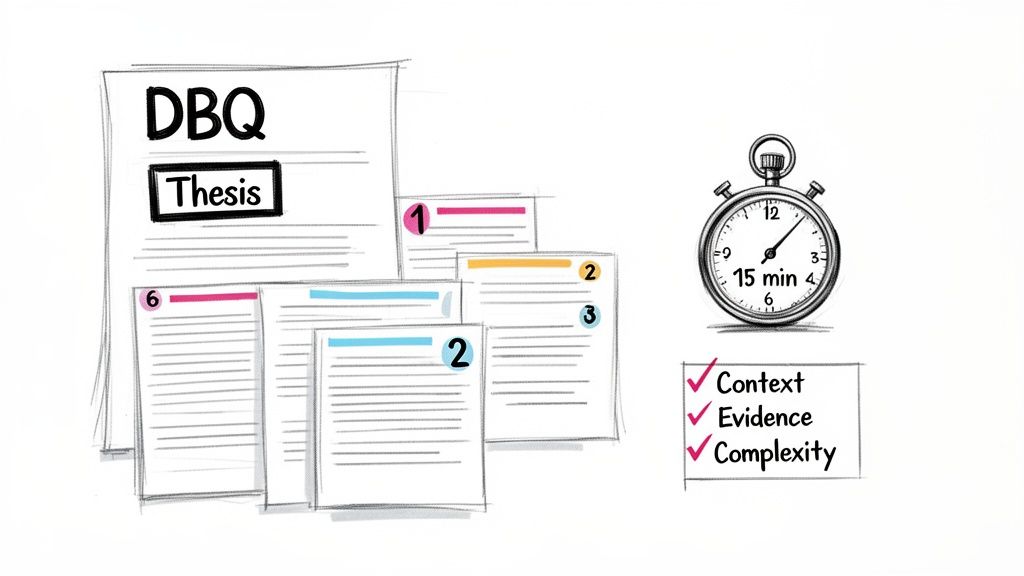
Your essays aren’t graded on vibes; they're scored against a very clear checklist. The DBQ is worth 7 points and the LEQ is worth 6. The points are awarded for similar skills: your thesis, your ability to set the scene, the evidence you use, and how you analyze it.
Here’s a quick breakdown of where your focus should be:
Thesis (1 Point): This isn't just restating the prompt. You need to make a historically defensible claim that takes a real stance.
Contextualization (1 Point): Think of this as setting the stage. Before you jump into your argument, describe the broader historical events or trends relevant to the prompt.
Evidence (2-3 Points): This is where you bring the receipts. For the DBQ, you have to use the documents. For both essays, you must also bring in specific outside knowledge to back up your thesis.
Analysis & Reasoning (2 Points): This is the money-maker. It’s where you explain how your evidence proves your point and (for the DBQ) analyze the documents by explaining their point of view, purpose, or audience. This is what separates a good essay from a great one.
Complexity (1 Point): Ah, the infamous unicorn point. This is for essays that show a sophisticated, nuanced understanding. Honestly, don't even worry about this point until you've mastered all the others.
The free-response sections are where top students separate themselves. APUSH exam trends show that while the DBQ, LEQ, and SAQs account for 60% of the score, the real differentiator is how students handle evidence and reasoning. Only about 13% of students earn a 5, and it's often because they've mastered these parts of the rubric. You can learn more about the scoring standards from the College Board's recent updates on their All Access site.
Your 15-Minute DBQ Attack Plan
On the DBQ, the clock is your biggest enemy. You get 60 minutes total, but the first 15 should be a sacred time for reading and planning only. No writing. Here’s how to use that time so you don't panic.
Deconstruct the Prompt (2 mins): Grab your pen and physically underline the key verb (like "evaluate the extent" or "compare"), the theme ("political change"), and the time period. Ask yourself: What is this question really asking me to do?
Brainstorm Outside Evidence (3 mins): Before you even touch the documents, jot down 2-3 specific facts, events, or people you know about the topic. This stops you from falling into the trap of just summarizing the documents later.
Read and Group the Documents (10 mins): As you read each document, make a quick note in the margin: What's the main idea? Who wrote it and why? Then, group the documents into 2-3 categories based on the arguments they could support. This becomes the blueprint for your body paragraphs.
This structured 15-minute plan is your defense against writer's block. It gives you a clear roadmap before you even think about writing a full sentence.
Taming the Essay with an AI Tutor
Let's be real: staring at a blank page with a prompt like "Evaluate the extent to which the Progressive Era fostered political change" can be completely overwhelming. You know the information is floating around in your notes somewhere, but pulling it all together under pressure is a different beast.
This is where having an AI study partner can be a game-changer. Think of Vivora’s chat feature as your personal, on-demand tutor.
If you’re stuck on a practice LEQ, you can prompt it to help you get started. For example, typing "Help me brainstorm arguments about political change in the Progressive Era" will get it to scan your uploaded class notes and pull out relevant concepts to build a thesis.
It also works as your personal grader. Say you wrote a practice essay on the New Deal and only scored a 4/7. You can ask, "I wrote an essay on the New Deal and only got a 4/7. Based on my notes, where did I miss points on evidence and reasoning?" The AI can analyze your materials and pinpoint specific details you overlooked, giving you targeted feedback to boost your score. It’s like having an expert available 24/7 to help you crack the code.
Your Final Month Prep Sprint
The final four weeks before the APUSH exam are your victory lap. The long marathon of learning new content is finally over. Now, it's all about shifting gears into a high-intensity practice sprint to refine your skills and build unshakeable confidence.
This is where all that hard work you've put in all semester starts to pay off. We're moving out of "learning mode" and into "performance mode," strategically getting you ready for whatever the College Board decides to throw at you on exam day.
Your Four-Week Countdown
Let's be clear: this final month isn't about panicked, all-night cramming. That's how you burn out. Instead, we're going to use a smart, week-by-week plan to keep you focused and on track.
Week 4 (One Month Out): Full-Length Practice Exam #1. Find a quiet spot and take a complete, timed practice exam. Treat it like the real thing. Don't obsess over the score right now—the real goal is to get a raw baseline and see exactly where your weaknesses are.
Week 3: Targeted Triage. That practice test you just took? It’s now your personal roadmap. If you got hammered on questions about Period 7 (1890-1945), that’s your mission for the week. Dive back into your notes, re-watch videos on the World Wars, and drill concepts from that era until they're second nature.
Week 2: Full-Length Practice Exam #2. Time for round two. Take another full-length test and compare the score to your first one. Did your targeted review make a difference? This second test is perfect for spotting any lingering content gaps and getting even more comfortable with the pacing.
Week 1 (The Final Stretch): Light Review and Final Drills. The week before the exam is not the time to learn new material. It's for light review, skimming thematic outlines, and running through quick-fire practice questions just to keep your mind sharp and the information accessible.
By spacing out your full-length exams like this, you give yourself the time to actually learn from your mistakes instead of just making them over and over again.
Reading Your Practice Test Scores
Getting a score back can feel like a final judgment, but it's not. It's just data. A score is a diagnostic tool that tells you exactly where to point your efforts.
So, break it down. Did you run out of time on the multiple-choice section? That's a pacing issue, and it means you need to do timed drills. Did you bomb an LEQ about the Gilded Age? That's your signal to review your materials on industrialization and political machines.
This is where having a centralized study hub becomes a massive advantage. Instead of digging through stacks of paper, you can go straight to the organized material you need.
Your Vivora study guides, which were created from your own class materials all semester, are now your secret weapon. If your practice test shows a weakness in Period 7, you can instantly pull up your personalized notes, flashcards, and quizzes on the Progressive Era and WWII. No wasted time, just hyper-focused, efficient review.
Using AI for Last-Minute Questions
As you get closer to the exam, you'll inevitably run into those nagging "wait, what's the actual difference between..." questions. In this final stretch, you don't have time to re-read an entire chapter to find one small detail.
This is the perfect moment to lean on an AI chat feature built for students. With a tool like Vivora, you can ask your AI specific questions based on your own uploaded notes and slides.
Need a quick refresher? Just ask it:
"Explain the difference between the New Deal and the Great Society using my lecture slides."
"Generate a 5-question quiz on the causes of the Spanish-American War based on my class notes."
"Summarize the main arguments for and against imperialism from my textbook chapter."
The AI can scan your materials and spit out a precise, contextual answer in seconds. It’s like having a personal TA on call 24/7 to clear up any final points of confusion.
The Last 48 Hours
The two days before the exam are all about your mindset. The goal is to walk into that testing room feeling calm, rested, and ready.
48 Hours Out: Do one last, very light review. Skim your thematic timelines or look over your "best" practice DBQ to remind yourself what a high-scoring essay looks like. Do not take another full practice test.
24 Hours Out: No more studying. Seriously. Put the books away. Your brain needs time to rest and consolidate everything you’ve crammed into it. Watch a movie, go for a walk, listen to music—do anything but think about history.
Exam Day Morning: Eat a solid breakfast. Don't try to cram on the bus or in the car. You've done the work. Now, just get yourself into a positive headspace and get ready to show what you know.
Following this sprint plan helps you avoid the classic last-minute panic that sinks so many students in May. You’ll walk in feeling prepared, confident, and ready to dominate.
The APUSH FAQ: Your Top Questions, Answered
When you're staring down the mountain of content that is AP US History, it's easy to get lost in the weeds. I get these same questions from students year after year, so let's clear the air and get you pointed in the right direction.
How Many Hours a Week Should I Actually Study for APUSH?
There’s no magic number, but let's be real: students who consistently pull a 4 or 5 are putting in about 4-6 hours a week outside of class. That’s not all cramming, though. It’s a smart mix of reviewing notes (1-2 hours), tackling homework (1-2 hours), and, most importantly, active studying like practice questions (1-2 hours).
As you get into the final month before the exam, you’ll probably see that number creep up to 8-10 hours a week. The real key, however, is consistency. A focused 45 minutes every single day will do more for you than a panicked five-hour marathon on Sunday night ever could.
This is where a tool like Vivora can be a game-changer. It can turn your class notes into quick-fire quizzes, making that 15-minute bus ride a surprisingly productive study session.
What Are the Most Important APUSH Periods to Focus On?
Okay, while the College Board says everything is fair game, they definitely play favorites. The sweet spot is Periods 3 through 8 (that's 1754 to 1980), which make up a whopping 80-90% of the entire exam.
Specifically, pay extra attention to Periods 4 (1800-1848), 5 (1844-1877), and 7 (1890-1945). These are the eras of massive change—think the market revolution, the Civil War and Reconstruction, and America's rise as a global power. You can bet they'll show up.
But don't completely ignore the bookends! Periods 1, 2, and 9 provide the essential context you need to write killer essays that nail those "big picture" connections and show you truly understand the historical narrative.
Pro Tip: The DBQ will always be drawn from Periods 3 through 8. Knowing this is a huge advantage. It lets you laser-focus your essay practice on the time periods that matter most for that specific, high-stakes task.
Is It Really Possible to Self-Study APUSH and Get a 5?
Totally. But you have to become your own project manager. Without a teacher breathing down your neck with deadlines, you are 100% in charge of mastering the curriculum. Your new bible is the official College Board Course and Exam Description (CED).
You'll also need to build your own study toolkit:
A rock-solid textbook (AMSCO is the go-to for a reason).
A video series you can rely on (Heimler's History is basically required viewing).
A massive supply of practice questions.
This is where staying organized is non-negotiable. Using a platform like Vivora is a lifesaver for self-studiers. You can upload all your resources—textbook PDFs, video links, scanned notes—and it acts like your personal digital TA, transforming your content into a structured study plan with quizzes and flashcards to keep you on track.
How Do I Get Faster at the Multiple-Choice Section?
The MCQ section is a flat-out sprint: 55 questions in 55 minutes. Speed without sacrificing accuracy comes down to two things: relentless practice and a smart strategy. Start by always doing timed practice. You have to build the stamina and internal clock for that pace.
Next, you need a plan of attack for the stimulus-based format. For every single question, do this:
Scan the document, chart, or cartoon. Get the gist.
Read the question. What is it really asking?
Immediately find and slash the two obviously wrong answers.
It almost always boils down to a 50/50 shot between the last two options. Go back to the question one last time and figure out which answer is the best fit, not just a good one. Vivora can generate endless practice MCQs from your own course materials, letting you drill specific time periods until you’re answering with both speed and confidence.
Feeling a little better? You should. The secret to conquering APUSH isn't about working harder; it's about working smarter. With the right strategies and a solid plan, you can turn that mountain of history into a manageable climb.
Ready to stop juggling scattered notes and files? Let Vivora transform your class content into personalized study guides and practice sets for you. Get started for free and see what an organized study plan feels like.