
What's the Best Time to Study? (Spoiler: It's Not 3 AM)
Jan 26, 2026

Let’s get one thing straight: the idea of a single "best time to study" for everyone is a total myth. The real answer is way more personal and, thankfully, backed by science. It all comes down to when your brain is naturally switched on and ready to absorb stuff.
For most students, research points to a prime window between 10 AM and 2 PM. This is when your brain typically hits its peak performance for the day. But don't worry, night owls, we got you.
Finding Your Peak Study Time
Forget the glorified all-nighter culture that just leaves you feeling like a zombie. The smartest way to study is to sync up with your body's internal clock, aka your circadian rhythm. Think of it as your brain's built-in schedule that controls your energy, focus, and ability to actually remember new information.
When you schedule study sessions during your peak window, you're not just staring at a textbook—you're actually absorbing the content. Research shows that students who study between 10 AM and 2 PM can retain 20-30% more information than those trying to cram late at night. Why? Your alertness hormones are at an all-time high, making it way easier to tackle complex subjects without your brain shutting down.
It's pretty interesting to see how your habits stack up against others. You can check out the latest student survey insights on study habits to get the full picture.
Your Quick Guide to Peak Study Times
To make this super simple, let's break your day down into three main productivity windows. Each one is perfect for different kinds of tasks. This is all about learning to stop fighting your brain and start working with it.
To help you visualize this, here’s a quick breakdown of how to match your tasks to your energy levels throughout the day.
Time Window | Best For | Ideal Student Vibe |
|---|---|---|
10 AM - 2 PM | Learning complex new concepts, problem-solving, and deep focus. | The "Lark" or anyone who feels sharpest in the late morning. |
4 PM - 10 PM | Creative tasks, brainstorming, and reviewing stuff you already learned. | The "Night Owl" who hits their stride when everyone else is winding down. |
6 AM - 9 AM | Quick reviews, planning your day, and organizing notes. | The "Early Bird" who wakes up with a clear and focused mind. |
This table isn't a set of strict rules, just a starting point. The real magic happens when you start paying attention to your own body's signals.
The goal isn't to study more. It's about studying smarter during the hours your brain is already fired up. This simple shift can make a massive difference in your grades and free up time for, you know, actually having a life.
Instead of just randomly hitting the books, you can start aligning your tasks with these natural energy zones. For instance, use those high-energy morning hours for that brutal stats class. Then, save the easier stuff, like organizing notes or making flashcards, for your afternoon slump.
You can make these peak times even more efficient. Imagine snapping a pic of your chaotic lecture notes and uploading them to an AI tool like Vivora. It instantly transforms them into a clean, organized study guide. This cuts out all the boring prep work, letting you dive straight into learning the moment your brain is ready for it.
Discovering Your Personal Study Clock, or "Chronotype"
Ever wonder why your roommate can hit the gym at 6 AM, full of energy, while you do your best thinking long after sunset? That’s not just a personality quirk—it’s your chronotype. Think of it as your body's internal manager, calling the shots on your natural sleep-wake cycle and when you feel sharpest.
This internal clock, scientifically known as your circadian rhythm, is responsible for the daily rise and fall of your energy levels. Forcing yourself to cram when your brain is naturally winding down is like trying to swim against a strong current. You’ll burn a ton of energy but won’t get very far. The real secret to finding the best time to study is learning to work with your chronotype, not against it.
Finding Your Chronotype Vibe
While everyone's internal clock is a little different, most of us fall into one of three main buckets. Figuring out which one you are is the first step toward building a study schedule that feels natural and actually works.
The Lion (Early Bird): You’re that person who wakes up ready to go, often before your alarm even rings. Your brainpower peaks in the morning, making it the perfect time to dive into your toughest subjects. By afternoon, though, you’re starting to feel the slump and are happy to call it a day early.
The Bear (Sun Follower): This is the most common chronotype. Your energy levels pretty much rise and fall with the sun. You're most productive from mid-morning to early afternoon, and you probably need a solid eight hours of sleep to feel your best. That 2-3 PM energy dip? Yeah, that’s you.
The Wolf (Night Owl): If you and early mornings just don't mix, and you feel a creative surge late at night, you're almost certainly a wolf. You hit your stride when everyone else is winding down, making those evening study sessions your sweet spot.
This concept map breaks down how a strategic study day can be structured around these natural energy phases.
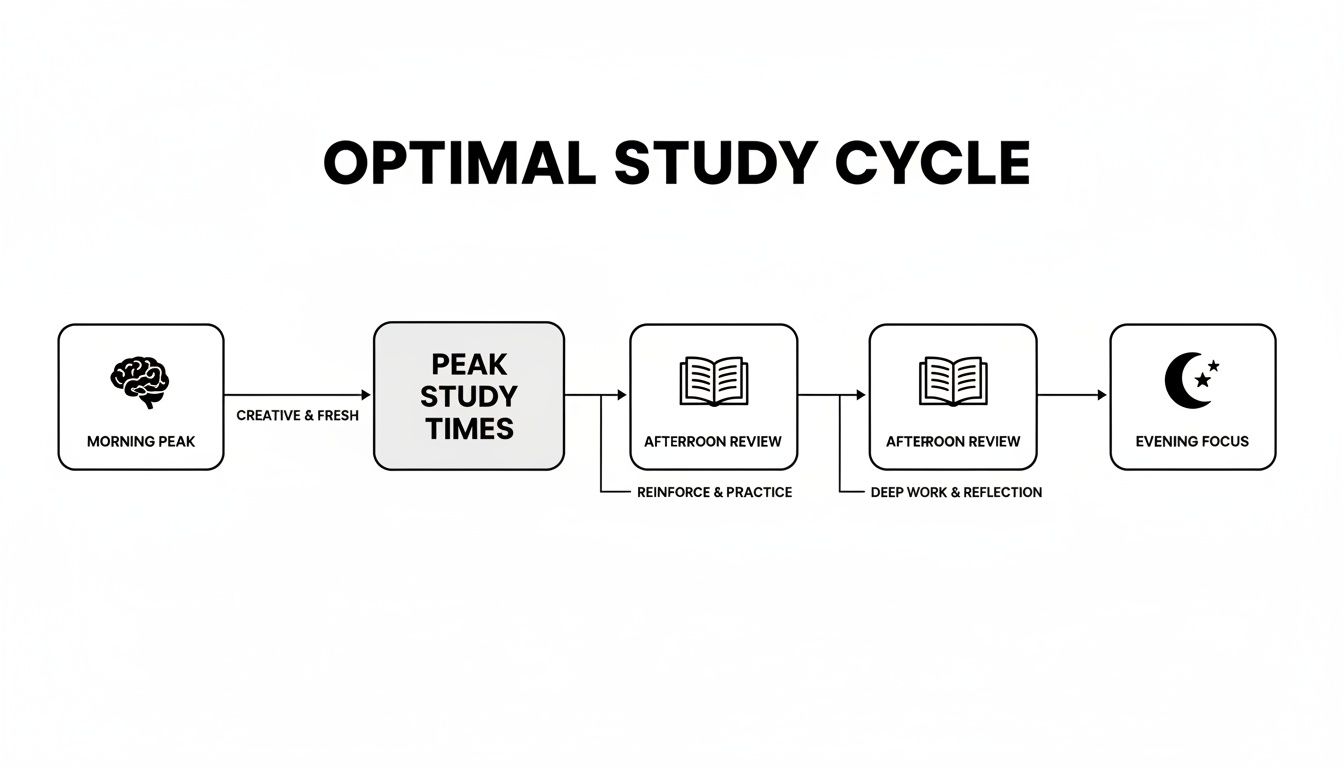
The image shows a smart approach: tackle new, difficult info during your morning peak, use the afternoon for review, and save the evening for creative tasks or lighter work.
Once you know your chronotype, you can stop fighting an uphill battle with your own biology. Instead of forcing an 8 AM cram session when you’re a Wolf, schedule your toughest classes or study blocks for later in the day.
The ultimate study hack isn't some new app—it's understanding your own biology. When you align your study schedule with your chronotype, you absorb more info with way less effort.
Imagine knowing your brain is firing on all cylinders between 8 PM and 11 PM. Instead of wasting that precious time sorting through a semester's worth of messy lecture notes, you could upload them to an AI tool like Vivora. It instantly organizes everything into a clean study guide, letting you spend your peak hours actually learning, not just prepping. A small shift like this makes your best study time even more powerful.
How to Harness Your Peak Brain Power Hour by Hour
Okay, so you’ve got a handle on your chronotype—whether you’re an early-rising Lion, a steady Bear, or a night-loving Wolf. Now it’s time to actually use that insight to build a study schedule that flows with your brain's natural energy, not against it.
Let’s break down the day into three key zones. This isn't about forcing yourself into a rigid timetable; it’s about matching the right kind of thinking to your brain's energy level at that moment.

The Morning Peak for Deep Learning
For most of us (especially Lions and Bears), the brain hits its stride somewhere between 10 AM and 2 PM. You’re fully awake, your focus is sharp, and you’re ready for the heavy lifting.
This is your golden window for "deep work"—the kind of stuff that demands serious, uninterrupted concentration. Don't waste this precious energy on mindless scrolling or organizing your desktop. Instead, put this peak time to good use:
Tackling gnarly calculus problems or physics equations.
Learning a new programming language or a dense scientific theory.
Writing that critical essay or analyzing complex literature.
Beat the Afternoon Slump with Smart Review
We’ve all been there. That post-lunch energy crash where your brain feels like it’s wading through mud. This "afternoon slump," usually hitting between 2 PM and 5 PM, is an absolute killer for learning new, complicated information.
But here’s the secret: it’s perfect for lighter, more passive tasks.
Instead of fighting it with another coffee, lean into it. This is your prime time to review and lock in what you've already learned. Your brain is surprisingly good at consolidating memories during this period, so use it to your advantage.
Pro-Tip: A short nap can supercharge your afternoon session. Studies show that napping for 20-30 minutes can boost memory retention by up to 40%. In fact, students who nap consistently outperform non-nappers by 34% on recall tests. It’s a huge deal when you realize that 47% of students report being sleep-deprived. Get the full scoop on how students can use strategic rest to improve academic performance.
The Evening Focus Zone for Creativity and Catch-Up
As the day winds down, many students—especially Wolves—get a second wind. The evening hours, roughly 6 PM to 9 PM, can be a fantastic time for creative thinking and less intense work. The world gets quieter, distractions fade, and it’s easier to find your flow.
This zone is ideal for tasks like:
Brainstorming ideas for a big project.
Catching up on lecture recordings you missed.
Creating mind maps or visual study guides.
To make these sessions even more powerful, let technology handle the grunt work. Before you settle in for the evening, upload your lecture recordings or slides to an AI tool like Vivora. It can instantly generate an organized study guide and flashcards, letting you spend your entire focus zone actually learning the material instead of just prepping it.
Let an AI Build Your Perfect Study Schedule
So, you’ve figured out your peak study time. Awesome. But knowing when to study and actually having your materials ready to go are two completely different things. Let's be real—organizing a semester's worth of messy notes, slides, and links is a huge pain and a total time suck.
This is where having an AI study partner like Vivora completely changes the game. It handles all the tedious prep work for you.
Instead of wasting your best brainpower just trying to get organized, you can dive straight into what actually matters: learning the material. The whole process is surprisingly simple and saves an incredible amount of time.
From Chaos to Clarity in Minutes
Picture this: You just got back from class. You’re staring at a chaotic pile of lecture slides, half-legible handwritten notes, and a few random YouTube links your prof mentioned. Normally, you’d waste the next hour just trying to stitch it all together into something you can actually study from.
With Vivora, you just dump everything in. Drag and drop your files, paste the links, and let the AI do its thing.
Here’s a look at how Vivora can instantly turn that jumbled mess into a focused, actionable study guide.

The platform instantly sorts through the chaos, pulling out key terms, summarizing big ideas, and generating personalized study guides, flashcards, and even practice quizzes. Everything you need is ready to go in minutes.
Make Your Peak Study Windows Count
This is a massive advantage, especially when it comes to making those peak study windows as efficient as possible. For night owls, this is a lifesaver. Science shows that studying in the evening from 7-9 PM can lead to 25% better comprehension compared to pulling a true all-nighter.
Why? It’s biological. After 9 PM, your brain ramps up melatonin production, which basically kills your focus. One study even found that students who studied at 7 PM scored 22% higher on retention tests than those who started at 10 PM.
Vivora slots perfectly into this productive evening window. Think about this scenario:
You get home, upload that confusing economics lecture video, and by the time you've grabbed a snack, Vivora has already generated a full study guide. Now, you can spend your entire peak energy window actually absorbing the material with an AI chatbot that can answer your questions on the spot.
By automating the prep, you’re not just saving time—you're multiplying the effectiveness of your best study hours. Instead of organizing, you're learning, reviewing, and acing your quizzes. It’s all about working smarter, not harder.
If you're looking for more ways to level up your study game, check out our guide on how to use AI to take better notes and make every single session count.
Matching Your Study Task to Your Energy Level
Okay, let’s be real—not all study tasks are created equal. Trying to write your monster research paper when your brain feels like a fried egg is a guaranteed recipe for staring at a blank screen for two hours.
The secret isn't just finding your best time to study; it's about matching the right task to your brain's current energy level.
Think of your brainpower like a phone battery. You wouldn't try to stream a 4K movie on 5% battery, right? Same idea. You need to save your high-energy, "full battery" moments for the heavy lifting and use the "low power mode" times for easier, more passive tasks. This simple strategy helps you make consistent progress without hitting burnout.
Align Your Tasks With Your Brainpower
When your brain is firing on all cylinders during your peak hours, that’s the time to tackle your most demanding work. This is when you should be diving into tasks that require deep focus, critical thinking, and serious problem-solving.
Conversely, during your natural energy slumps—like that classic afternoon crash—your brain is better suited for low-stakes, repetitive tasks. Trying to learn a complex new topic then is just setting yourself up for frustration.
Don't fight the slump—use it. By aligning your to-do list with your energy, you can turn those typically unproductive hours into valuable time for review and organization, keeping the momentum going all day.
Your Cheat Sheet for Smart Task-Matching
To make this super practical, here’s a quick guide on what to do and when. Think of this as your roadmap to getting the most out of every study session, whether you’re feeling like a genius or just trying to stay awake.
Match Your Task to Your Brain's Energy
Use this guide to align your study activities with your natural energy fluctuations throughout the day for maximum efficiency.
Energy Level | Best Time of Day | Recommended Study Tasks | Vivora Feature to Use |
|---|---|---|---|
High Energy | Your peak window (e.g., 10 AM - 2 PM) | Learning new concepts, solving tough math problems, writing essays, analyzing literature. | Upload new lecture content to generate a fresh study guide and ask the AI chatbot complex questions. |
Medium Energy | Mid-afternoon or early evening | Reviewing lecture notes, active recall practice, outlining a project, working on practice problems. | Take a practice quiz on the topic you studied earlier to see what stuck and identify weak spots. |
Low Energy | Afternoon slump or late evening | Organizing notes, watching lecture recordings, reviewing flashcards, planning your next study session. | Use the auto-generated flashcards for quick, low-effort review. Check out our guide on how to create flashcards that help you remember everything. |
This approach makes your study time way more effective. For example, during a low-energy afternoon, instead of zoning out, you can flip through a quick quiz from Vivora.
It’s the perfect way to keep the information fresh in your mind without completely draining what’s left of your mental battery. You stay productive, reinforce what you've learned, and save your peak energy for the work that truly needs it.
Your Action Plan for Smarter Studying
All this theory is great, but it’s useless if you don't actually do anything with it. So, let's stop guessing and start building a study schedule that actually works for you. This is your no-fluff, step-by-step guide to making that happen.
Your mission is simple: find your rhythm and build a routine around it. This isn't about finding more hours in the day—it's about making your best hours count for more.
The One-Week Energy Audit
First things first, you need some actual data. For the next week, you’re going to be a detective, and your own energy level is the case you need to crack.
Set reminders: Every two hours, from when you wake up until you go to sleep, set an alarm on your phone.
Rate your focus: When the alarm goes off, give your mental energy a quick rating on a scale of 1-10. A "1" is "I can barely keep my eyes open," and a "10" is "I could solve world hunger right now."
Spot the patterns: After a week, look at your ratings. You’ll start to see clear peaks and valleys. That, right there, is your personal productivity roadmap.
Once you’ve nailed down your peak windows, your next job is to protect them like they’re the last slice of pizza. This is your prime time for deep, focused work—not for scrolling through TikTok.
During your high-energy hours, turn off notifications, close extra tabs, and let your friends know you’re going dark for a bit. Treat your focus as your most valuable asset, because when it comes to studying, it is.
Finally, you need the right tools to squeeze every bit of value out of those precious peak hours. Instead of blowing the first 20 minutes trying to organize messy notes, let an AI tool handle the grunt work.
With Vivora, you just upload all your class materials—slides, notes, videos, you name it—and get a clean, organized study guide in seconds. This means you can spend your entire peak window actually learning and reviewing. Check out our deep dive into using AI-powered study guide strategies to see how much time you can claw back. By automating the prep, you get to dedicate your best brainpower to what actually matters.
A Few More Questions You Might Have
Still trying to figure out the perfect routine? Let's clear up some of the most common questions students have when trying to lock in their ideal study schedule.
Does the Best Time to Study Change by Subject?
Totally. Think of it like a workout. You wouldn't try to max out your deadlift at the end of a long, tiring day, right? The same logic applies to your brain.
Your peak mental hours—usually that sweet spot in the late morning—are perfect for the heavy lifting. This is when you should tackle subjects that demand intense focus, like working through complex math problems or digging into dense scientific theories.
Save the less demanding tasks for your lower-energy periods. Things like brainstorming an essay outline, reviewing history notes, or making flashcards are a great fit for the late afternoon or evening when your creative brain is often more active, even if your analytical power is winding down.
How Long Should a Study Session Be?
Forget those endless, soul-crushing library marathons. Your brain just wasn't built for that. The real magic happens in focused bursts, not long slogs.
This is where the Pomodoro Technique is a game-changer. It's simple: study with intense focus for 25 minutes, then take a 5-minute break (and actually get up and walk away from your desk). After four of these cycles, take a longer break of 15-30 minutes.
This method keeps your mind fresh, prevents burnout, and helps you actually retain what you’re studying.
What if My Schedule Is Just Chaos?
Let’s be real—sometimes a perfectly structured schedule is a fantasy. Classes, work, and life in general love to mess up the best-laid plans.
When your schedule is unpredictable, your focus needs to shift from when you study to how efficiently you study. Instead of wasting precious minutes trying to figure out what to even look at, you can use a tool like Vivora to do the heavy lifting for you.
Just upload your lecture notes, slides, or even video recordings. It instantly organizes everything into coherent study guides and quizzes. That way, even a random 30-minute gap between classes can become a surprisingly productive review session. You’re making the most of whatever scraps of time you can find.
Stop letting disorganized notes dictate your study schedule. Vivora turns your chaotic class content into personalized study guides in seconds, so you can study smarter, not harder. Try Vivora for free and get organized today.