
How to Actually Stay Focused While Studying (For Real This Time)
Jan 27, 2026
Learning how to stay focused while studying isn't about having superhuman willpower. It’s about building a solid system so you're not just gritting your teeth and trying harder. The real move is to create a distraction-free bubble, manage your time like a pro, and actually engage with your material instead of just letting your eyes glaze over it. The secret is to organize the chaos first so your brain can finally get down to business.
Why Is It So Hard to Actually Study?
Ever sit down to cram for a huge exam, and suddenly, the urge to organize your Spotify playlists by obscure micro-genres becomes overwhelming? You're not alone. It can feel like your brain is actively sabotaging you—and low-key, it kind of is.
Our brains simply weren’t designed for the constant waterfall of notifications, pings, and infinite scrolls that make up modern life. Every buzz from your phone is a tiny little dopamine hit, which makes that dense textbook chapter seem even more like a punishment. This isn't a you problem; it's you fighting against an entire environment engineered to hijack your attention.
The Real Enemy is Chaos
Beyond the TikTok pings, the bigger issue is usually information chaos. Think about it: your professor posts lecture slides on one portal, assigns readings from a separate PDF, and casually mentions a must-watch YouTube video in class. Before you even start learning, you're basically on a digital scavenger hunt.
This disorganization creates a ton of mental friction. Your brain burns through precious energy just trying to piece everything together, leaving you feeling drained before you’ve even reviewed the first concept. This is the exact point where most of us get stuck and just give up for the day.
The struggle to focus isn't about a lack of willpower. It's a symptom of a disorganized study system. When your materials are a mess, your mind follows.
The good news? Focus isn't some superpower you're born with. It's a skill, and like any skill, you can build it by creating a better system. By taming the chaos first, you free up the mental bandwidth to do what actually matters—learning.
This is exactly where a tool like Vivora comes in clutch. It’s built to solve this specific problem, taking all your scattered class content and magically transforming it into a single, organized study guide.
Instead of fighting your own brain, you can give it a clear, straightforward path. This simple shift can turn an overwhelming task into something completely manageable, setting you up for deep, effective study sessions that actually work.
Build a Distraction-Proof Study Zone
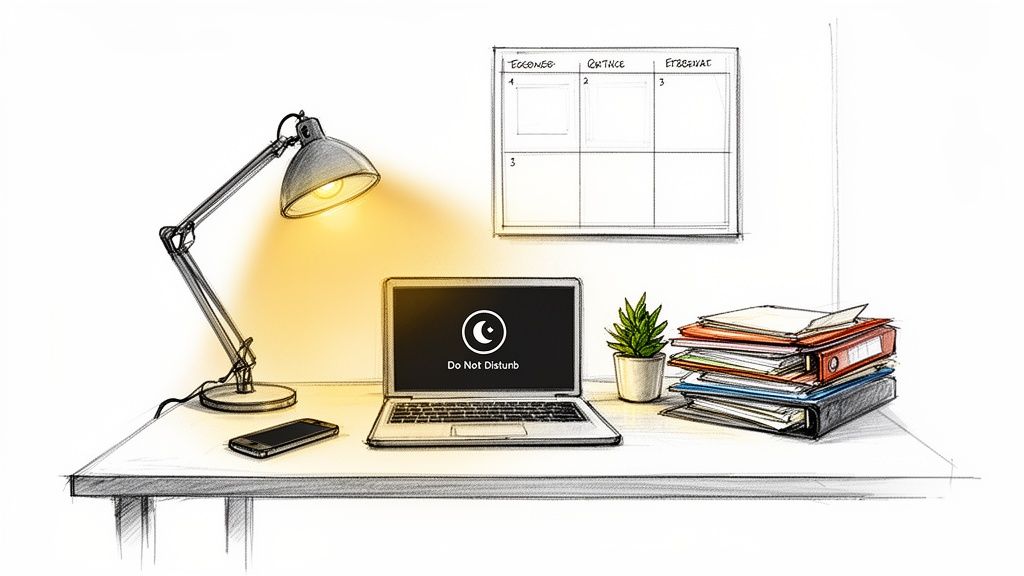
Your study space can be your greatest ally or your biggest enemy. We all know the generic advice to "find a quiet spot," but creating a truly distraction-proof zone is about much more than that. It’s about intentionally designing your physical and digital worlds to send a clear signal to your brain: it's time to focus.
When your environment is engineered for success, you stop wasting precious mental energy fighting off distractions and can pour all that energy into what actually matters—learning.
Design Your Physical Sanctuary
Think of your desk as the command center for your brain. It picks up on environmental cues, so a desk cluttered with last night's snack wrappers and random junk sends a very different message than one that's clean, organized, and ready for work. You don't need a fancy setup, just an intentional one.
Lighting is Key: Trying to study in a dim room is a recipe for eye strain and drowsiness. If you can, position your desk near a window for natural light. If not, a good desk lamp is a non-negotiable for keeping your mind bright and alert.
Comfort Matters: You can't enter a state of deep focus if your back is aching or your neck is stiff. An uncomfortable chair or a desk at the wrong height will constantly pull your attention away from your work. Make small adjustments until it feels right to sit there for a while.
One Desk, One Purpose: This is a big one. If at all possible, try to use your desk only for studying. When you mix your study space with watching Netflix or scrolling TikTok, your brain gets confused about what it's supposed to do there. Create a clear association: this desk is for work.
Lock Down Your Digital Space
Let's be real: digital distractions are the silent killer of productivity. Your smartphone alone can steal an average of 2.5 hours daily from your study sessions. The goal here isn't to pretend technology doesn't exist, but to make it work for you instead of against you.
Modern tools can amplify your focus by centralizing everything you need. For example, a platform like Vivora lets you organize an entire semester's worth of lecture notes, PDFs, and relevant videos in one place. Its AI can then generate tailored study materials or act as a chatbot to answer questions, keeping you on-task within a single ecosystem.
The simple trick is to create friction for distractions. Make 'Do Not Disturb' your default mode on every device before you start a session. Use browser extensions that block time-wasting websites for set periods. These small barriers are surprisingly effective at breaking the habit of mindless clicking. For more on this, check out our guide on using AI study tools to beat distraction.
Prioritize Like a Pro With the Eisenhower Matrix
Okay, your space is set up. Now, what do you actually work on? Feeling overwhelmed by a massive to-do list is another huge focus-killer. This is where the Eisenhower Matrix comes in—it’s a brilliantly simple framework for sorting your tasks so you know exactly what deserves your attention right now.
The Eisenhower Matrix splits tasks into four quadrants based on urgency and importance. This helps you move from reacting to every little thing to proactively focusing on what truly moves the needle on your grades.
Here’s the breakdown:
Urgent & Important (Do First): These are the tasks with immediate, serious consequences. Think: finishing that essay due tomorrow morning or cramming for a midterm that's just two days away.
Not Urgent & Important (Schedule): This is where real, meaningful progress happens. These are the activities that lead to long-term success, like reviewing lecture notes from the week, starting research for a big project due next month, or outlining a paper ahead of time.
Urgent & Not Important (Delegate): These are the distractions that masquerade as work. They feel pressing but don't actually contribute to your core goals. This could be responding to a non-critical group chat message or handling a minor administrative task that could wait.
Not Urgent & Not Important (Delete): This is the stuff you just shouldn't be doing when you need to study. Mindlessly scrolling through social media or binge-watching a new series falls squarely into this quadrant. Be ruthless here.
Use Time Management That Actually Works
Okay, your study space is dialed in, but that huge exam is still breathing down your neck and your motivation has packed its bags. Staring at a massive to-do list is a guaranteed recipe for overwhelm, making it way too easy to just throw in the towel.
The answer isn't some rigid, soul-crushing schedule. It’s about finding a rhythm that tricks your brain into focusing. Smart time management isn't about forcing yourself into a miserable eight-hour library session; it's about breaking things down into a series of small, manageable wins. This approach builds momentum and makes those marathon study days feel way less impossible.
Master the Pomodoro Technique
You've probably heard of the Pomodoro Technique, and for good reason—it’s legendary among students. It's a ridiculously simple but powerful method for fighting off burnout and staying sharp.
You just study in a focused, 25-minute sprint, then take a short 5-minute break. After four of these "pomodoros," you reward yourself with a longer break of 15-30 minutes.
This system works because it turns a huge, vague task (like "study for biology") into a small, concrete goal ("do one 25-minute focus session"). Knowing a break is always just around the corner makes it so much easier to resist the siren song of your phone. It’s especially clutch for students feeling the heat. According to the Chegg.org Global Student Survey 2023, 56% of students feel stressed and 57% feel overwhelmed—feelings that absolutely crush concentration. The Pomodoro Technique is proven to cut through that anxiety and boost focus.
Try Task Batching for Peak Efficiency
Another total game-changer is task batching. This is where you group similar study tasks together and knock them all out in one dedicated power session. Your brain hates constantly shifting gears between different kinds of thinking, and batching keeps you locked in the zone.
For instance, instead of bouncing all over the place, create themed study blocks:
Flashcard Frenzy: Dedicate one session just to creating and reviewing flashcards for all your classes.
Reading Block: Set aside another block to power through all your assigned PDF readings for the week.
Practice Problem Power Hour: Use another session to work through every single math or chemistry problem you have due.
When you switch between writing an essay, reading a textbook, and solving equations, your brain wastes a ton of energy just trying to transition. Batching keeps you in a state of flow, making your study time way more effective.
Time Management Techniques That Don't Suck
Still on the fence? Here’s a quick comparison of these two science-backed methods to help you decide which one fits your study style.
Technique | Best For | How It Works |
|---|---|---|
Pomodoro Technique | Students who get easily distracted or feel overwhelmed by large projects. | Short, timed intervals (e.g., 25 min) of intense focus, followed by a short break. Builds momentum. |
Task Batching | Students juggling multiple subjects or different types of assignments. | Grouping similar tasks (e.g., all readings, all problem sets) into one dedicated block of time to maintain focus. |
Both methods are fantastic, but they solve slightly different problems. The key is to experiment and see which rhythm helps you get the most done with the least amount of stress.
This is where a tool like Vivora really shines. You can upload all your course materials—lecture slides, PDFs, video links—and Vivora’s AI instantly generates flashcards and practice quizzes. This lets you seamlessly batch your active recall sessions without burning hours creating the materials yourself. It’s all about working smarter, not just harder.
Learn How to Study Smarter With Active Recall
Let's be honest, just rereading your notes is one of the worst ways to study. Seriously. That feeling of productivity you get from highlighting half a textbook is a total illusion. It’s a classic passive learning trap, where information flows in one ear and right out the other.
If you really want to learn how to stay focused while studying—and actually make the material stick—you have to get your brain in the game. It’s all about shifting to "active learning."
This is where two of the most powerful study techniques come into play: active recall and spaced repetition.
Stop Rereading and Start Recalling
Active recall is pretty much what it sounds like: you actively pull information out of your memory instead of just looking at it. Instead of passively reviewing a concept, you force your brain to retrieve it. It's this mental effort that builds and reinforces the neural pathways, making the memory stronger.
Think of it like lifting weights. The struggle is what makes the muscle grow.
This simple change from passive to active is massive. It's the difference between vaguely recognizing a term on the page and being able to explain it from scratch when your exam is sitting in front of you.
Here’s a simple way to visualize how it works.
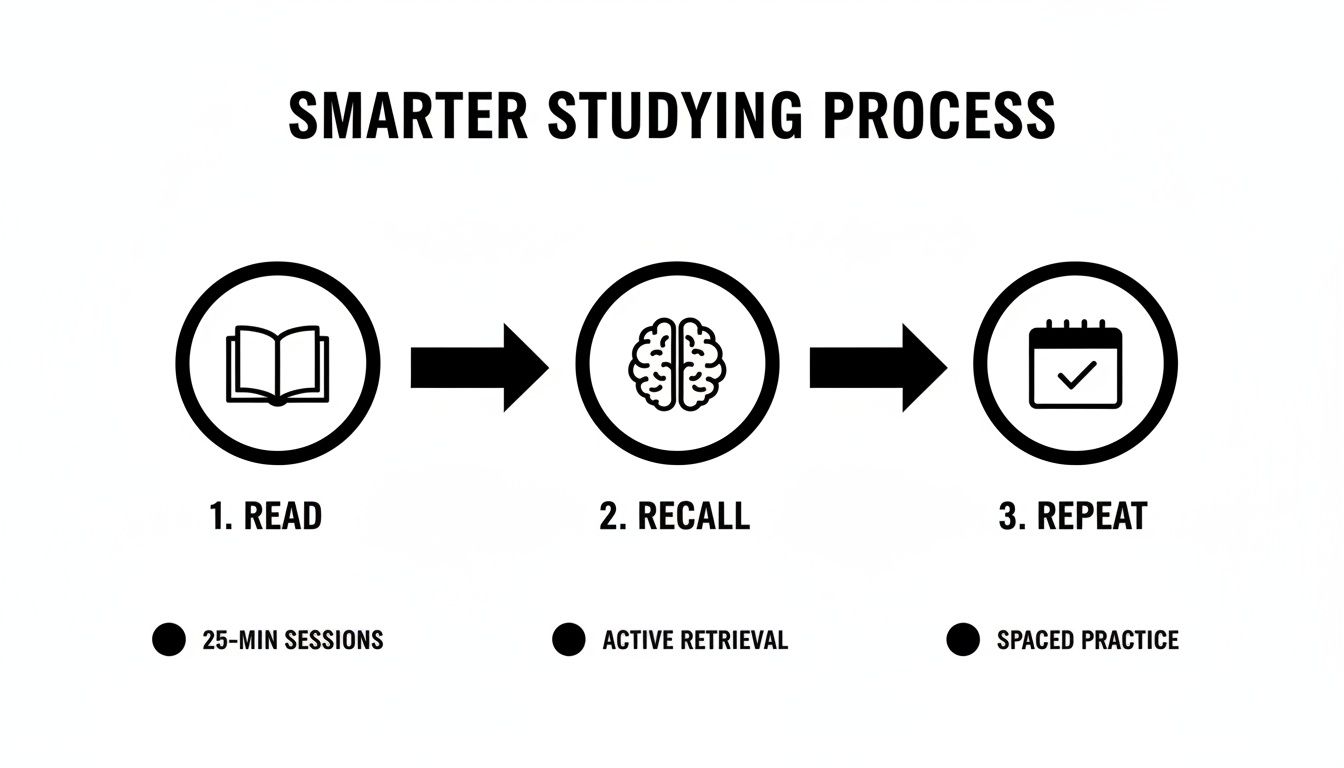
As you can see, real learning isn't a one-and-done deal. It’s a cycle of reading, actively pulling that information out of your head, and then repeating the process over time.
Make Active Recall Effortless
Okay, so active recall is great. But who has the time to manually turn every single page of notes into a practice quiz or a stack of flashcards? It's a huge time sink. The entire point is to spend your precious focus time actually learning, not just prepping your materials.
This is where a smart tool can completely change the game. With Vivora, you just upload all your messy class materials—lecture slides, PDFs, even video links—and its AI instantly transforms them into practice quizzes and flashcards for you.
By automatically creating quizzes and flashcards from your actual course content, you eliminate the friction of getting started with active recall. You go from disorganized notes to a powerful study session in minutes.
Imagine turning your last lecture into a pop quiz with a single click. The hour you would have spent making flashcards can now be spent mastering the concepts on them. You can learn more about how to create flashcards that help you remember everything in our detailed guide.
Combine Recall With Spaced Repetition
Active recall gets even more powerful when you pair it with spaced repetition. This is a simple but brilliant idea: review information at increasing intervals over time. You’ll hit the concepts you struggle with more often, while the stuff you know gets reviewed less frequently.
Here’s what that might look like in practice:
Day 1: Learn a new concept and test yourself with flashcards.
Day 2: Review only the cards you got wrong.
Day 4: Review all the cards from Day 1 again.
Day 7: Go through them one more time.
This strategic spacing directly fights the "forgetting curve," which is just a fancy term for your brain's natural tendency to dump information over time. By spacing out your reviews, you're sending a strong signal to your brain: "Hey, this stuff is important. Keep it."
The Vivora Workflow: From Chaos to Clarity
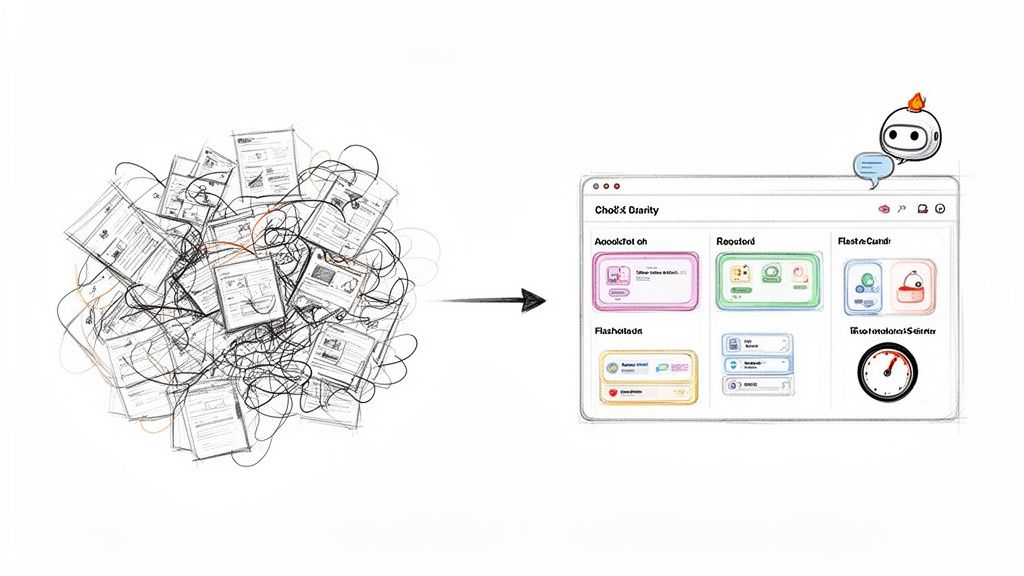
Alright, we've talked a lot about the why and the how of focus. Now, let's get practical. Let's see how all these pieces—organization, active recall, time management—snap together into a single, powerful system.
Because knowing how to study is one thing. Actually doing it without burning half your energy on prep work is another game entirely.
Think about your last big study session. Was your desktop a graveyard of vaguely named PDFs? Did you have five YouTube links saved somewhere, lecture slides buried in your university’s clunky portal, and a bunch of photos of handwritten notes lost in your camera roll? Just finding everything you need is exhausting before you’ve even started.
This is where you stop the digital scavenger hunt.
Bring Everything Together
Your first move is to dump all that scattered material into one central hub. Seriously, everything. Stop trying to remember which folder holds which reading. A tool like Vivora is built for exactly this.
Just upload it all:
Lecture slides and typed notes (PDFs, PowerPoints)
Textbook chapters and required readings
Links to those YouTube videos that finally made a concept click
Photos of your handwritten notes from class
The goal is to create a single source of truth for each subject. Once your brain knows everything is in one place, it can stop juggling and finally get down to the real work of learning.
Let the AI Do the Heavy Lifting
Here’s where the magic happens. Once everything is uploaded, the AI gets to work. It doesn't just store your files; it reads, analyzes, and actually understands your course content.
And then, it automatically generates the tools you need for active recall.
This means you get instant flashcards and practice quizzes built from your actual class materials—not generic ones from the internet. The hour you used to waste meticulously writing out flashcards by hand? You just got that hour back. You can jump straight into the most effective study methods we've been talking about.
Launch a Truly Focused Session
Now you’re ready to get in the zone. Here’s what it looks like in practice:
Start your timer. Kick off a 25-minute Pomodoro session.
Engage with AI-generated tools. Dive into the flashcards or take a practice quiz on the topic you’ve chosen.
Get instant answers. Hit a tricky concept? Don't break your focus by opening a new browser tab and falling down a Google rabbit hole. Just ask the built-in AI chatbot. It uses your own course materials to give you a clear, relevant explanation right then and there.
This entire workflow is designed to keep you in a single, distraction-free environment. By eliminating the need to search for materials or get lost online, you protect your attention and make every single minute count.
When the timer rings, take your 5-minute break. Then dive back in. This system isn't just about having organized notes; it’s about creating a powerful, streamlined process that combines a chaos-free environment with proven learning techniques. This is how you build a rock-solid framework for focus.
A Few Common Questions About Staying Focused
Alright, we’ve covered a lot of ground. But if you’re still wrestling with how to lock in and focus while studying, you’re in the right place. Let's tackle some of the most common questions that come up when it's time to get stuff done.
What if I Have a Really Short Attention Span?
First off, you’re not alone. Our brains are being constantly rewired by an endless scroll of short-form content, which can make a long study session feel like climbing Mount Everest. The trick is to work with your attention span, not fight against it.
Start with the Pomodoro Technique but shrink the intervals down. Seriously, try a 15-minute focus block followed by a quick 3-minute break. The goal isn’t to force yourself into a two-hour marathon right away. It's about building momentum with small, achievable wins. Over time, you can slowly stretch those focus periods as your brain gets more comfortable with sustained effort.
Is It Okay to Listen to Music While I Study?
This is the classic debate, isn't it? The real answer is: it depends entirely on you. For some people, music with lyrics is the ultimate distraction, pulling their focus away from the material. But for others, the right kind of audio can be a total game-changer for drowning out background noise.
Try instrumental music: Think lo-fi hip-hop beats, classical music, or even ambient soundscapes. Anything without words.
Avoid your favorite songs: You’ll just be tempted to sing along instead of absorbing that chemistry chapter. It's a trap!
Use it strategically: Music can be great for more repetitive, low-concentration tasks like making flashcards, but you'll probably want pure silence for deep reading and comprehension.
How Can I Stop Procrastinating When I Feel Overwhelmed?
Procrastination isn't just laziness; it's often a direct symptom of feeling completely overwhelmed. When an assignment feels too massive, our brains just sort of shut down. The best way to fight back is to break the task down into ridiculously small, almost laughable steps.
Don't just put "Write History Paper" on your to-do list. That's a recipe for disaster. Instead, break it into tiny, non-threatening tasks like these:
Open a new Google Doc and just write the title.
Find one academic source.
Write only the topic sentence for the first paragraph.
Each tiny step you complete builds a little bit of momentum and makes the next one feel that much easier. If you still have more questions, feel free to check out our full FAQ page for more answers.
Feeling overwhelmed is a sign to shrink the task, not to quit. Break it down until the next step feels so easy you can’t say no.
This is also where a tool that organizes your work for you can be a lifesaver. When your entire semester’s worth of materials is a chaotic mess of files and folders, just figuring out where to start is the hardest part. Vivora helps you organize it all, turning that chaos into a clear path forward.
Ready to stop fighting for focus and start studying smarter? Vivora transforms your scattered class materials into organized, personalized study guides with AI-powered flashcards and quizzes. Start your free trial today and see how easy it is to get in the zone.