What Is Elaborative Rehearsal And How Can It Transform Your Studying?
Jan 28, 2026
Elaborative rehearsal is just a fancy term for making new info actually stick by connecting it to stuff you already know. So instead of repeating a fact over and over until you’re totally zoned out, you link it to a personal experience, a memory from high school, or even that one viral TikTok sound.
This simple act of making a connection gives the information meaning, which is the secret to moving it from your short-term "cram session" memory into long-term storage where it’ll stay for the actual exam.
The Real Reason You Forget Everything After An Exam
We've all been there. You spend hours highlighting, rereading notes, and staring at a textbook until your eyes glaze over. You feel like you've got it down, but the second you sit down for the exam, your brain goes blank. Poof. All that information you crammed in? Gone.
The problem isn't that you're bad at studying. The problem is you're probably using the wrong method.
This is where understanding elaborative rehearsal becomes a total game-changer for your grades and your sanity. Don't let the dry, academic-sounding name fool you. Think of it as the ultimate study hack that works with your brain, not against it. It's the difference between mindlessly chanting facts and actually making them part of your mental world.
Making Your Memories Stick
At its core, elaborative rehearsal is all about creating meaningful connections. So, instead of just memorizing a definition from a lecture slide, you actively process it by asking yourself a few simple questions:
How does this connect to something I learned in another class?
Can I think of a real-world example of this from my own life?
How would I explain this to a friend who has no clue what this is?
This active engagement makes information way more memorable than passively rereading it for the tenth time. And the research backs this up, big time. One study found that the quality of students' elaborative rehearsals accounted for an incredible 90% of the difference in their exam scores. You can read the full research on how rehearsal quality impacts performance.
Elaborative rehearsal is like giving new information a network of friends inside your brain. A lonely fact is easy to forget. But a fact connected to a personal story, a funny analogy, or a scene from your favorite show? It has a support system that keeps it from getting lost.
This approach is a lifesaver when you're drowning in a sea of dense PDFs and endless lecture recordings. It gives you a clear path to turn that chaotic mess of information into knowledge that actually sticks.
And when you have a tool like Vivora that can instantly transform your scattered notes into organized study guides, you’re already one step ahead. It sets the stage perfectly for a smarter, faster, and much less stressful study routine.
Why Rereading Your Notes Is A Waste Of Time
We’ve all been there. You spend hours highlighting an entire textbook chapter, turning the page into a sea of neon yellow, only to realize you’ve learned absolutely nothing. You stare at the words, but your brain feels completely empty.
If this sounds painfully familiar, you’re not alone. This frustrating cycle is the result of a study technique called maintenance rehearsal.
Think of it as the academic equivalent of running on a treadmill. You’re putting in the work, but you’re not actually going anywhere. It’s the low-effort trick you use to hold information in your brain for a few seconds, like repeating a phone number over and over just long enough to dial it. A minute later? It’s gone.
That’s exactly what happens when you just reread your notes. You’re keeping the information on life support, but you’re not giving it a permanent home in your long-term memory. It's a fast track to all-night cram sessions and burnout.
The A-Student Method For Real Learning
So, what's the alternative? Let's talk about elaborative rehearsal. This is the deep processing method that actually builds lasting knowledge. It’s not about repetition; it’s all about connection.
Here’s an analogy: maintenance rehearsal is like saving a random file to your already chaotic desktop. Sure, it’s there somewhere, but good luck finding it later.
Elaborative rehearsal, on the other hand, is like creating a new, clearly labeled folder for that file, adding relevant tags so you can search for it, and even creating a desktop shortcut for instant access. You’re not just saving the information; you’re organizing it in a way that makes sense to you.
This simple concept map shows how elaborative rehearsal forges strong connections, creating memories that are genuinely sticky.
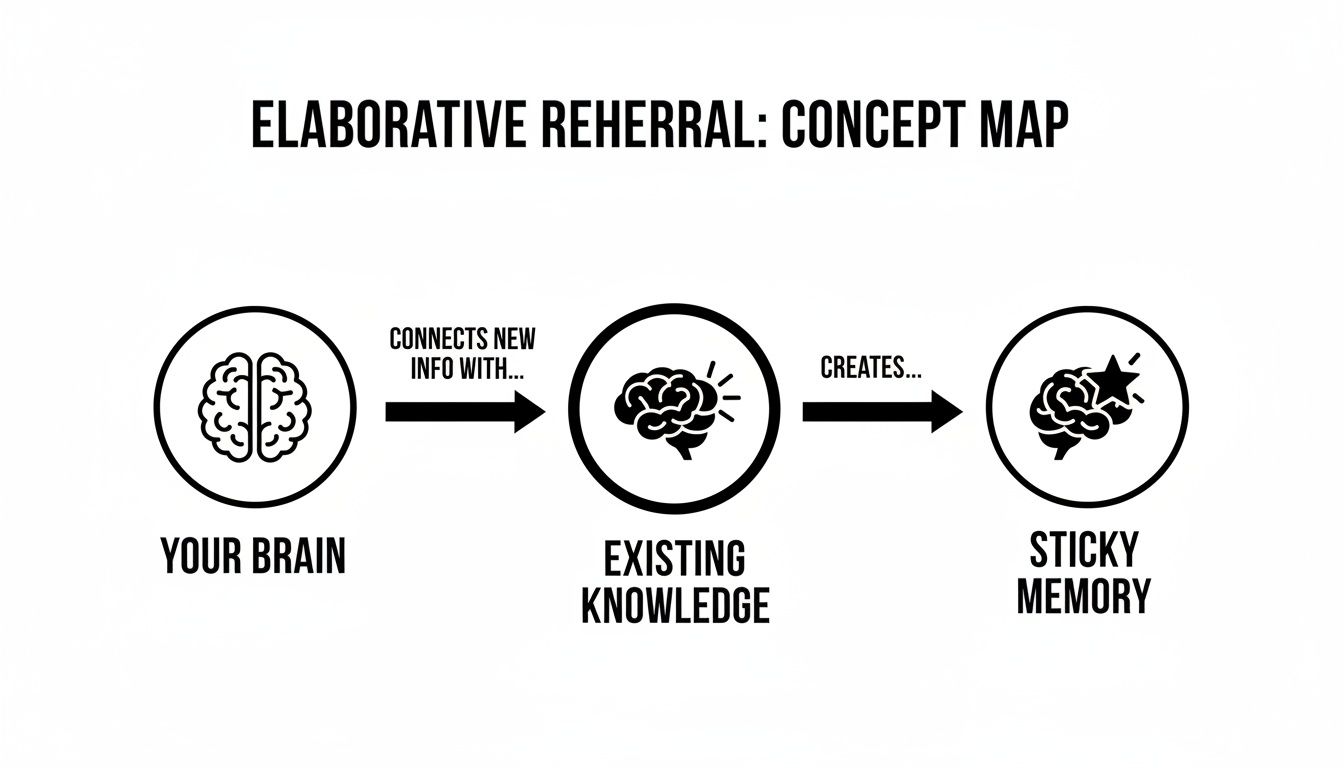
The big takeaway here is that memory isn't about brute force. It's about intelligently linking new concepts to the knowledge that's already wired into your brain.
When you simply repeat information, you're treating your brain like a temporary storage drive. When you elaborate, you're treating it like an intelligent network, building strong, lasting connections between new and old knowledge.
This is the fundamental difference between cramming for an exam and genuinely understanding the material. One path leads to stress and forgotten facts. The other leads to less anxiety, better grades, and knowledge that actually sticks around for the long haul.
Maintenance Rehearsal vs Elaborative Rehearsal
Choosing the right rehearsal method is crucial for effective studying and long-term memory. This quick comparison breaks down why one approach leads to cramming while the other leads to genuine understanding.
Feature | Maintenance Rehearsal (The Crammer's Method) | Elaborative Rehearsal (The A-Student's Method) |
|---|---|---|
Primary Goal | Hold info in short-term memory | Move info to long-term memory |
Cognitive Effort | Low (passive repetition) | High (active connection-making) |
Technique | Rereading, repeating out loud | Asking "why," making analogies, self-explaining |
Memory Duration | Very short (seconds to minutes) | Very long (days, weeks, or even years) |
Best For | Remembering a phone number to dial it | Deeply understanding course material for an exam |
Typical Outcome | Information is quickly forgotten after use | Information is integrated with existing knowledge |
As you can see, the methods aren't even in the same league. For any learning that actually matters, elaborative rehearsal is the only way to go.
The best part? You don't have to build these connections from scratch. An AI study guide with smart strategies can do a lot of the heavy lifting. A tool like Vivora transforms your class content into personalized study guides that prompt you to make these critical connections, saving you hours of wasted effort.
The Brain Science Behind Effective Memory
Alright, let's get into the why of it all. What makes elaborative rehearsal so powerful? It’s not some random study hack; it’s a technique based on how your brain is literally built to learn. When you use it, you're not just memorizing—you're physically rewiring your brain.
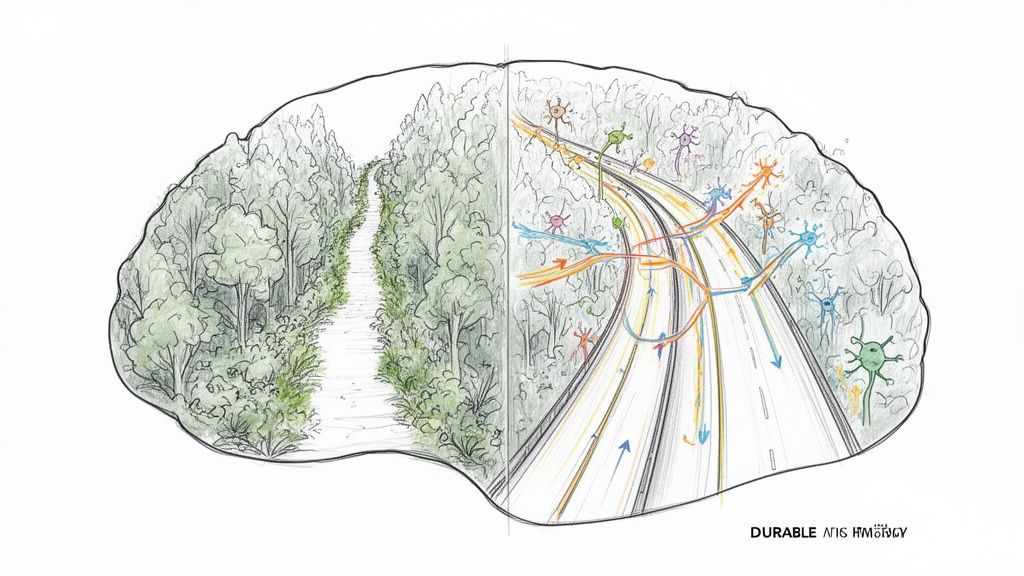
Think of your brain like a dense forest. When you just repeat a fact over and over (that’s maintenance rehearsal), you’re stomping down a flimsy little trail. It’s weak, easily overgrown, and good luck finding it again when you’re stressed out during an exam.
From Fragile Trail To Neural Highway
Elaborative rehearsal, on the other hand, is like bringing in a construction crew to build a multi-lane highway. You're not just walking the path; you're paving it, putting up guardrails, and adding exit ramps.
Every time you connect a new idea to something you already know—a personal memory, another topic from a different class, or even a weird TikTok trend—you're reinforcing that neural pathway. This process physically strengthens the connections between your brain cells. The more links you build around a single concept, the more ways your brain has to find that information later.
You’re basically moving that knowledge out of your brain’s temporary holding area (your short-term memory) and giving it a permanent, well-cataloged spot in the vast library of your long-term memory.
This isn't just a metaphor. Brain scans show this process in action. Deep processing lights up different, more complex regions of your brain than simple repetition. You’re building a rich, interconnected web of knowledge, not just a single, fragile trail.
This is absolutely clutch for the kind of complex topics you see in college or AP classes. Simply memorizing the definition of "mitochondria" is pretty useless. But connecting it to its role as the "powerhouse of the cell," and then linking that idea to how your phone battery works? Now you've got a memory that's built to last.
The Science Of Deep Processing
Brain imaging studies back this up—elaborative rehearsal isn't just a feeling of deeper learning, it's a measurable neurological event.
For instance, a 2021 EEG study found that this exact technique changes your brainwave patterns. When participants engaged in deep processing, researchers saw a spike in activity in the left anterior temporal lobe—a brain region tied to understanding meaning. That spike directly correlated with better performance on memory tests later. You can get the full story on how your brain lights up during deep learning.
This is where a tool like Vivora becomes a secret weapon. It’s designed from the ground up to prompt this kind of deep thinking. Instead of just spitting facts back at you, its AI-generated quizzes and flashcards ask questions that force you to forge those critical connections. It helps you build that neural highway network automatically, turning study time into brain-rewiring time.
Practical Ways To Use Elaborative Rehearsal Today
Okay, enough of the brain science. Let's get into the good stuff—how you can actually use elaborative rehearsal to make studying less of a grind, starting right now. These aren't complicated, time-sucking strategies; they're quick, practical methods you can fold into any study session today.
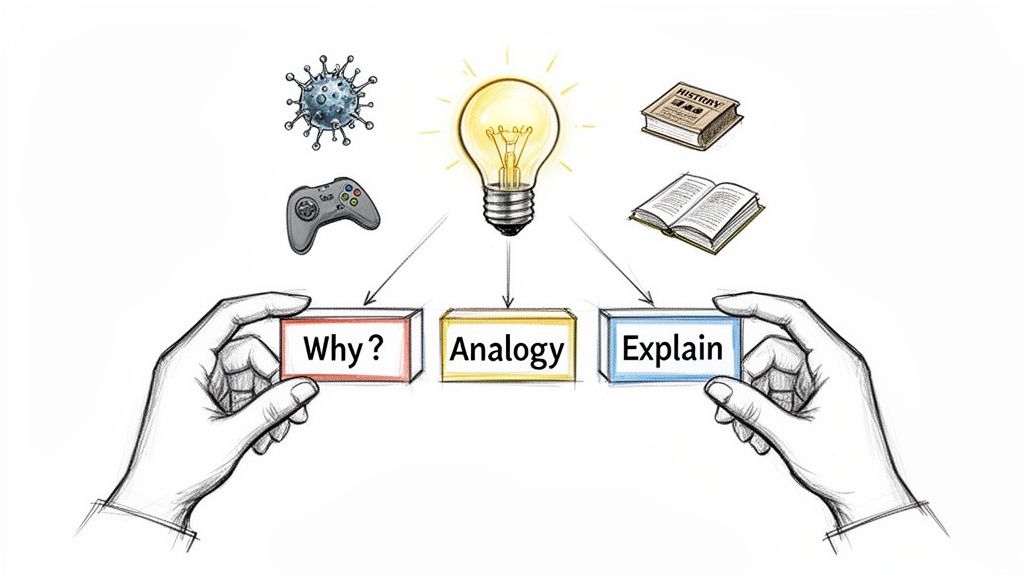
The best part? These techniques feel way more natural than just rereading your textbook for the fifth time. You're just getting curious and connecting the dots, which is exactly how your brain is wired to learn in the first place.
Master the "Why" Method
This is probably the easiest way to start. For any new concept you run into, just get in the habit of asking yourself: "Why does this work this way?" or "Why is this even important?"
That simple question forces you to go beyond a surface-level definition and find the real logic underneath. Instead of just memorizing that the American Revolution started in 1775, ask why it started. Thinking about "taxation without representation" instantly links the date to a cause, making it way more memorable.
Create Your Own Weird Analogies
Analogies are your secret weapon for making abstract ideas feel concrete and real. The goal isn't to come up with a perfect, textbook-ready comparison. It's to create one that makes sense to you—and honestly, the weirder and more personal, the better.
Biology: Is the Krebs cycle a total mystery? Picture it as a complex crafting recipe in a video game, where you have to put in specific ingredients to build a final, energy-packed item.
Chemistry: Trying to remember ionic vs. covalent bonds? Think of an ionic bond like that one friend who just straight-up steals your fries (transfers an electron). A covalent bond is more like two friends agreeing to share an appetizer (sharing electrons).
This isn't just a random study hack; it's grounded in decades of cognitive science. The idea grew from the 'levels-of-processing' framework of the 1970s, which proved that the deeper you process information by connecting it to what you already know, the stronger the memory becomes.
Explain It To Someone Else (Even If They're Imaginary)
Ever noticed that you finally get a topic right after you explain it to a friend? That's the self-explanation effect in action, and it’s a super powerful form of elaborative rehearsal.
You don't even need a real person. Grab a stuffed animal, talk to your dog, or just explain the concept out loud to an empty room. The simple act of organizing your thoughts to teach someone else forces you to find the holes in your own understanding and simplify complex ideas into your own words.
Pro Tip: Try recording yourself explaining a topic on your phone. When you listen back, you'll immediately hear where you sound confident and where you start to waffle. That's where you need to study more.
Let AI Do The Heavy Lifting For You
Look, coming up with deep, meaningful questions on the fly is tough, especially when you're tired and facing a mountain of material. This is where a tool like Vivora becomes your ultimate study partner.
Vivora's AI is built on the exact principles of elaborative rehearsal. When you upload your lecture notes or slides, it doesn't just spit out basic definition flashcards. It generates smart, thought-provoking questions designed to make you think.
Instead of asking, "What is the Treaty of Versailles?" it might ask, "How did the terms of the Treaty of Versailles create the conditions for WWII?" This forces you to make those crucial connections between different historical events. It’s like having a tutor who knows exactly what to ask to make the information stick for good.
Turn Your Scattered Notes Into A Smart Study Guide
Let's be real—your study materials are probably a mess. You've got class notes in a random Google Doc, the professor's lecture slides are buried in some forgotten folder, and that one perfect YouTube video explaining a key concept is lost forever in your watch history. It’s a chaotic system that makes studying feel ten times harder than it should.
This is the exact problem we built Vivora to solve. It’s the answer to the scattered, disorganized reality of being a student. You can finally stop the endless searching and scrolling and just focus on learning.
Get Your Life Organized in Minutes
Imagine taking all that chaos—your Docs, PDFs, PowerPoints, and video links—and just dropping it all into one place. With Vivora, that’s exactly what you do. Our AI instantly gets to work, pulling everything together and generating a clean, personalized study guide from all your different materials.
Here’s a quick look at how Vivora transforms your jumbled files into a single, streamlined dashboard, saving you hours of painful prep time.
What you're seeing is the end of digital clutter. It's all your course content, finally in one place, turned into a smart, actionable study plan.
Smart Tools Built on Brain Science
But Vivora doesn't just organize your notes; it makes them smarter. The platform's flashcards, quizzes, and AI chatbot are all built on the core principles of elaborative rehearsal. We know from experience that just memorizing definitions is a complete waste of your time.
That's why our AI doesn't just spit out the answer. It asks you probing questions that force you to connect ideas, apply what you know, and actually think critically about the material.
Vivora's AI acts like a personal tutor in your pocket. Instead of just asking, "What is this?" it asks, "How does this concept relate to that one?" or "Why is this important in the bigger picture?" This is what pushes you to form the strong neural connections that make memories stick.
This approach is how you finally break the cycle of cramming and forgetting. By prompting you to engage deeply with the material, Vivora helps you study smarter, not just harder. The goal is to turn hours of disorganized, passive review into focused, effective learning sessions that actually get results. Ready to ditch the note-taking chaos? Learn more about how you can use AI to take smarter study notes.
Common Questions About Elaborative Rehearsal
Alright, let's get into the nitty-gritty. You get the concept, but how does elaborative rehearsal actually work when you're staring down a midterm deadline? Let's tackle some of the most common questions.
How Long Does It Take to See Results with This Method?
Honestly, you'll probably feel a difference almost immediately. Unlike cramming, where info feels like it's just temporarily renting space in your brain, making meaningful connections helps knowledge stick from your very first study session.
The best part? The quality of your study time matters way more than the hours you put in. A single, focused 30-minute session connecting concepts to your own life will beat two hours of passively re-reading slides, hands down. You'll likely see better recall on your next pop quiz, and the effects just build from there as you make it a habit.
Can I Use This for Subjects Like Math or Chemistry?
Absolutely. In fact, elaborative rehearsal is practically a superpower for tricky STEM subjects. Instead of just memorizing a formula from a textbook, this method forces you to dig in and understand why and how it actually works.
For example, don't just memorize the equation for kinetic energy. Connect it to something real, like why a faster fastball in baseball has way more impact. When you’re walking through a complex math problem, try explaining each step out loud as if you were tutoring a friend. This process of linking abstract formulas to concrete examples is the heart of elaboration, and it makes those tough topics far less intimidating.
Think of it this way: Memorizing a formula is like knowing the ingredients for a recipe. Understanding why it works is like actually knowing how to cook. One is temporary knowledge; the other is a real skill.
What If I’m Not a “Creative” Person?
You seriously don't need to be an artist or a poet to make this work. "Creativity" here just means making a connection that clicks for you. It doesn't have to be clever or profound.
It can be as simple as this:
Connecting a historical date to a family member's birthday.
Linking a psychology term to a character from your favorite Netflix show.
Remembering a biology concept by making up a dumb joke about it.
The connection doesn't have to impress anyone else—it just has to be yours. This is also where smart tools can take the pressure off. Vivora's AI, for instance, can hit you with smart questions that guide you toward making these connections, so you don't have to pull them out of thin air.
How Is This Different From Just Making Flashcards?
It’s all about what you put on the flashcards. Traditional flashcards often lean on boring, simple repetition—Term on one side, definition on the other. That’s just maintenance rehearsal dressed up on an index card.
Elaborative rehearsal completely transforms flashcards into powerful study tools. Instead of a card that says, "Define photosynthesis," a much smarter card would ask, "Explain photosynthesis as if you were talking to a 10-year-old."
See the difference? The second one forces your brain to engage deeply, process the information, and put it into your own words. And guess what? Vivora's AI automatically creates these kinds of smarter, more effective flashcards for you, turning a passive review tool into an active learning machine.
Ready to stop cramming and start actually learning? Vivora transforms your scattered notes, slides, and videos into a personalized study guide built on the principles of elaborative rehearsal. Try it for free and see how much faster you can learn.