
How to prep for finals: Fast, effective study hacks that actually work
Feb 10, 2026
That feeling when finals are looming is universal. It’s like standing at the bottom of a mountain, knowing you have to climb it but having no idea where to start. The panic starts to creep in. But what if, instead of getting overwhelmed, you could turn that chaos into a clear, actionable roadmap?
The trick is to have a solid game plan before you even think about cracking open a textbook. This isn't about pulling all-nighters; it's about being strategic. Let's build a practical, anxiety-reducing kickoff plan to get you started on the right foot.
Your Pre-Finals Kickoff Plan
Forget doom-scrolling through TikTok or staring blankly at a disorganized pile of lecture notes. Trying to absorb an entire semester's worth of knowledge overnight is a losing battle. It’s time to work smarter, not harder.
Audit Your Syllabi Like a Detective
Your syllabus is more than just a list of due dates—it's the treasure map to your final exam. Seriously. Your professors have literally spelled out what they think is important and how they'll test you on it. It’s time to put on your detective hat.
Go through each syllabus and highlight every detail about the final exam's structure, format, and weight.
Look for these critical clues:
Exam Weight: Is the final worth 20% or 50% of your grade? This is the most important factor. An exam that makes up half your grade demands way more of your attention than one that’s just a small fraction. Prioritize the heavy hitters.
Content Scope: Is it cumulative, covering everything from day one? Or does it only cover material since the last midterm? Knowing the scope tells you exactly how much ground you need to cover.
Question Format: Will it be multiple-choice, essays, short answers, or a mix? You wouldn't train for a marathon the same way you'd train for a sprint. Likewise, you don’t study for an essay exam the same way you’d prep for a multiple-choice test.
Once you’ve done this for each class, rank them. Which exam will be the toughest? Which one carries the most weight? This quick audit gives you a clear hierarchy of what to tackle first.
Set Realistic Goals, Not Fantasies
Let's be real: saying "I'm going to study for 10 hours a day" is just setting yourself up for burnout. It’s a fantasy. Instead, the key to building momentum is setting small, achievable goals. Break down that giant, intimidating task of "study for finals" into bite-sized, manageable pieces.
Your goal isn't just to "study." It's to understand specific concepts, solve particular types of problems, or outline potential essay questions. Clarity is your best defense against feeling overwhelmed.
For example, instead of a vague goal like "Study for Psych 101," get specific:
"Create flashcards for all key terms in Chapters 8-12."
"Complete the practice problems for the last two chemistry problem sets."
"Outline three potential essay topics for my American History final."
Each time you check one of these off your list, you get a small win. This creates a positive feedback loop that keeps you motivated and makes the next step feel so much easier.
Get Your Materials Organized Before You Dive In
How much time have you wasted digging for that one PDF your professor emailed three months ago? Or hunting for that specific lecture recording you know you need to review? It adds up. That frantic search for scattered materials is a massive time-suck.
This is where you can get a serious edge. Before you even begin studying, centralize everything.
An AI-powered study tool like Vivora is a game-changer here. Just upload all your course materials—PDFs, lecture slides, YouTube video links, even your messy handwritten notes. Vivora instantly transforms that mess into a clean, centralized dashboard for each class. It takes a semester's worth of chaos and turns it into a personalized study guide, letting you focus on actually learning instead of just hunting for files. With everything in one place, you can finally build a study plan that actually sticks.
Build a Study Schedule That Actually Works
Let's be real for a second. If your study plan is just a calendar reminder that says "Study," you're setting yourself up for failure. We’ve all been there—that generic schedule looks great until life actually happens, and then it all falls apart.
A truly effective plan has to be flexible, realistic, and built for your timeline, not some influencer's picture-perfect study vlog. Whether you have a month or just 24 hours, there’s a smart way to focus your energy where it’ll make the biggest impact.
Your Finals Prep Timeline
No two study periods are the same. A month out requires a different mindset than the final week's sprint. The key is to match your strategy to the time you have, focusing on what's most important at each stage. This timeline breaks down exactly what you should be doing and when.
Timeline | Primary Focus | Key Actions | Vivora Power-Up |
|---|---|---|---|
1 Month Out | Deep Understanding | Slow, steady content review from the beginning of the semester. Focus on grasping core concepts without the pressure. | Upload all your lecture slides, notes, and PDFs. Let Vivora transform everything into a centralized, searchable study guide for easy access. |
2 Weeks Out | Targeted Reinforcement | Identify your weakest areas from your syllabus audit. Prioritize the high-weight exams and allocate your time accordingly. | Use Vivora’s AI to generate flashcards and summary notes for the topics you’re struggling with most, saving you hours of manual prep. |
1 Week Out | High-Yield Topics | Shift your focus almost entirely to practice exams and active recall. Simulate exam conditions to find your remaining knowledge gaps. | Hammer the AI-generated quizzes for rapid-fire practice on the most critical concepts. It’s like a personalized drill sergeant for your brain. |
Last 24 Hours | Consolidation & Rest | Lightly review your summary sheets and flashcards. Prepare your gear for exam day and, most importantly, get a good night's sleep. | Do a final, quick scan of the high-level summaries Vivora created. Don’t learn anything new—just reinforce what you already know. |
Ultimately, a good schedule isn't about cramming more hours into the day; it’s about making the hours you have more effective. By tailoring your approach, you can walk into your finals feeling prepared and confident, not panicked.
The One-Month Study Blueprint
Having a full month is a luxury, so don't waste it. This isn't about grinding for hours every single day. It's about consistent, low-stress effort that builds real momentum. The goal here is deep, lasting understanding, not last-minute cramming.
Start with a thorough content review in weeks one and two. Go back to the beginning of the semester and re-familiarize yourself with the material. This is the perfect time to dump all your scattered PDFs and lecture slides into Vivora. It’ll automatically sort everything by class, so you can find what you need without a frantic 2 a.m. search through your downloads folder.
Then, in weeks three and four, switch gears from passive reading to active practice. This is when you start working through practice problems, drilling the flashcards Vivora creates from your notes, and taking low-stakes quizzes on the topics you’ve reviewed. This is how you move information from short-term to long-term memory.
The Two-Week Crunch Mode
Okay, this is where things get serious, but it’s still completely manageable. Your focus shifts from a broad overview to a surgical strike on your weak spots. Prioritization is everything now.
Divide your study time based on which exams are the biggest monsters. If that Chemistry final is worth 40% of your grade and you’re barely hanging on, it obviously gets more attention than the History final you’re acing. Block out specific times for specific tasks—maybe mornings for heavy problem-solving and evenings for lighter concept review. Your schedule should be a guide, not a prison.
Here's a great visual for how to map out your prep timeline, from that initial syllabus audit all the way to getting your materials organized.
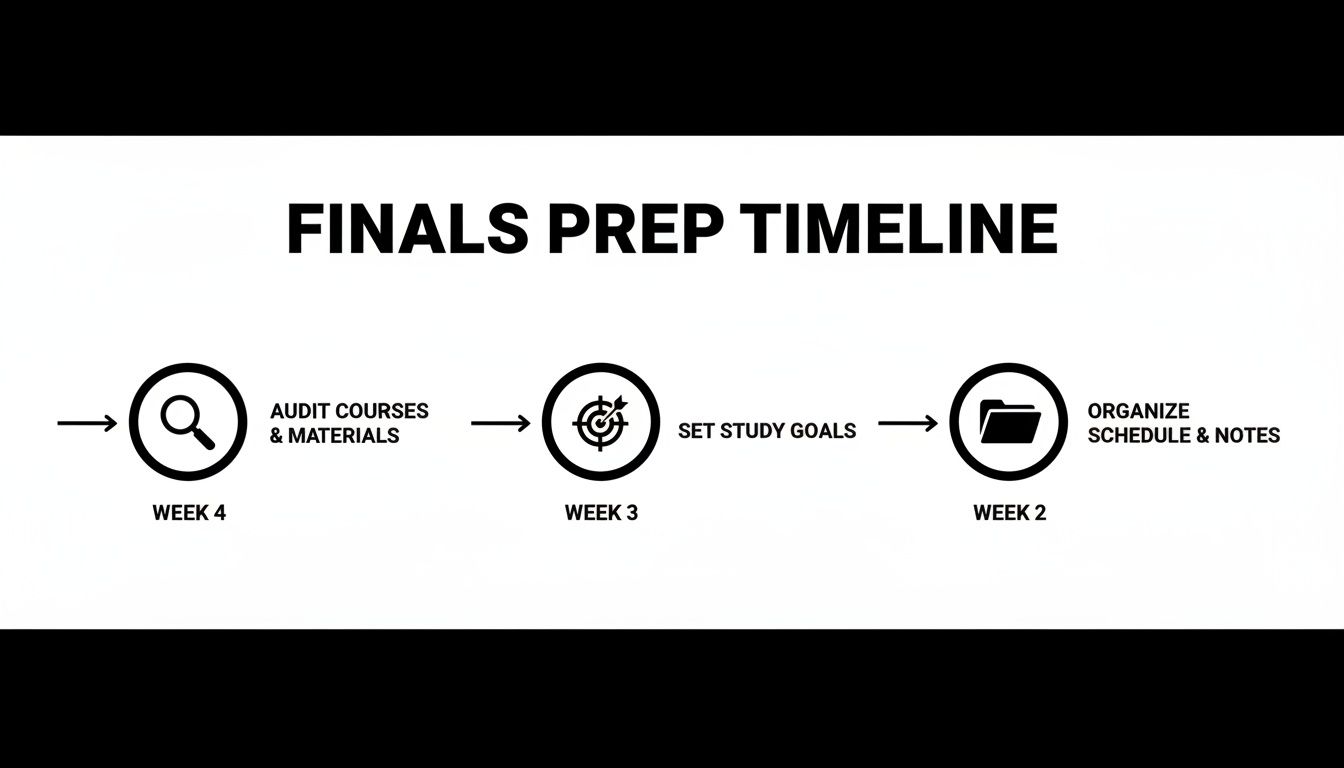
As you can see, a winning strategy always starts with auditing, goal setting, and organization—these are the non-negotiable first steps for any study schedule.
The One-Week Sprint to the Finish
With only a week left, your mission is simple: attack high-yield topics. You don’t have time to re-learn an entire semester's worth of material. Go back to that syllabus audit you did and pinpoint the concepts that will give you the most bang for your buck on the exam.
At this stage, practice exams and summary sheets are your best friends. Simulating real exam conditions is the fastest way to figure out what you really don't know yet, showing you exactly where to spend those precious final hours.
Stop passively re-reading chapters. Instead, spend your time actively quizzing yourself. Use the quizzes generated by Vivora to drill the most critical information into your brain. This is a total lifesaver when you're short on time, as it automatically pulls out key concepts and turns them into test questions, saving you from hours of manual work. If you want to make every moment count, check out our guide on how to plan weekend study sessions for maximum results.
The Last 24 Hours Survival Guide
Alright, this is it. Game time. The goal now is not to learn new information. It's to consolidate what you already know and get your brain ready to perform. Pulling an all-nighter might feel like a badge of honor, but study after study shows that sleep is absolutely essential for memory consolidation.
Here's your plan for the final 24 hours:
Stick to light review only. Do a quick scan of your summary notes or flashcards. Focus on core formulas, key dates, or major themes.
Do not touch new material. Seriously. Trying to cram new concepts now will just create anxiety and confusion. Trust the work you've already put in.
Get your gear ready. The night before, pack everything you need: pencils, a calculator you know works, your student ID, a snack, and a water bottle.
Prioritize sleep. Aim for at least 6-7 hours. Your brain needs that downtime to lock in everything you’ve studied. You’ll perform infinitely better rested than you will running on fumes and caffeine.
Master Active Learning to Study Smarter
If you’ve ever spent hours rereading a textbook only to blank out the next day, you know the pain of passive learning. Just staring at your notes and hoping the information magically sticks is one of the biggest time-wasters in any study plan.
To actually make knowledge stick, you have to get your brain in the game.
Welcome to the world of active learning. These aren’t just trendy study hacks; they're scientifically-backed techniques designed to move information from your short-term "cramming" memory into long-term storage. It’s all about engaging with the material, not just passively consuming it.
Embrace Active Recall to Test Your Knowledge
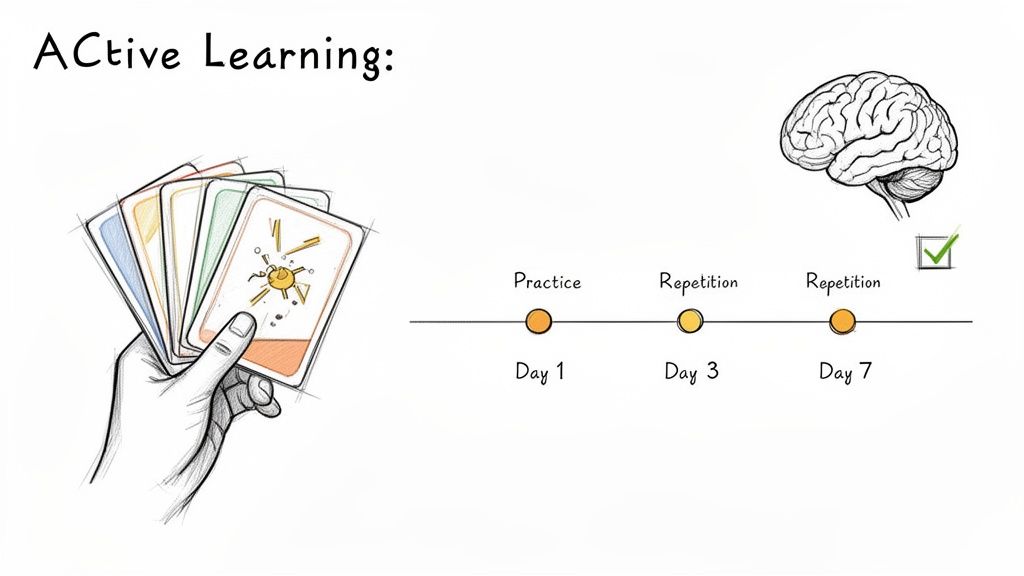
Active recall is the simple act of pulling information from your brain without looking at your notes. It’s the difference between recognizing a term on the page and being able to explain it from scratch. Every time you force your brain to retrieve a fact, you strengthen the neural pathway to that information. This makes it much easier to access later—like during a high-pressure exam.
Instead of just rereading your history chapter, try this:
Read a section, then close the book and summarize the main points out loud.
After a lecture, jot down the three most important concepts without peeking at your notes.
Turn the headings in your textbook into questions and try to answer them.
This feels harder than just reading because it is harder. That mental struggle is literally your brain building stronger memories. Think of it as lifting weights for your mind.
Use Spaced Repetition to Beat the Forgetting Curve
Ever cram for a test, ace it, and then forget everything a week later? That’s the "forgetting curve" in action. Our brains are wired to discard information they don't think is important. Spaced repetition hacks this system by reintroducing information right before you're about to forget it.
The idea is to review material at increasing intervals—maybe after one day, then three days, then a week. This process signals to your brain that this info is important and needs to be stored for the long haul.
Keeping track of this manually can be a huge pain. This is where technology comes in. When you use a tool like Vivora to create flashcards from your lecture notes, it transforms your content into a smart study system. It knows when to show you certain cards to maximize retention, automating one of the most powerful study techniques out there. For more on this, check out our guide on how to create flashcards that help you remember everything.
Key Takeaway: The goal isn't to study more; it's to make each study session more effective. Active recall and spaced repetition ensure the time you spend actually translates into better retention and higher scores.
Mix It Up with Interleaving
It feels natural to block study—spending hours drilling one type of math problem before moving to the next. But research shows that "interleaving," or mixing up different subjects or problem types in a single study session, leads to much stronger learning.
For instance, instead of doing 20 problems on concept A and then 20 on concept B, try doing a random mix of both. This forces your brain to constantly switch gears and identify the correct strategy for each problem, rather than just mindlessly applying the same formula over and over. This is exactly how exams work—they rarely present questions in neat, predictable blocks.
AI-powered study tools are changing this whole game. A 2025 Microsoft study found that university students using AI chatbots improved their exam grades by nearly 10%. This makes sense, as the exam prep market is projected to hit $91.26 billion globally by 2030, driven by tools that help students get organized. Early adopters of Vivora noted that the chaos of scattered PDFs and videos wasted 40% of their study time—a problem that AI neatly solves. You can read the full Microsoft report on AI in education to see the data for yourself.
Tools like Vivora are built for this modern approach. Instead of you having to manually create questions or figure out a review schedule, the AI does the heavy lifting. Just upload your class content—slides, notes, even video links—and Vivora turns it all into interactive study materials. It generates quizzes that force active recall and flashcards that use spaced repetition, making powerful study methods a seamless part of your prep.
You wouldn’t train for a marathon and a powerlifting meet the same way, right? It just wouldn't work. The same logic applies to your finals. Prepping for a STEM exam is a completely different beast than getting ready for an essay-based final, and using a one-size-fits-all approach is a recipe for wasted time and frustration.
Knowing how to study means knowing how to adapt. It’s about shifting from a vague "I need to study" mindset to a specific, subject-focused attack plan. This is how you get the biggest return on your study investment.
Conquer Your STEM Finals
When you're dealing with math, physics, chemistry, or computer science, just reading the textbook is your worst enemy. You can re-read a chapter on thermodynamics ten times, but that won't help you when you're staring at a blank page, trying to solve a problem you’ve never seen before.
Success in STEM comes from doing, not just reading.
Work Through Problem Sets: Your main focus should be on actually working through problem sets and past exams. The goal isn't just to find the right answer but to deeply understand the process behind it. Why that formula? What are the exact steps to get from the question to the solution?
Explain Concepts Aloud: Grab a whiteboard or even just a piece of paper and try to teach a complex concept to an imaginary audience. If you can explain it simply, you've got it down. The moment you get stuck, you’ve found a knowledge gap you need to fill.
Don't Just Memorize Formulas: You have to understand when and why to use them. Pure memorization falls apart under the pressure of an exam.
This is where a good AI tool can act like a personal tutor. If you're stuck on a confusing physics formula, ask Vivora to explain it with a real-world example. It can break down dense, technical material into something that actually clicks, saving you from getting hopelessly lost in a textbook.
Ace Your Humanities and Social Science Exams
For classes in history, literature, sociology, or political science, the game is completely different. Here, it’s all about arguments, themes, and connecting big ideas. Your exam will almost certainly ask you to synthesize information and build a coherent argument, not just spit back isolated facts.
Your prep needs to mirror that. Instead of just memorizing names and dates, you should be focused on building frameworks.
The best way to prepare for an essay exam is to predict the questions. Look at the major themes from your syllabus and lectures, then outline potential essay arguments for each one. This practice is far more valuable than re-reading every assigned text.
Try creating concept maps that visually link key people, events, and theories. Outlining killer essay arguments beforehand is like having a cheat sheet you created yourself. When you see a similar prompt on the exam, your brain will already have a roadmap to follow.
The real challenge here is often the sheer volume of information you have to manage. This is where AI excels. Upload your messy lecture notes and assigned readings into Vivora, and it can instantly generate a quiz on key dates from your history lecture or create flashcards for the main theorists in your sociology class. This transforms your content into targeted study tools, making your prep super specific and relevant to what you actually need to know.
Why a Tailored Approach Matters
Adapting your study technique isn't just a nice idea—it directly impacts your results. Look no further than professional exams, where you can see a massive gap between those who prepare strategically and those who just try to memorize everything.
For example, the pass rates for ACCA's Applied Skills and Strategic Professional exams consistently hover between 40-55%, while the foundational levels are much higher. This gap exists because rote learning completely fails when you face application-based questions that require real analysis, not just recall.
The data is clear: adequate, tailored preparation is proven to boost pass rates by 20-30% across different levels. You can dig into how preparation impacts professional exam pass rates to see the difference it really makes.
By switching up your strategy for different subjects, you’re not just studying harder; you're studying smarter. You're aligning your prep with what the exam will actually demand of you, setting yourself up for success long before you walk into the room.
Manage Your Energy, Not Just Your Time
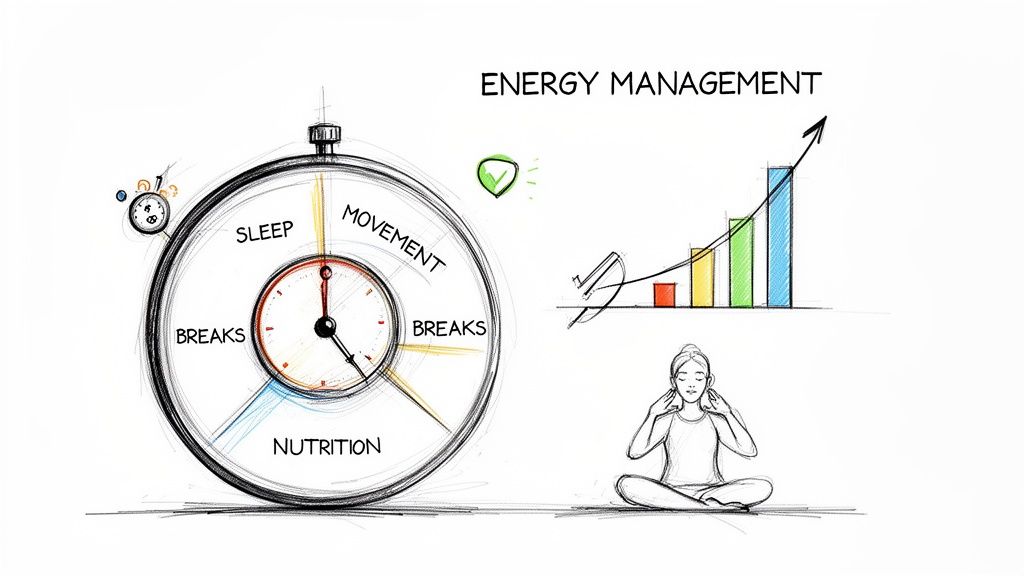
You can have the most perfectly planned study schedule on the planet, but it’s completely useless if you’re running on fumes. Final exams are a mental marathon, and winning is as much about managing your energy as it is about managing your time. If you’re burnt out, your ability to think critically and recall information plummets.
Let's shift the focus from simply packing in more hours to making the hours you do have more effective. This means protecting your mental energy, keeping stress in check, and giving your brain the fuel it needs to perform at its peak.
Work in Sprints, Not Marathons
Let's be real: the human brain wasn’t designed for hours of nonstop, intense focus. Trying to force it is a fast track to burnout. The Pomodoro Technique is a game-changer because it respects your brain's natural rhythm of focus and rest.
The setup is simple but incredibly effective:
Work for 25-45 minutes on a single task. No distractions.
Take a real 5-10 minute break. Get up, walk around, listen to one song, or just stare out a window.
After four of these "sprints," take a longer break of 20-30 minutes.
This method prevents mental fatigue and keeps you fresh. By working in focused bursts, you maintain a higher quality of concentration and actually get more done in less time.
Make Sleep Your Top Priority
Pulling an all-nighter might feel like a rite of passage, but it’s one of the worst things you can do for your grades. Sleep is non-negotiable for memory consolidation—that's the critical process where your brain converts shaky short-term memories into stable, long-term knowledge. Without it, much of what you studied simply won't stick.
A well-rested brain is a high-performing brain. Sacrificing sleep to cram is like trying to win a race with a flat tire. You might move, but you won't get far.
Aim for at least 7-8 hours of sleep, especially in the nights leading up to an exam. You’ll walk in with better focus, sharper recall, and way less anxiety.
Reduce Your Cognitive Load
A huge source of final exam stress comes from feeling completely swamped by the sheer volume of information. Every minute you spend organizing notes, creating flashcards, or just figuring out what to study first is a minute of precious mental energy drained away.
This is where you can be strategic. Tools like Vivora are designed to reduce this cognitive load. It automates the tedious stuff—like generating organized notes from lecture slides or creating practice quizzes from a PDF—which frees up your mental bandwidth.
Instead of getting bogged down in low-level prep work, your brain can focus on what really matters: understanding complex concepts and making connections. This keeps you fresher and more engaged during your study sessions. For more ideas on how to manage your workload, check out our stress-free weekend study guide.
Managing your energy is a skill that pays off. Just look at the December 2025 ACCA exam session, where over 120,000 students took exams. Pass rates for foundational topics were high (87% for Business & Technology), but plummeted for tougher papers like Taxation (55%) and Financial Reporting (51%). This proves that while basic review is manageable, advanced application requires focused mental energy. You can dive deeper into these ACCA exam insights to see why strategic preparation is so critical.
A Few Lingering Questions You Probably Have
Alright, we’ve covered a ton of ground, from building a solid schedule to mastering the right study techniques. But let's be real—finals week always brings its own special brand of chaos and a fresh wave of questions.
Here are some quick, no-nonsense answers to the questions that pop up when you're in the final stretch.
How Many Hours a Day Should I Actually Study for Finals?
Forget about a magic number. Quality beats quantity every single time. Bragging about a 10-hour study marathon is useless if half of it was spent scrolling through TikTok.
Instead of just tracking hours, focus on achieving "deep work" sessions. A highly productive 3-4 hours of focused, active studying is way more powerful than 8 hours of distracted, passive reading. Try using a method like the Pomodoro Technique to keep your energy and focus sharp.
What's the Best Way to Juggle Multiple Exams at Once?
This is all about smart planning and mixing things up, a technique known as interleaving. First, get brutally honest and rank your exams by difficulty and how much they’re worth. Your toughest final, the one that makes up 40% of your grade, obviously needs more of your prime study time.
On any given day, try to switch between two or three different subjects. Maybe you tackle calculus problems in the morning when your analytical brain is fresh, then switch to reviewing history flashcards in the afternoon. This approach actually helps your brain form stronger, more flexible connections, which is a massive advantage when you've got finals back-to-back.
Pro Tip: Centralizing all your materials is an absolute lifesaver here. When you can seamlessly flip from your chemistry notes to your philosophy readings in one place, like with Vivora, you avoid that momentum-killing search for scattered files and links.
Should I Pull an All-Nighter or Just Get Some Sleep?
Sleep. Always choose sleep. I know it feels productive to cram through the night, but sleep is when your brain does its most important work: memory consolidation. This is the biological process that actually locks in everything you've learned.
Without it, you'll walk into that exam with fuzzy cognitive function, slower recall, and almost zero critical thinking skills. Aim for at least 6-7 hours of solid rest. The real pro move is consistent, spaced-out review in the days leading up to the exam so you never even feel the need to cram.
How Do I Stay Motivated When I Feel Totally Buried?
You have to break everything down into ridiculously small, non-intimidating steps. The goal "study for my Bio final" is terrifying and will make you want to hide under your covers. But a goal like "review Chapter 5 flashcards for 25 minutes" feels completely doable.
Checking off these tiny tasks builds momentum and gives you a series of small wins. Don't forget to reward yourself for hitting those goals—finish a tough study block, then go watch an episode of your favorite show. Using a tool like Vivora also helps because you can see tangible progress. Watching your AI-generated quiz scores improve provides real, concrete proof that your hard work is paying off, which is one of the best motivators there is.
Stop wasting time organizing and start actually learning. Vivora transforms your scattered class materials into personalized study guides, flashcards, and quizzes automatically. Try it free and see how much faster you can prepare for your final exams. Get started with Vivora today.