How to Study Effectively in College (Without Totally Burning Out)
Feb 14, 2026

Let's be real: the first week of college is a firehose of syllabi, lecture slides, PDFs, and random YouTube links. Most students just try to tread water, which is probably why you feel like you're drowning by midterms.
The key to actually getting ahead isn't about pulling more all-nighters. It's about having a real system—one that organizes your entire semester from the jump, uses legit learning strategies, and gets smart tools to do the grunt work for you.
Organize Your Semester Before It Turns Into a Dumpster Fire
It's a weird paradox of college life. A recent national survey found that a whopping 50.5% of students study for less than two hours a day, yet almost everyone feels perpetually behind. You can see the full breakdown in this analysis of student study habits.
The problem isn't laziness. It's the total lack of a system.
Build Your Semester Command Center
This is where you stop reacting and start planning. You need a single, central hub for the entire semester—a command center. This one move eliminates that classic "where the heck did I save that PDF?" panic attack a week before the final.
Your goal is to turn that initial chaos into a clear, actionable plan. You'll feel back in control from day one.
The secret is to wrangle all your scattered materials before you get swamped. Don't wait until midterms to get your act together. Build a central hub for each class right at the beginning.
This means no more dragging slides into a random "Downloads" folder or letting important links get buried 200 emails deep. It’s time to get organized.
The Three Pillars of Semester Organization
Building your command center really just comes down to three simple, powerful moves you make at the start of the term. This isn't about color-coding every single note; it’s about creating a solid framework that will literally save you hours down the line.
Here’s how to set yourself up for a win:
Grab Everything Immediately: The second you get access to your course materials, download it all. Every syllabus, every lecture slide, every single PDF and reading list. Don't wait. Shove it all in one dedicated place.
Map Out Your Key Dates: Fire up a calendar and immediately plug in every single major deadline—exams, essays, projects, the works. This gives you a bird's-eye view of your semester, instantly flagging those brutal "hell weeks" before they sneak up on you.
Consolidate All Your Content: This is where the magic happens. Instead of juggling dozens of files and links, you need to pull them all together. This is exactly what Vivora was built for. Just upload all your documents, slides, and even YouTube lecture links, and our AI transforms that messy pile of class content into a single, personalized study guide for each course. Think of it as an organizational assistant that turns your digital chaos into a perfectly structured library.
Once you have this foundation in place, you’ve eliminated the mental drag of just trying to find stuff. Your brain is finally free to do the important part: actually learning the material instead of just managing it.
Moving Beyond Cramming With Active Recall
Let’s be honest—we’ve all been there. It's 2 a.m., the exam is in a few hours, and you're mainlining energy drinks while trying to absorb an entire semester's worth of knowledge. We know cramming is a terrible way to learn, yet we keep falling back on it.
That's because passive studying—things like re-reading your notes or highlighting half the textbook—feels productive. It’s comfortable. It’s easy. But the truth is, that information rarely sticks around for long.
It's time to ditch the comfortable habits and embrace active recall, one of the most powerful learning strategies backed by science. Active recall isn't about just looking at information; it’s about actively pulling it out of your brain. Think of it as forcing your mind to do a mental push-up instead of just watching a workout video.
This simple three-step process is your foundation for building a semester that runs on active learning, not last-minute panic.
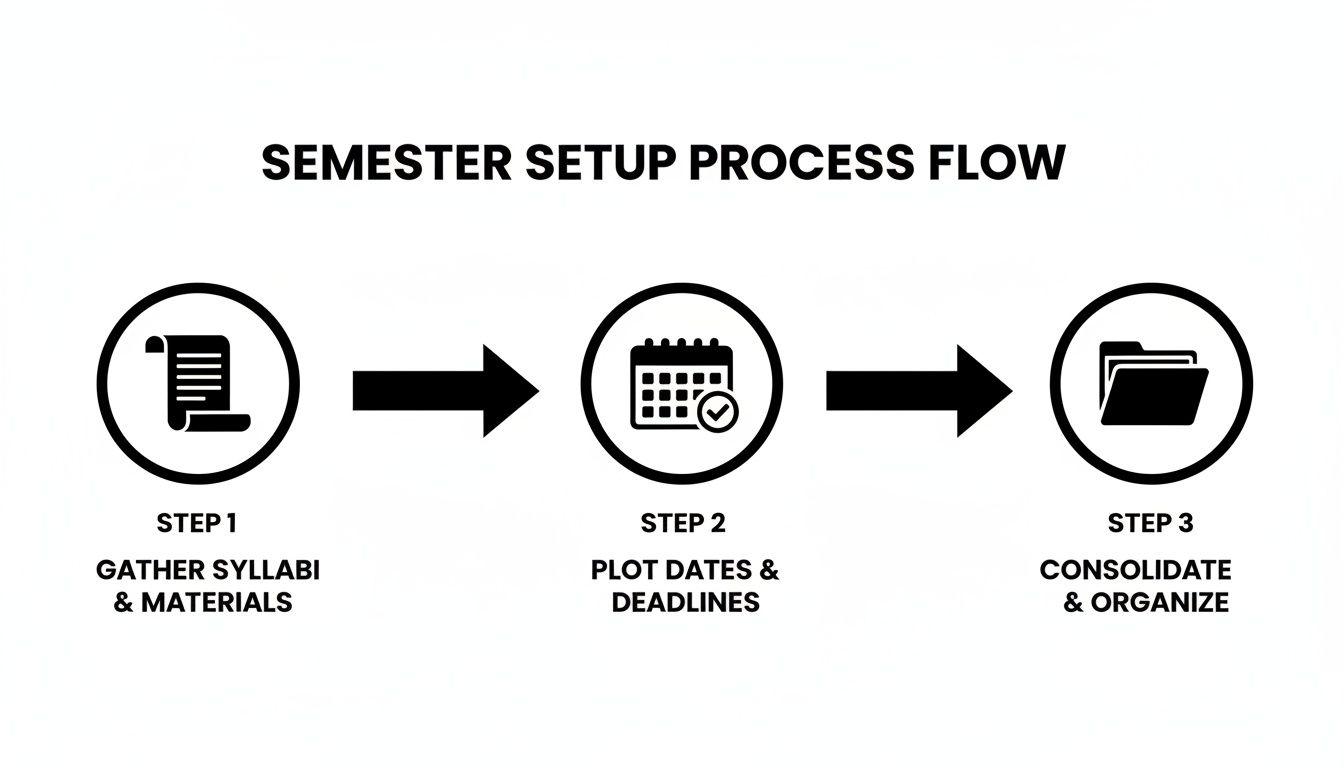
When you gather, calendar, and consolidate your materials upfront, you clear the mental space needed to focus on actually learning, not just scrambling to find files.
Why Your Brain Hates Highlighters
So why do we love our highlighters so much if they don't work? Because highlighting and re-reading create what psychologists call an "illusion of competence." Your brain recognizes the words on the page, which tricks you into thinking you’ve learned the material.
But recognition isn't the same as recall. It's a huge difference. You can recognize a celebrity’s face in a magazine, but could you draw it accurately from memory? Probably not.
Active recall forces you to retrieve information without any cues, which strengthens the neural pathways in your brain. It’s harder, for sure, but that difficulty is precisely why it works. It turns your brain from a passive spectator into an active participant in your learning.
Cramming for an exam is like stuffing clothes into a suitcase. You might get everything in there for a short trip, but the second you open it, everything explodes out. Active learning is like neatly folding each item—it takes more effort upfront, but everything stays organized and accessible when you need it.
Passive vs Active Studying: What Actually Works
Most students default to passive methods because they feel easier. But easier doesn't mean better, especially when it comes to long-term memory. Here’s a quick breakdown of common study methods and where they fall on the effectiveness scale.
Study Method | Type | Effectiveness for Long-Term Memory | Example |
|---|---|---|---|
Re-reading notes | Passive | Very Low | Reading your lecture notes over and over. |
Highlighting text | Passive | Very Low | Using a highlighter on key sentences in a textbook. |
Summarizing | Active | High | Writing a one-paragraph summary of a chapter without looking at it. |
The Feynman Technique | Active | Very High | Explaining a concept simply, as if to a child, to find knowledge gaps. |
Practice Testing | Active | Very High | Answering quiz questions or working through problems from memory. |
Flashcards (self-testing) | Active | Very High | Using a card to prompt your brain to retrieve the answer. |
As you can see, the methods that require more mental effort are the ones that build stronger, more reliable memories. It’s about working smarter, not just longer.
Simple Ways to Practice Active Recall
You don't need complicated systems to start using active recall. It's really about changing how you interact with your class content. Instead of just consuming it, you need to start producing it from memory.
Here are a few practical ways to get started:
Become the Teacher (The Feynman Technique): Grab a blank sheet of paper and try to explain a concept from your class as if you were teaching it to a 10-year-old. Use simple language and analogies. The parts where you get stuck, hesitate, or have to say "uhm..."—those are your exact knowledge gaps. Go back and fill them in.
Ask, Don't Just Answer: After a lecture, don't just summarize your notes. Go through and turn your notes into a list of questions. For example, if your note says, "Mitochondria is the powerhouse of the cell," your question becomes, "What is the primary function of the mitochondria?" Then, test yourself later by answering those questions.
Create Better Flashcards: Most people make terrible flashcards—a term on one side and a long, copied-and-pasted definition on the other. This just encourages passive review. Instead, make flashcards that ask questions or require you to explain a process. For a deep dive into this, check out our guide on how to create flashcards that help you remember everything.
Let AI Do the Heavy Lifting for You
Let's be real: the biggest hurdle with active recall is the setup time. Manually creating hundreds of quality flashcards or writing dozens of practice questions for every single class is a massive time sink. It’s easy to get burned out before you even start studying.
This is where smart tools come in to make effective studying a realistic goal.
With Vivora, you can skip all that tedious prep work. Just upload your lecture slides, class notes, or even a link to a recorded lecture. Our AI-powered study tool instantly analyzes your materials and generates personalized flashcards and practice quizzes for you.
Instead of spending hours creating study materials, you can spend that time actually studying—practicing recall and mastering the concepts. Vivora automates the "how" so you can finally focus on the "what."
Creating a Weekly Study Routine You Can Stick To
Mapping out your semester is like punching a destination into your GPS. But it's your weekly routine that provides the turn-by-turn navigation that actually gets you there. Consistency beats cramming every single time—that’s not just a nice idea, it’s a fact of how our brains work.
The goal here isn't to build some rigid, military-style schedule that makes you miserable. It’s about creating a flexible blueprint for your week that makes progress feel automatic and keeps burnout at bay. This is your best defense against the Sunday scaries and that heart-stopping moment when you realize a huge paper is due tomorrow.
Find Your Rhythm With Time Blocking
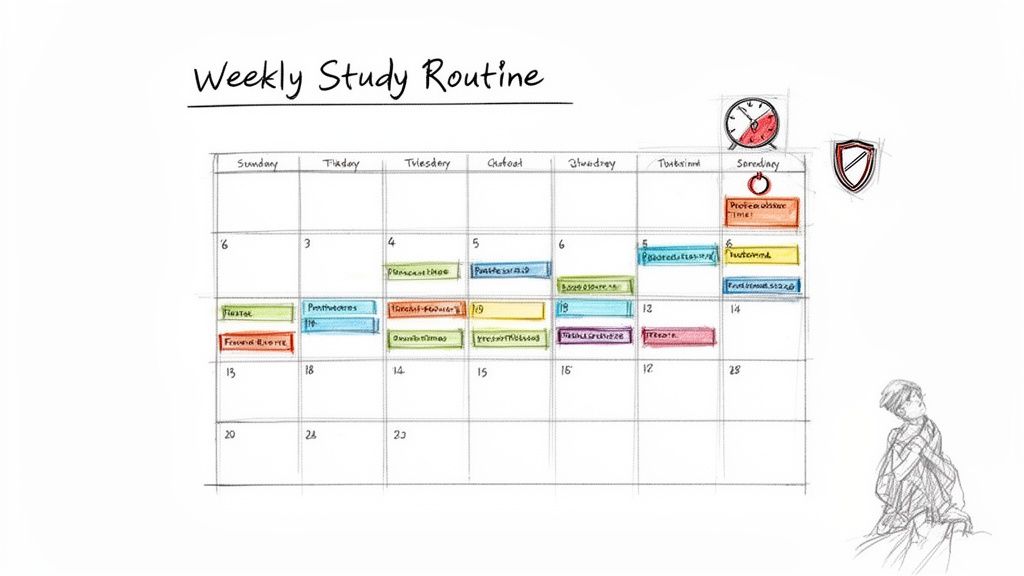
The secret to a routine that you'll actually follow is working with your brain's natural tendencies, not against them. One of the simplest and most powerful ways to do this is time blocking. Instead of a vague, overwhelming to-do list, you assign every task a specific home on your calendar.
Think of it as making an appointment with your biology notes. You wouldn’t just blow off a doctor's appointment, would you? Give your study blocks that same level of respect. Even a dedicated 45-minute block between classes is a huge win.
This simple shift does two incredible things:
It destroys procrastination. When you know exactly what you’re supposed to be doing from 2:00 to 2:45 PM, it’s a lot harder to justify falling down a TikTok rabbit hole.
It protects your free time. By scheduling your work, you also get to schedule your downtime—guilt-free. You can fully unplug knowing your study time is already handled.
The Power of Short, Focused Bursts
Forget those eight-hour library marathons. Your brain just wasn't built for that kind of punishment. Research on learning consistently shows that shorter, more frequent study sessions lead to way better long-term retention. This is a core principle of studying effectively in college.
A super popular method for this is the Pomodoro Technique. It's incredibly simple:
Set a timer for 25 minutes and focus on one single task. No multitasking.
When the timer dings, take a real 5-minute break. Get up, stretch, look out the window.
After four of these cycles (or "pomodoros"), take a longer break of 15-30 minutes.
This system works because it slices overwhelming tasks into manageable bites. Plus, knowing a break is just around the corner makes it so much easier to stay laser-focused and fight off distractions.
Your brain is a muscle, not a machine. You wouldn't try to lift weights for eight hours straight. Give it the short, intense workouts and rest periods it needs to actually get stronger.
This approach makes studying feel less like an endless grind. If you're struggling to make your weekends count without burning out, check out our stress-free weekend study guide for more specific tips.
Consistency Over Intensity
The students who really thrive aren't the ones who study the most hours; they're the ones who study the most consistently. The data backs this up completely. About 42% of students study 4-5 days per week, while only 37% try to cram everything into 2-3 days. That small shift in frequency makes a massive difference in how much you actually remember.
Your goal should be to touch each subject a few times a week, even if it's just for 30-45 minutes at a time. This keeps the material fresh in your mind and stops you from having to relearn an entire chapter from scratch right before an exam.
Ultimately, building an effective weekly routine is all about creating a predictable system. When your study habits become automatic, you free up precious mental energy to focus on what really matters—actually understanding the material, not just surviving the semester.
Finding Your Motivation When You Feel Like Quitting
Let's be real: motivation isn't some magic switch you can just flip on. The idea that successful students are always fired up and ready to go is a complete myth. Some days, you're on top of your game, and other days, the thought of cracking a textbook feels physically impossible.
Relying on sheer willpower to drag yourself through a semester is a recipe for burnout. The real secret to studying effectively in college, especially when you're running on empty, isn’t about forcing yourself to feel motivated. It's about building a system that works even when motivation is nowhere to be found.
It all comes down to understanding what actually drives you and using it to your advantage.
Grades vs. Growth: The Real Motivation Hack
We’re all trained to chase the grade. An "A" feels like the ultimate goal, but focusing only on the final letter can absolutely crush your motivation. When the grade is your only prize, every study session becomes a chore, and one bad quiz score can make you feel like a total failure.
This isn't just a feeling; the data backs it up. A recent study showed that students driven by a genuine desire to master the material—what researchers call task-oriented motivation—used smarter, deeper learning strategies like self-testing and connecting ideas. It's no surprise they also earned the best grades. Meanwhile, students just trying to outperform their classmates ended up cramming and doing worse. You can dig into the details on how motivation impacts student learning habits.
The hack is simple: shift your mindset from "I have to do this for a grade" to "What's in this for me?"
When you study to understand rather than just to pass, something shifts. The material becomes a puzzle to solve instead of a mountain to climb. This mindset change is the single most powerful tool for staying driven.
Connect Your Classes to Your Real Life
It’s a thousand times easier to study for a class when you can see its place in your bigger picture. That required stats class might feel totally pointless now, but if you want to launch a marketing career, knowing how to work with data is a superpower.
Take a few minutes and actually connect the dots for each of your classes:
Career Goals: How will that boring econ theory actually help you launch your own business one day?
Personal Interests: Can that dense history class give you context for that political podcast you love?
Skill Building: Is that brutal coding class teaching you the logic you need to finally build that app you’ve been dreaming about?
When you anchor your coursework to something you genuinely care about, you're not just studying for a test anymore. You're investing in yourself.
Gamify Your Progress and Reward Yourself
Your brain is wired to love a good dopamine hit. You can absolutely use this to your advantage by setting up a system of small, immediate rewards for hitting your study goals. This isn't about bribing yourself; it's about acknowledging the hard work you're putting in.
Think small and satisfying:
Finish a tough chapter? You've earned an episode of that show you're binging.
Nail a practice quiz? Time for a well-deserved coffee run.
Stick to your study schedule for a whole week? Go ahead and order that takeout.
The trick is to make the rewards immediate and proportional to the effort. This creates a positive feedback loop that teaches your brain to associate studying with a good feeling.
This is also where a good study tool can make a huge difference. For example, when you use Vivora, it doesn't just spit out study guides for you—it helps you see your progress in real time. Nailing the automatically generated quizzes and watching your mastery score climb gives you a tangible sense of accomplishment. It turns studying from a dreaded chore into a satisfying challenge, giving you that little boost you need to keep pushing forward, even on the days you really, really feel like quitting.
Building Your Ultimate Student Tech Stack
Let's get one thing straight: your brain is for thinking, not for remembering which of the five different "Downloads" folders you stashed that crucial PDF in. To get ahead in college today, using the right tech isn't just a nice-to-have. It’s a non-negotiable part of the game.
This isn't about downloading every productivity app you see on TikTok, though. It's about building an intelligent, connected system that actually works for you. The goal is to create a digital workflow that handles the boring stuff—organization, consolidation, and prepping materials—so you can focus on what actually moves the needle: deep learning.
It’s time to move beyond a scattered collection of apps and build a real tech stack that simplifies your entire study process.
Centralize Everything or Suffer the Consequences
The biggest time-waster for most students is just finding things. Your materials are probably scattered all over the place: lecture slides on your laptop, readings in your email, recorded lectures on a clunky university portal, and that one super helpful YouTube video link buried in a group chat somewhere. This digital chaos creates constant friction and mental drag.
A centralized hub is the only way out. I'm not just talking about a cloud storage folder; I mean a single platform where all your course content can live and actually interact with each other.
Imagine uploading a PDF of a textbook chapter, a link to your professor's lecture on YouTube, and a photo of your handwritten notes from class. Then, picture all of that getting mashed up and transformed into a single, cohesive, personalized study guide. That's the power of a true content hub.
The Power of an AI-Powered Study Assistant
This is where the new generation of tools completely changes the game. An AI-powered study tool like Vivora is built to be the brain of your tech stack, designed to take all those different content formats and transform them into personalized study guides you can actually use.
Here’s what that looks like in practice:
Upload Anything and Everything: Just drag in your PowerPoint slides, copy-paste a link to a lecture recording, or upload a scanned PDF. Vivora takes all these random pieces of information and organizes them into one unified, interactive space for each class.
Automatic Study Guide Generation: Forget spending hours manually summarizing notes or making flashcards. Our AI analyzes your class content and instantly generates clear, organized study guides, key term flashcards, and practice quizzes. This alone can save you dozens of hours over a semester.
A Chatbot That Knows Your Class: This is the real game-changer. Instead of Googling a concept and getting a generic answer, you can ask Vivora’s AI chatbot a question, and it will answer based specifically on your course materials. It’s like having a 24/7 TA who knows your professor’s exact wording.
You don't get extra credit for spending hours organizing files. The goal is to minimize the admin work of being a student so you can maximize your time actually learning. Let technology handle the digital grunt work.
Building Your Core Stack
While a central hub like Vivora is your command center, a few other tools are essential for a complete, effective student tech stack. Think of these as the supporting cast that makes your workflow seamless.
Your Essential Toolkit:
A Solid Note-Taking App: While Vivora can process your notes, you still need a place to capture them. Apps like Notion, OneNote, or GoodNotes (for tablet users) are great for taking live notes during lectures. The key is to pick one and stick with it.
A Digital Calendar: This is absolutely non-negotiable for time blocking and mapping out your semester deadlines. Google Calendar is the obvious choice for its simplicity and integrations.
A Distraction Blocker: Your willpower is a finite resource. Don't waste it. Use an app like Forest or Cold Turkey to block distracting websites and apps during your scheduled study blocks.
A Reference Manager: If you're writing research papers, a tool like Zotero or Mendeley will save your life. They automatically format citations and bibliographies, saving you from a world of headache.
Ultimately, the best tech stack is the one you actually use. Start with a powerful central hub like an AI study assistant to handle the heavy lifting of organization and content creation. Then, add a few key apps to support your daily workflow. This streamlined approach frees up your mental energy and gives you the tools you need to study smarter, not just harder.
Your Top College Studying Questions, Answered
Alright, we've walked through the entire playbook, from mapping out your semester to locking in your focus. But let's be real—sometimes you just need a quick, no-fluff answer to a specific problem. Here are some of the most common questions I hear from students trying to get their study game right.
How Much Should I Actually Study Every Day?
Honestly, there's no single magic number. It's far more about consistency than it is about cramming hours. The real goal isn’t hitting some arbitrary hourly quota but making tangible progress every single day. Instead of psyching yourself up for a monster four-hour library session, think in terms of 45-60 minutes of focused work for each class, broken up throughout your day.
This is all about quality over quantity. Four hyper-focused, 25-minute Pomodoro sprints will move the needle way more than three hours of half-hearted studying with your phone buzzing next to you. Consistency is the true game-changer; chipping away at a subject a little bit each day is infinitely more effective than a massive weekend cram session.
How Do I Study for a Class That’s a Total Slog?
We have all been there. That one required class you have to take that feels like watching paint dry. The secret is to trick your brain into caring by connecting the material to something you’re actually interested in.
Stuck in a boring history class? Find a killer documentary on the era to bring it to life. For a dry science course, hunt down some real-world videos showing how those abstract concepts are used in cool tech or medicine.
Another pro-level tip is to gamify your learning. This is where a tool like Vivora can make a huge difference. You can toss your boring lecture slides and class content into the app and have it automatically transform them into interactive quizzes and flashcards. Trying to beat your own high score on a practice quiz feels a lot more engaging than just staring at the same textbook chapter for the tenth time. It adds a layer of challenge that can make even the driest topics feel more manageable.
The fastest way to learn boring material is to make it less boring. Turn your study session into a game, link it to your passions, or just find a way to engage with the info beyond passively reading it.
What’s the Best Way to Catch Up After Missing a Class?
First thing's first: don't panic. The absolute worst thing you can do is let one missed class turn into a mountain of unlearned material. Your immediate mission is to get your hands on the lecture content. Text a friend for their notes, check if the professor posted slides or a recording online, and grab any handouts you missed.
This is where having a central digital hub for your classes becomes a total lifesaver. As soon as you get the materials, upload them. If a classmate sends you a link to the recorded lecture, you can drop it right into an AI tool like Vivora that will spit out a summary with all the key takeaways. This lets you absorb the core concepts in a fraction of the time it would take to sit through the whole recording. From there, hit the practice questions it generates to make sure you actually get it.
Should I Study Alone or in a Group?
The real answer? Both. They each have unique superpowers, and the students who crush their exams know how to use them together.
Solo Study: This is non-negotiable for the initial learning phase. You absolutely need quiet, focused time to wrestle with the material yourself, make your own connections, and figure out what you’re truly confused about. This is your "deep work" time.
Group Study: This is where you level up. It’s perfect for reviewing tough topics, pressure-testing your knowledge, and filling in gaps. Trying to explain a complex idea to someone else (the Feynman Technique in action) is one of the most powerful ways to lock it into your own brain for good.
Here’s a great workflow: tackle the material on your own first. Then, get together with your group to debate the tricky concepts and quiz each other until everyone is solid.
Ready to stop scrambling for scattered notes and start actually learning? Vivora transforms all your class materials into one spot and uses AI to instantly create the personalized study guides, quizzes, and flashcards you need to feel confident on exam day.