
How to Take Better Notes in Class: The Ultimate Guide to Nailing Your Next Exam
Feb 15, 2026

Let's be real: taking notes in class feels like a race you can't win. You're trying to scribble down every word the professor says, your hand is cramping, and by the end, you're left with a wall of text you'll never actually look at again. Sound familiar?
The goal isn't to become a human transcription machine. It's to stop wasting time and start creating a personalized study tool that actually works for your brain, not against it.
Why Your Note-Taking Sesh Is a Total Fail
We’ve all been there. That frantic feeling of trying to capture every single slide and sentence. It’s draining. You walk out of class with a dead hand and pages of chaotic notes that give you anxiety just thinking about them.
The problem with this "write-everything" vibe is that it's a trap. It forces you into passive listening. Your brain is so focused on getting the words down that you don't have the mental bandwidth left to actually process and understand the concepts. You're just collecting words, not connecting ideas.
Spilling the Tea on the "Perfect Notes" Myth
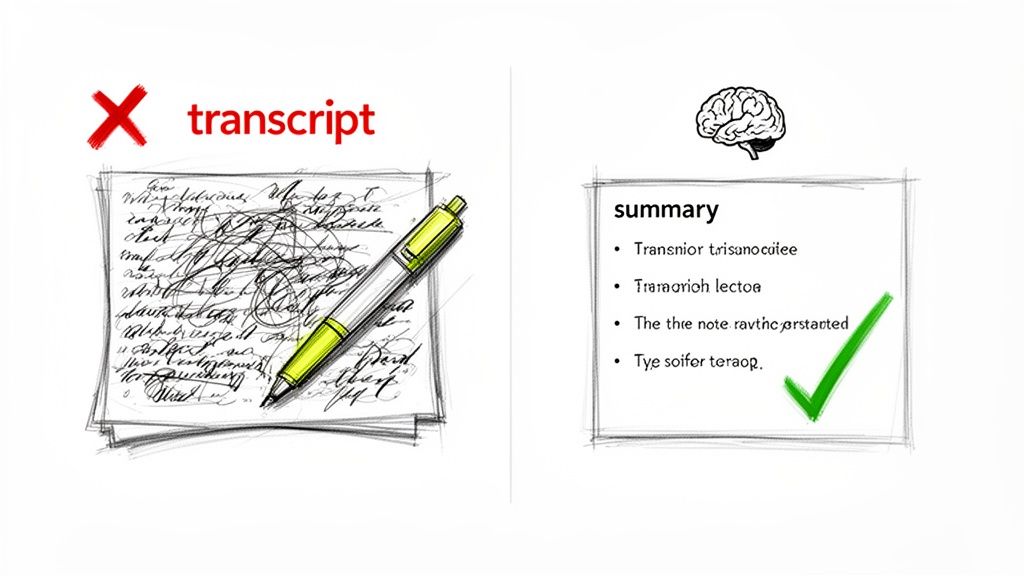
Here’s the thing: a perfect, word-for-word transcript of a lecture is one of the least effective ways to study. You just end up with a novel-length doc that's a nightmare to review. Trying to pull out the key info for an exam is basically impossible. This is exactly why so many students feel like they're putting in the hours but not seeing the grades to match.
The issue comes from a few bad habits we were all probably taught were "good" note-taking:
Verbatim Vibes: Trying to write everything is a surefire recipe for burnout and zero learning. Your mind is on autopilot, not in the game.
Highlighting Everything: When half the page is glowing neon, nothing actually stands out. This just creates the illusion of being productive without helping you retain a single thing.
Chaos Mode: Just jotting down points randomly without any structure makes it impossible to see connections or review efficiently later.
These methods fail because they treat note-taking as a task of pure collection instead of a process of critical thinking.
The real goal isn’t to create a flawless script of the class. It’s to build a personalized study guide that highlights connections, clarifies confusing topics, and makes exam prep feel less like a nightmare.
Switching from Passive to Active Note-Taking
So, how do you actually take better notes? It all starts with a simple mindset shift. The most effective students don't just record information; they vibe with it in real time.
They’re constantly asking themselves questions like, "What's the main point here?" or "How does this connect to last week's lecture?"
This is active engagement. It's the difference between just hearing the noise and actually feeling the beat. When you listen actively, you’re already starting the learning process right there in class—not saving it all for a late-night cram sesh. This is the foundation for creating notes that save you time and genuinely boost your grades.
And this is where modern tools are a total game-changer. Imagine turning your messy lecture notes and class slides into interactive flashcards and quizzes with a single upload. That's the power of working smarter. Platforms like Vivora are literally designed for this. It’s an AI-powered study tool that transforms your raw class content into an organized, personalized study guide, so you can spend less time transcribing and more time acing the material.
The Pre-Class Glow Up That Guarantees Better Notes
Ever walked into a lecture completely cold? It’s like trying to start a new video game on the hardest level with zero tutorial. You’ll get lost, miss the important stuff, and end up feeling totally overwhelmed.
The real secret to taking amazing notes in class doesn’t start when the professor begins talking—it starts before you even walk through the door.
A simple 15-minute routine is all it takes to flip your brain from passive observer to active learner. This isn't about hours of deep reading. Think of it as a strategic warm-up that builds a mental framework for all the new information coming your way. When you prime your brain like this, you know what to listen for, making it way easier to spot and lock down the most important concepts.
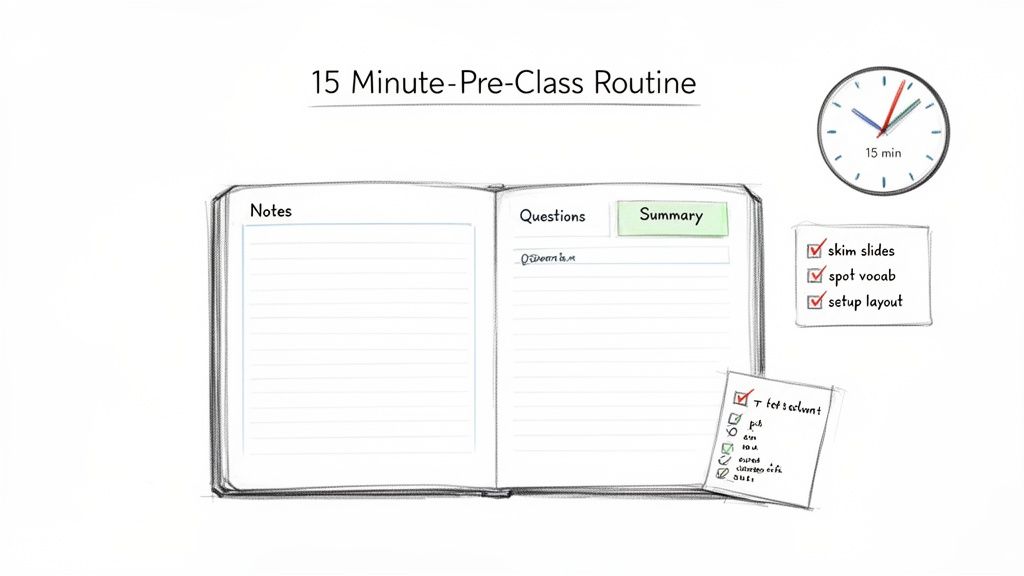
Your 15-Minute Pre-Lecture Game Plan
Think of this as your pre-class cheat code. Before you head to your lecture, find a quiet spot and run through these quick steps. It’s a small time investment that pays off big when it comes to understanding and retention.
Skim the Syllabus & Slides (5 mins): Pop open the syllabus, assigned readings, or any slides your prof posted. The goal here isn't mastery; it's a quick vibe check. Look for headings, bolded terms, and summary points to get a feel for the main themes.
Jot Down Key Terms & Questions (5 mins): As you skim, pull out any vocabulary or concepts that seem new or important. Writing them down flags them for your brain, so when the professor mentions them, you're already tuned in.
Set Up Your Note-Taking Space (5 mins): Whether you're using a notebook or a laptop, get your page or doc ready before class starts. Don't waste those crucial first minutes of the lecture creating a new file or finding a clean page.
This quick prep makes you an active participant from the second the professor starts talking. You're no longer just reacting; you're anticipating.
The point of pre-class prep isn’t to learn everything in advance. It’s to build a mental scaffold so that when your professor starts talking, you have a place to hang every new idea.
Structure Your Notes for Success
Staring at a blank page when class starts is low-key intimidating. A much better approach is to set up a structured layout ahead of time. This tiny step helps organize your thoughts in the moment and makes reviewing your notes later about a thousand times easier.
The Cornell method is a classic for a reason—it’s simple and incredibly effective.
Before class, just divide your page into three sections:
Main Notes Area (Right Side): This is the biggest part, where you'll capture everything from the lecture.
Cues/Questions Column (Left Side): This is a narrower column where you can jot down key questions, main ideas, or vocab that corresponds to your notes on the right.
Summary Section (Bottom): Leave a few inches at the bottom to write a one or two-sentence summary of the entire lecture after class is over.
By having this structure ready to go, you’re priming yourself to think critically during the lecture itself. Your brain will automatically start looking for main ideas to fill the cues column and thinking about the big picture for that summary section. For students looking to level up, an AI study assistant can help turn these structured notes into powerful review tools.
Mastering In-Class Strategies That Actually Work
Alright, you did your pre-class prep and you're walking into the lecture feeling ready. This is where the magic happens. The key to taking better notes in class isn’t about becoming a human photocopier; it’s about becoming a skilled translator, turning a firehose of information into something your future self can actually use.
The biggest mistake students make during a lecture is trying to write everything down. This instantly kills your ability to listen and process. Instead, your goal is to capture the vibe of the lecture—the core ideas, the key connections, and the "aha!" moments. This requires a smarter, more strategic approach.
Choose Your Weapon Wisely
Not all classes are created equal, so why would you use the same note-taking style for everything? A dense history lecture filled with dates and names needs a different strategy than a complex STEM class focused on formulas and processes.
Matching your method to the subject is a pro move that will immediately level up your notes. Think of it like choosing the right tool for the job.
With so many methods out there, picking the right one can feel overwhelming. Let’s break down the big three and when they work best.
Choosing the Right Note-Taking Method for Your Class
Method | Best For | Key Advantage |
|---|---|---|
Outline Method | Story-driven classes (History, English, Sociology) | Its natural hierarchy makes it easy to see how main topics and details relate. |
Mind Mapping | Concept-heavy classes (Biology, Psychology, Economics) | Great for visualizing connections and seeing the big picture at a glance. |
Cornell Method | Problem-solving classes (Math, Physics, Chemistry) | Separates main notes from key terms and summaries, which is amazing for revision. |
Don't be afraid to experiment. What works for your friend in chem might not work for you, and that's okay. The goal is to find what helps you understand the material, not just copy it down.
Develop Your Own Secret Language
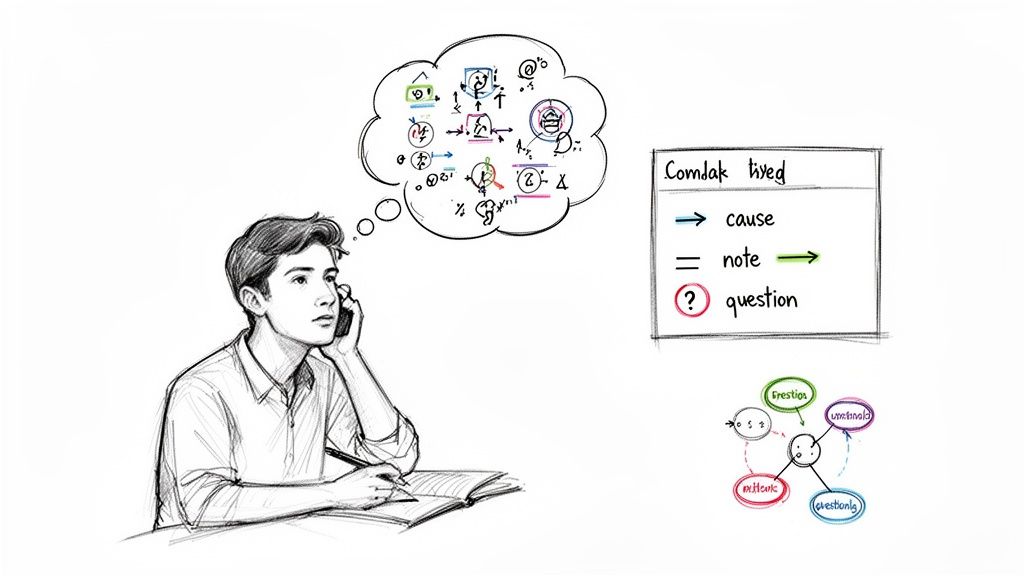
Your professor is cruising through slides, and you’re trying to keep up. The solution isn't to write faster; it's to write less. This is where creating your own shorthand and symbol system becomes a total game-changer. It's not just about speed; it's about reducing the mental effort it takes to record complex ideas.
Don't overthink it. Start simple and build your system over time.
Shorthand and Abbreviation Ideas:
w/= withb/c= because&= and→= leads to, results in== is the same as, means≠= is not the same as↑= increase, rise↓= decrease, fall
Create a small "legend" on the first page of your notebook so you don't forget your symbols. After a few classes, it'll become second nature.
The point of a personal shorthand is to free up your brain. When your hand isn’t struggling to keep up, your mind can focus on what really matters: understanding the material.
This isn’t just a hunch; it’s backed by science. Studies show that using symbols and diagrams seriously cuts down on memory load. In fact, effective symbols can save 30-40% of recording time, and using diagrams has been shown to increase the number of information units captured by 28%. You can learn more about the science behind efficient note-taking.
Master the Art of Active Listening
Ultimately, the best notes come from being an engaged listener. Don't just let the information wash over you. Actively listen for cues that signal importance.
Pay close attention when your professor:
Repeats a concept: If they say it more than once, it’s definitely important. Hint: it's probably going on the exam.
Writes something on the board: This is a huge sign that it's a core idea you need to know.
Uses signal phrases: Listen for things like "This is the key takeaway," "The most important thing to remember is," or "This will be on the exam."
Changes their tone or pace: Professors often slow down or get more passionate when covering critical information.
When you're ready to review, you can take those awesome handwritten notes to the next level. Imagine uploading a quick photo of your pages to a platform like Vivora, which can instantly turn your shorthand and diagrams into organized digital study guides. You can explore how to digitize and organize your class materials to make studying even more efficient.
The Surprising Science of Pen and Paper Notes
In a world where your laptop and tablet are basically glued to your hip, pulling out an actual notebook can feel a little... vintage. But what if one of the most powerful study hacks available wasn't an app, but good old-fashioned pen and paper? It sounds completely backward, but the science behind it is surprisingly solid.
The next time you're tempted to open a blank doc, consider this: the physical act of writing is a massive upgrade for your brain. When you type, it’s way too easy to slip into mindless transcription mode. Your fingers are just trying to keep up, and you end up recording words without really processing the ideas behind them.
Handwriting, on the other hand, is slower. And that's its superpower.
Because you can't possibly write as fast as someone can speak, your brain is forced to make decisions on the fly. You have to listen, digest the information, and summarize it in real-time to capture the most important parts. That process of filtering and rephrasing is where the real learning kicks in, transforming you from a passive stenographer into an active participant.
The Brain Boost of Writing by Hand
It’s not just about slowing down, though. It's about engaging more of your brain. The unique motor skills involved in forming letters—the loops, the lines, the pressure of the pen—activate distinct neural pathways. This creates a stronger, more complex memory trace than just tapping away at keys.
Think of it like this: typing is like taking a quick photo of a scene, while handwriting is like sketching it. The artist doing the sketch has to pay way more attention to the details and how everything connects. That deeper level of engagement is exactly what helps you remember concepts better when the exam rolls around.
The real goal of taking notes in class isn't just to record information. It's to create a tool for future learning. Handwriting forces you to start that learning process the moment the lecture begins, not just when you sit down to study.
The cognitive benefits aren't just a theory; they're measurable. One fascinating study showed that students taking notes longhand consistently outperformed those using a digital stylus. The handwriting group scored significantly higher on tests measuring information processing speed, working memory, and visual memory. Basically, handwriting encodes the concepts into your muscle memory as well as your brain. If you want to dive into the research, you can explore the cognitive science of handwriting.
Finding the Best of Both Worlds
So, does this mean you should ditch your tech completely? Absolutely not. The key is to be strategic. You want a hybrid system that gives you the learning benefits of handwriting and the organizational power of digital tools.
Here’s a simple but incredibly effective workflow that does just that:
In Class: Use a notebook and pen. Focus on summarizing, using your own shorthand, and drawing quick diagrams to connect ideas. Embrace the brain-boosting power of doing it by hand.
Post-Class: This is where technology becomes your BFF. Instead of letting those brilliant handwritten notes get lost in the abyss of your backpack, digitize them.
This two-step process isn't about creating extra work. It's about making your study time way more efficient.
From Paper to Personalized Study Guide
Once your notes are written, the final step is to make them actually work for you. Manually re-typing everything or making flashcards by hand is a massive time sink. This is exactly where an AI-powered tool like Vivora comes into play.
Just snap a picture of your handwritten pages and upload them. Vivora’s AI gets to work, instantly transforming your notes—even with your unique shorthand and messy diagrams—into a clean, organized digital study guide. Better yet, it can automatically generate flashcards on key terms and create practice quizzes based on the lecture's main concepts. This workflow gives you the powerful memory-enhancing benefits of writing by hand without sacrificing the convenience and power of digital study tools.
Your Post-Class Workflow for Note Mastery
The lecture's over, but the most important part of note-taking has just begun. Seriously. What you do in the first few hours after class is the difference between notes that collect dust and notes that actually help you ace your exams.
This is where you lock in what you've learned. Think of your in-class notes as a rough draft—a messy but brilliant collection of ideas. Now it's time to turn that raw material into a powerful study asset.
The 20-Minute Rule to Beat the Forgetting Curve
Ever walk out of a lecture feeling like you totally get it, only to find it’s all a blur the next day? That’s not just you; it’s a real thing called the "forgetting curve." To beat it, you need a quick post-class routine.
Set aside just 20 minutes within a few hours of the lecture (and def within 24 hours) to process your notes. This small investment pays off big time and makes future study sessions way less painful.
Review and Refine: Read through everything while the lecture is still fresh. Clean up your messy handwriting, expand on your shorthand, and fill in any gaps you left.
Highlight Key Concepts: Now that you have the full picture, pull out the main ideas. What were the core themes? What did the professor repeat or really emphasize?
Write a Quick Summary: At the bottom of your page (this is a key part of the Cornell method), jot down a 2-3 sentence summary of the entire lecture. This one step forces your brain to synthesize everything at a high level.
This simple workflow cements the knowledge in your memory. It's a proven strategy, too. One study found that 91% of university students agreed that effective note-taking, especially summarizing and structuring, had a major impact on their academic success. These practices are strongly linked to higher grades and can improve reading comprehension by 20-30%. You can read the full research about these note-taking findings.
From Handwritten Notes to a Digital Study Hub
Combining the memory benefits of writing by hand with the efficiency of technology is the ultimate study hack. It’s all about creating a system where your physical notes become the foundation for a dynamic digital study guide.
This simple process shows how you can blend the best of both worlds: write by hand for better recall, digitize for powerful tools, and study smarter.
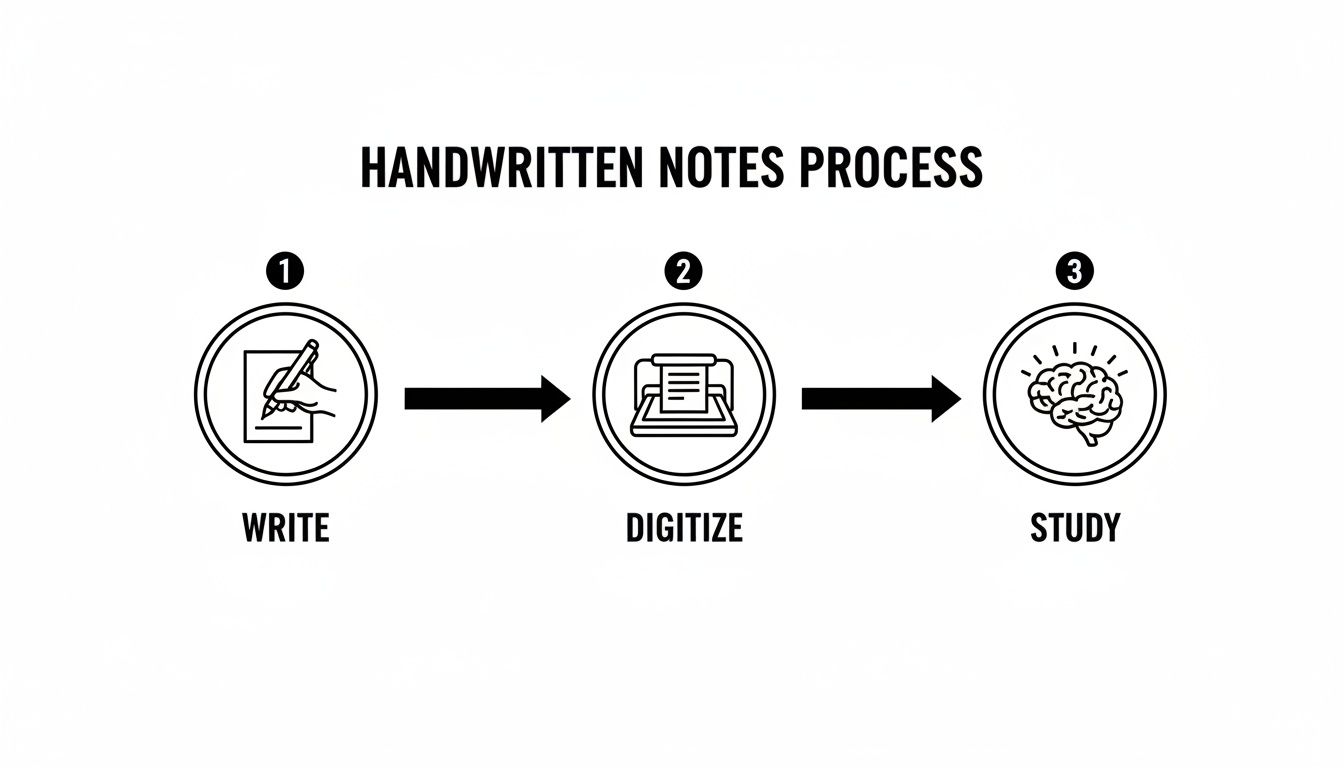
This visual breaks down how your raw, in-class notes can be transformed into an efficient and interactive study asset.
Let's be real: manually retyping your notes or making stacks of flashcards by hand is a serious time drain. Modern tools can completely eliminate that grind.
Your post-class routine shouldn’t feel like more work. It should be an efficiency hack that saves you hours of cramming later on. The goal is to spend less time organizing and more time mastering the material.
This is where an AI-powered tool like Vivora becomes your secret weapon. You can just snap photos of your handwritten notes and upload them right alongside your class slides, PDFs, or even relevant YouTube links. Vivora’s AI takes over from there.
It automatically pulls all your scattered materials together into one cohesive study guide for each course. Even better, it intelligently generates tools to help you actually learn. You can discover more about creating interactive AI flashcards from your notes.
Imagine your messy notes instantly turning into a set of practice quizzes and flashcards on the key concepts from that day’s lecture. This workflow closes the loop, turning your class content into a personalized, interactive study system that helps you truly understand and remember what you’ve learned.
Frequently Asked Questions About Note-Taking
You’ve got the strategies and the workflows down. But let's be real—putting it all into practice is where things get messy. This is where we tackle the most common questions and hurdles students face when they're trying to lock in a better note-taking system.
What If My Professor Talks Way Too Fast?
This is probably the number one struggle, especially if you're committed to taking notes by hand. When your professor is flying through slides at lightning speed, it feels impossible to keep up.
The key is to completely abandon the idea of writing down everything they say. It's a losing battle. Your new mission is to capture key ideas, not a perfect transcript.
Here’s how to handle it in the moment:
Go All-In on Shorthand: Now's the time to use those symbols and abbreviations we talked about earlier. Don't be afraid to get creative and make up your own on the fly.
Leave Strategic Gaps: Miss something important? Just leave a blank space on the page and keep moving. Don't let one missed detail derail your entire flow. You can fill it in later by asking a friend or checking the lecture recording.
Record the Audio: If your professor allows it, recording the audio of the lecture on your phone is a total game-changer. Think of it as your safety net.
After class, you can upload your skeletal notes and that audio recording to a tool like Vivora. Its AI can help connect the dots, fill in the blanks using the audio, and create a complete, easy-to-review study guide without you having to manually re-listen to the entire lecture.
Is It Actually Better to Use a Laptop or a Pen?
Ah, the classic debate. Laptops are obviously faster for getting words on the page, but a ton of research shows that writing by hand is the clear winner for memory and genuine understanding.
The physical act of writing forces your brain to process and summarize information on the spot. It’s a powerful form of active learning. Typing, on the other hand, often leads to mindless transcription—your fingers are moving, but the information isn't really sinking in.
But we get it, digital is just too convenient to ignore.
The ultimate solution isn't choosing one over the other. It's creating a hybrid system that gives you the best of both worlds.
Here’s the pro workflow:
Take notes by hand in class. This gives you all those awesome cognitive benefits and a real boost in retention.
Digitize your notes after class. Just snap a photo and upload your pages. This simple step turns your powerful handwritten notes into a searchable, organized digital asset you can access anywhere.
This way, you learn better in the moment and get the organizational power of digital tools for your exam prep.
How Do I Keep All My Notes Organized?
Juggling different notebooks, scattered Google Docs, and random PDF downloads for each class is a recipe for chaos. Come midterms, you end up wasting hours just trying to find everything before you can even start studying.
Good organization is the secret to stress-free studying.
Instead of scattering your materials across a dozen different apps and folders, create a central hub for each course. The goal is to build a single source of truth for each class.
When you upload your handwritten notes, class slides, textbook chapters, and relevant videos to one spot, you eliminate that frantic search for materials later. Platforms like Vivora are built for exactly this, automatically organizing all your content by course and turning it into a single, cohesive study guide.
How Soon After Class Should I Actually Review My Notes?
To make your notes stick, you need to review them within 24 hours. This isn't just some random tip; it's based on the "forgetting curve," a well-documented psychological principle showing we forget a massive chunk of new information almost immediately if we don't reinforce it.
A quick 15-20 minute review session later that day is a game-changer. During this time, you should:
Clean up any messy handwriting.
Fill in the gaps you left in class.
Expand on your shorthand so it makes sense later.
Write a one or two-sentence summary at the bottom of the page.
This simple habit dramatically increases how much you remember long-term. It makes studying for exams feel more like a light review session instead of a desperate, all-night cram session. It’s one of the easiest ways to ensure all your hard work in class actually pays off.
Ready to stop juggling messy notes and start studying smarter? Vivora uses AI to turn your class materials—handwritten notes, slides, and even videos—into organized study guides, flashcards, and quizzes. Try Vivora for free and see how much time you can save.