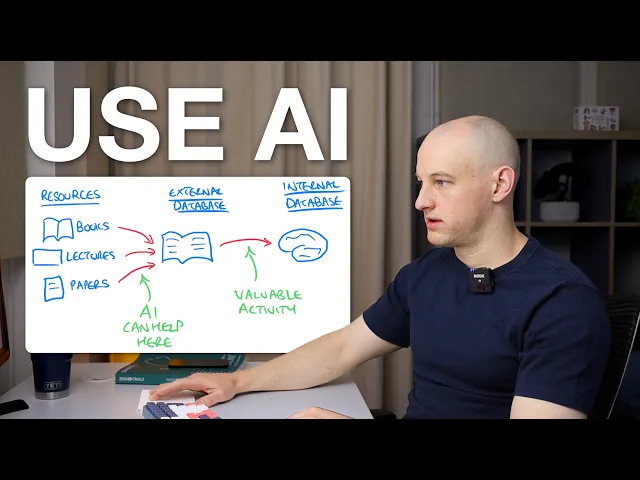
How to Study for AP Exams Without the Burnout (Seriously)
Jan 30, 2026
Let's be real: acing your AP exams isn't about pulling all-nighters fueled by energy drinks. The secret sauce is playing the long game. Starting early, staying organized, and using smart tools to study smarter—not harder—is what separates a score of 3 from a 5.
So, let's ditch the last-minute cram session vibe. A semester-long strategy breaks down those intimidating subjects into bite-sized pieces you can actually handle, making sure you walk into the exam room feeling prepped and confident, not completely fried.
Your Semester-Long AP Exam Game Plan
You know that feeling when you first look at the entire AP syllabus and your stomach just drops? Yeah, we've all been there. Staring at months of dense material feels impossible, so the natural reaction is to just... not think about it. But we all know how that ends: a frantic, caffeine-fueled panic a few days before the test that never really works.
The key to crushing AP exams without the burnout is to build a smart, sustainable plan from day one. This isn't about logging more hours with your head in a book; it's about making every hour you do spend actually count.
Start with the End in Mind
First things first: reverse-engineer your study schedule. Pull up the official College Board calendar and find your exam dates. Now, work backward.
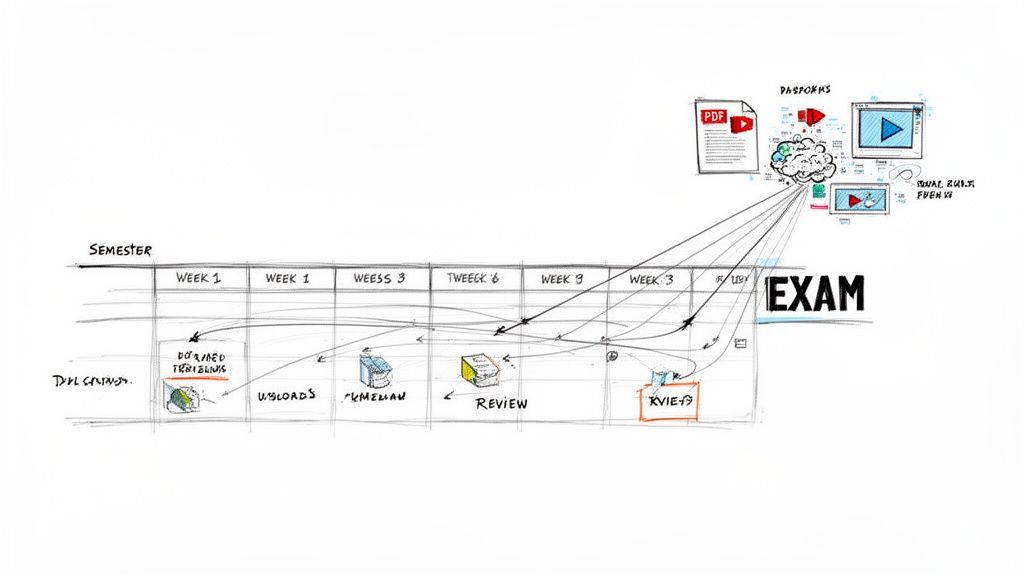
How many weeks do you have until game day? Break the entire syllabus down into weekly goals. If you have 15 weeks until the APUSH exam, you can dedicate one week to each major unit, leaving yourself a comfy buffer for review at the end.
This simple trick transforms a mountain of content into a series of small, manageable hills. Instead of a vague goal like, "I have to learn all of U.S. History," it becomes, "This week, my only job is to master the key concepts of the American Revolution." It’s a small mental shift that makes a world of difference.
This timeline gives you a bird's-eye view of how to structure your prep. You start by getting your materials in order, then move into active learning, and finish strong with consistent review.
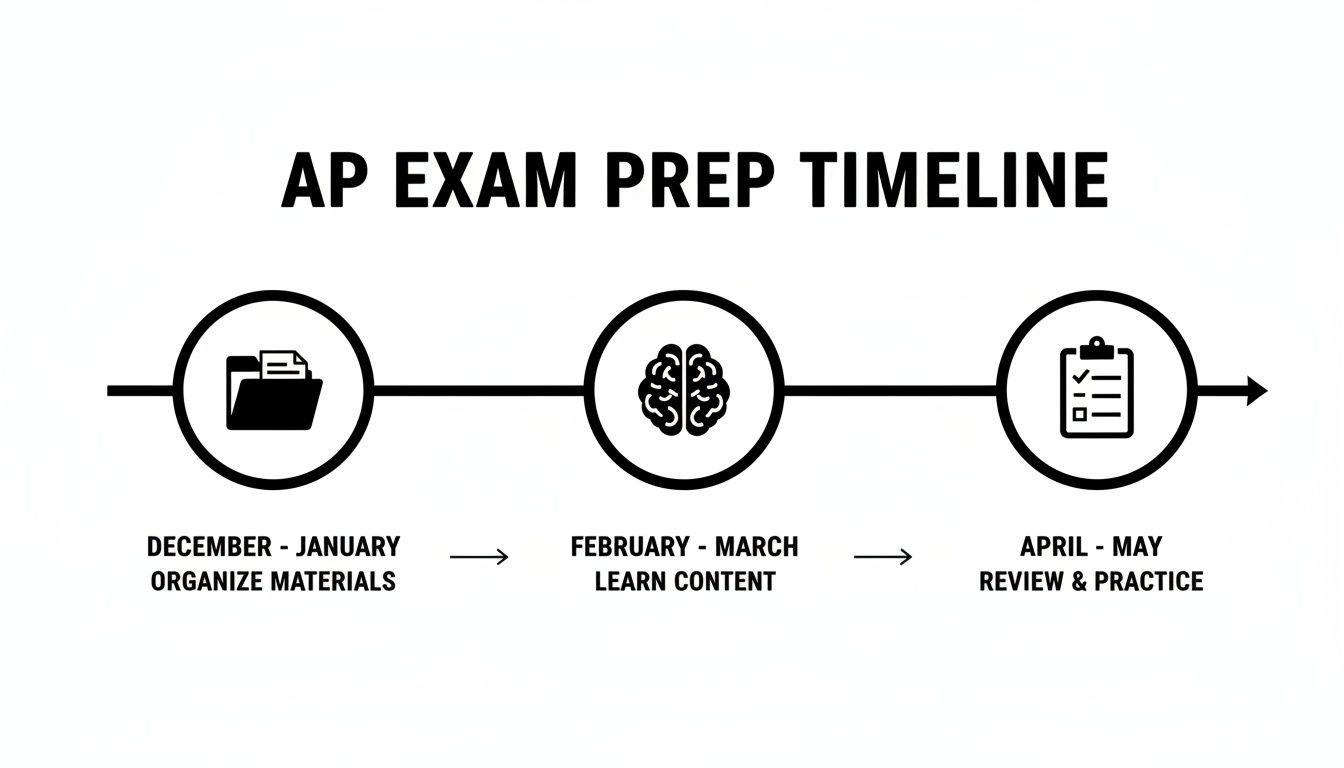
As you can see, success isn't about one heroic push at the end. It's a steady, phased approach that builds momentum over time.
To make this even more concrete, here's a simple pacing guide you can adapt.
Semester Study Pacing At a Glance
Timeframe | Your Main Goal | Key Action with Vivora |
|---|---|---|
December – January | Organize & Digitize | Upload every syllabus, PDF, and lecture note you have. Let the AI create your foundational study guide. |
February – March | Learn & Understand | Actively work through each unit. Use Vivora's auto-generated quizzes to test yourself weekly. |
April | Review & Practice | Shift focus to practice exams. Identify weak spots and use Vivora to generate targeted flashcards. |
First Week of May | Final Polish | Do a final, high-level review of key concepts and complete one last full-length mock exam. |
This timeline isn't just about scheduling; it's about building a system that prevents you from ever feeling overwhelmed.
Create a Digital Brain for Everything
Let's be honest, your class materials are probably a mess. You've got lecture slides in one folder, random PDFs in your downloads, YouTube video links saved somewhere, and notes scribbled in a physical notebook. Trying to stitch all that together in April is a recipe for disaster.
This is where you need to build a "digital brain." From the very first week of the semester, make it a habit to centralize everything into a single hub. This is the bedrock of an organized study plan. Instead of wasting 20 minutes hunting for that one specific diagram your teacher showed in February, you'll have it at your fingertips.
Pro Tip: Your energy should be spent learning the material, not just finding and organizing it. A centralized system is your single biggest time-saving hack.
This proactive approach is more critical than ever. AP exam participation has surged by approximately 20% between 2021 and 2024. This means the curve is getting more competitive, and systematic, organized study habits are essential for standing out. Students who use a structured review method are giving themselves a serious edge. You can discover more insights about these AP exam trends and what they mean for you.
This is precisely why tools like Vivora were created. You just dump all your scattered content—lecture slides, YouTube links, PDFs, even those TikTok explainers you saved—into one place. Vivora’s AI then transforms that chaotic mess of files into a perfectly organized, interactive study guide. It basically does the boring organization part for you, freeing you up to focus on what actually moves the needle: mastering the concepts. It's the ultimate upgrade for your digital brain.
Study Methods That Actually Work
Okay, let's get real about what actually works when studying for AP exams. If your go-to move is re-reading highlighted notes until your eyes glaze over, I've got some bad news: that's one of the least effective ways to learn. Your brain gets tricked into thinking it knows the material just because it looks familiar.
Real learning happens when you force your brain to work a little. It means ditching that passive review for active, science-backed techniques that make information stick. Think of it like going to the gym; you don't build muscle by watching someone else lift weights. You have to do the reps yourself.
Ditch Passive Highlighting for Active Recall
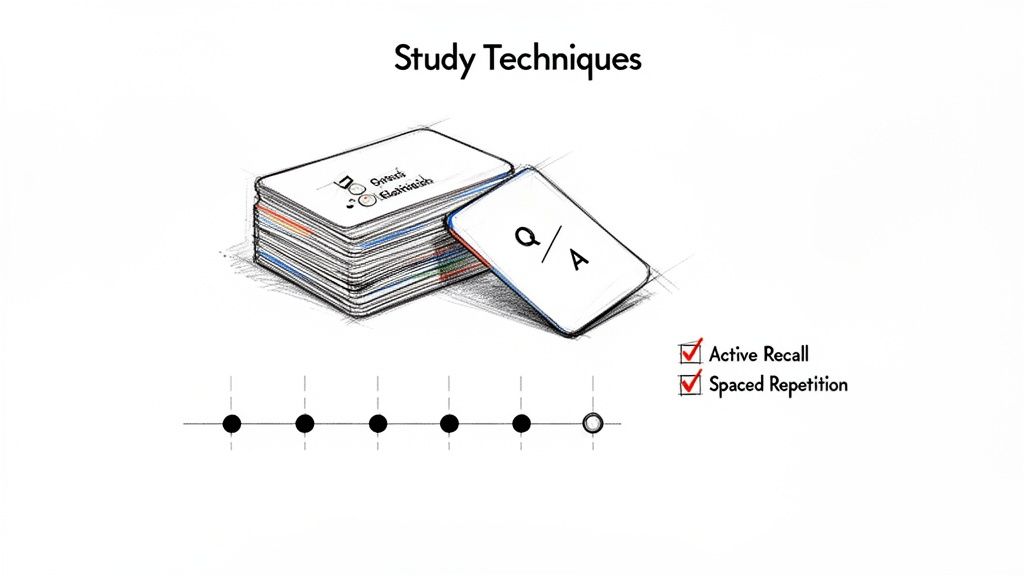
First up is a powerhouse technique called active recall. This is simply the act of pulling information out of your brain, rather than just shoving it in. Every time you try to remember a concept without looking at your notes, you strengthen that neural pathway, making it easier to access on exam day.
So, how do you actually do it? It's easier than it sounds.
Turn statements into questions: Instead of just reading "The Treaty of Versailles ended WWI," cover your notes and ask yourself, "What treaty ended WWI?"
Explain it out loud: Grab a whiteboard (or just talk to your wall, no judgment) and explain a concept from memory like you're teaching it to a friend. The moments you get stuck are the exact spots you need to review.
The "Brain Dump" method: After studying a chapter, close your book and just write down everything you can possibly remember. Then, compare what you wrote to the actual material to see what you missed.
This process feels harder than re-reading, and that's the whole point. The struggle is what makes the information stick. It's the difference between recognizing a face in a crowd and knowing their name, backstory, and why they matter.
Master Your Timing with Spaced Repetition
The second key method is spaced repetition. Our brains are literally wired to forget things over time. Spaced repetition fights this "forgetting curve" by getting you to review information at increasing intervals, right before you’re about to forget it. This systematically locks it into your long-term memory.
You don't need complicated software to get started. Here's a simple schedule for your flashcards:
Day 1: Learn the new concept.
Day 2: Review it.
Day 4: Review it again.
Day 8: And again.
Day 16: One more time for good measure.
Each time you successfully recall the info, you can push the next review session further out. This method is a total game-changer because it forces you to focus your limited time on the material you're weakest on, instead of endlessly reviewing things you already know cold.
Spaced repetition is the ultimate time-saver. You study less often but remember more effectively—the perfect formula for avoiding that pre-exam burnout.
Put Your AP Prep on Autopilot
Now, let's be honest: creating all these questions and managing flashcard schedules can be a major time sink. You should be spending your energy learning, not just building study materials.
This is exactly where an AI-powered tool like Vivora comes in clutch. When you upload your class notes, a lecture link, or even a dense textbook chapter, the AI puts these powerhouse study methods into action for you.
Instead of manually turning concepts into questions, Vivora’s AI instantly generates flashcards and practice quizzes based on your material. This puts active recall on autopilot. It builds a personalized study guide that's ready for you to start quizzing yourself immediately, saving you hours of prep work. For more ideas, check out our detailed guide on how to create flashcards that help you remember everything.
It’s all about working smarter, so you can walk into that AP exam feeling confident and genuinely prepared.
Customizing Your Strategy for Different AP Subjects
Let's be real: you wouldn't use the same game plan for AP Physics C and AP U.S. History, would you? One is all about twisting formulas and logic to solve brain-bending problems, while the other demands you dissect historical documents and build a bulletproof argument from scratch.
This is exactly why a one-size-fits-all study method will only get you so far. Truly knowing how to study for AP exams means tailoring your attack plan to the unique demands of each subject. The skills that lock in a 5 in AP Biology are a world away from what you need for AP English Literature. Let's break down the major AP categories and find a strategy that actually works for each.
Cracking the Code for STEM Subjects
For your STEM classes—think AP Calculus, Chemistry, Biology, and Physics—your entire world should revolve around problem-solving and concept application. You simply can't memorize your way through these exams. You have to get the core principles and know how to apply them to brand-new problems you've never seen before.
Your study sessions should feel less like reading a textbook and more like hitting the gym. It's all about active problem-solving.
Work through practice problems relentlessly. Don't just do the homework. Hunt down old exam questions and grind through them under the pressure of a timer.
Explain the 'why' behind the formula. Instead of just memorizing an equation, force yourself to explain why it works. If you can teach the concept behind a physics formula to a friend, you truly own that knowledge.
Zero in on your weak spots. After a practice quiz, don't just pat yourself on the back for what you got right. Dive deep into every single question you missed. Was it a dumb calculation error or a fundamental gap in your understanding?
This is where a tool like Vivora becomes your MVP. Let's say you upload your lecture slides on Newtonian mechanics from AP Physics. You can then ask the AI, "Generate a 20-question quiz focusing only on the formulas from these slides." Instantly, you have a targeted practice session designed to drill the exact material you need to master, saving you from the headache of creating your own problem sets.
Mastering the Narrative for Humanities
Okay, now let's flip the script and talk about the humanities—AP World History, APUSH, AP European History, and AP Government. You still need to know a mountain of content, but the real challenge is weaving all those facts into coherent arguments, especially for those notorious Document-Based Questions (DBQs).
The strategy here is a two-pronged attack: master the content, then perfect your analytical writing.
Connect the dots. Don't just memorize isolated dates and names. Create timelines, mind maps, or anything visual that shows how events, people, and ideas are all tangled together.
Practice DBQs and LEQs like it's your job. This part is absolutely non-negotiable. You have to get comfortable analyzing primary sources, crafting a solid thesis, and backing it up with evidence, all while the clock is ticking.
Obsess over historical thinking skills. Pay close attention to things like causation, comparison, and contextualization. These aren't just buzzwords; they're the building blocks of a high-scoring essay.
Pro Tip: For humanities, your goal is to become a storyteller. You need to construct a clear narrative supported by historical evidence, not just dump a list of disconnected facts on the page.
Vivora can be your secret weapon here, too. Upload a primary source document for APUSH, like a complex political cartoon from the Gilded Age. You can then ask the chatbot, "Explain the historical context of this document and identify three key points the artist is trying to make." This gives you instant, on-demand analysis that deepens your understanding and gets you ready for whatever DBQ gets thrown your way.
The Importance of a Tailored Approach
The need for a subject-specific strategy isn't just a hunch; the data screams it. Recent 2025 data shows huge differences in how students perform across different AP subjects. For instance, AP Physics 1 saw its pass rate jump a massive 19 points after a format change, while AP Calculus BC maintained a ridiculously high 79% pass rate.
Meanwhile, humanities subjects like European History often have lower rates of top scores. These numbers prove that your study plan has to be customized for each subject's unique content, exam format, and even its historical scoring patterns. You can discover more about these AP exam score distributions to see how your subjects stack up.
Ultimately, by recognizing that each AP exam is a different beast, you can stop wasting time on generic strategies and start focusing on what will actually move the needle for each specific test.
Using Mock Exams to Your Advantage
Taking full-length practice exams is completely non-negotiable when you’re prepping for APs. But let's be real: just doing the questions isn't the magic trick. The secret sauce that separates a score of 3 from a 5 is how you take them and, more importantly, what you do afterward.
Anyone can passively bubble in answers. A serious student, however, treats a mock exam like the real deal. This is your dress rehearsal—a chance to simulate the pressure, timing, and mental fatigue of test day so that nothing feels surprising when you walk into that exam room.
Recreate the Real Testing Vibe
First things first, you have to create a realistic testing environment at home. This isn’t the time for a casual study sesh with a lo-fi playlist in the background and your phone buzzing every few minutes. You need to go full-on exam mode.
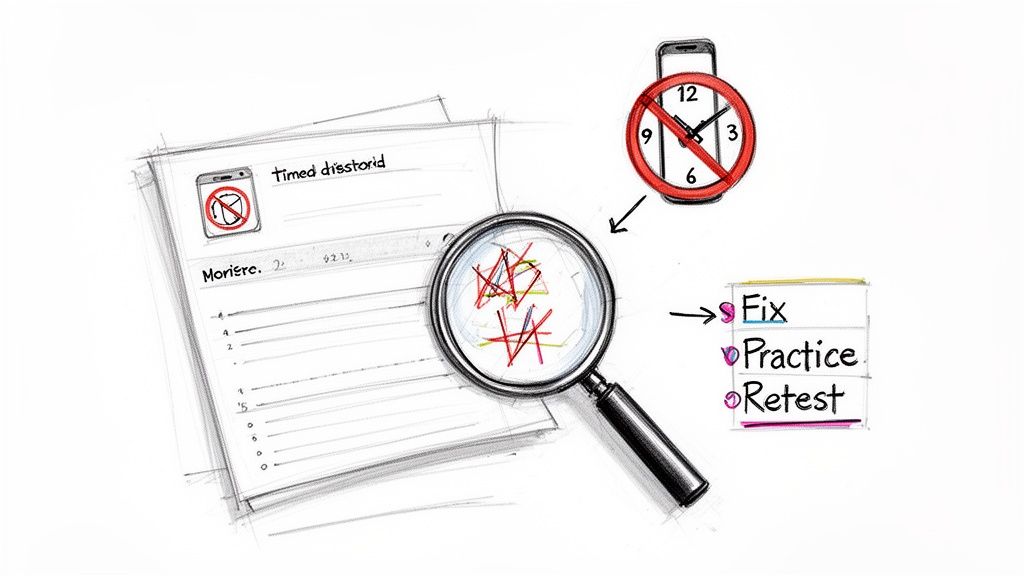
That means finding a quiet space where you won't be interrupted for a solid chunk of time. Set a timer for each section exactly as it will be on the actual test—no "just five more minutes" to finish that last free-response question. And yes, that means your phone needs to be in another room, completely out of sight and mind.
The goal is to mimic the entire experience, right down to the timed sections and short breaks. This practice isn’t just about the content; it's about building the mental stamina you'll need to stay sharp for a 3-hour exam.
Your Mistakes Are Your Best Tutors
Okay, so you’ve survived the mock exam. The timer goes off, and you can finally breathe. But the most important part of the whole process is just beginning. The real learning happens in the review.
Don't just glance at your score, feel good (or bad) about it, and move on. You need to perform a deep-dive "autopsy" on your results. Go through every single question you got wrong or even just guessed on.
Categorize Your Errors: Was it a careless mistake? A concept you totally blanked on? A question you just didn't understand?
Identify Patterns: Are you consistently missing questions about a specific historical era? Or maybe you always run out of time on the multiple-choice section.
Create an Action Plan: For every mistake, write down one specific thing you will do to fix it. This turns vague feedback into a concrete to-do list.
Pro Tip: Your mock exam results are not a judgment of your intelligence. They are a diagnostic tool—a roadmap showing you exactly where you need to focus your precious study time.
Turn Weaknesses into Strengths with AI
This detailed review process is where the real gains are made, but let's be honest, it can also be incredibly time-consuming. Manually creating study materials to patch up your knowledge gaps is a total drag.
This is another spot where a smart AI tool completely changes the game. After you take a practice test and identify your weak spots, you can use that intel to create hyper-focused review sessions in seconds.
For example, let’s say you took an AP Biology practice exam and realized you bombed all the questions on cellular respiration. Instead of re-reading the entire chapter, you can upload your notes on that topic to Vivora. Then, you can simply ask the AI to generate a targeted quiz focusing only on the concepts you struggled with. Check out how you can use Vivora’s AI quiz generator to create these personalized review sessions instantly.
This approach lets you stop wasting time reviewing things you already know and dedicate all your energy to shoring up your weaknesses. It’s the most efficient way to turn the feedback from your mock exams into real, measurable score improvements.
Making AI Your Ultimate Study Partner
Let's talk about the digital shift. The way we study is changing, and with a growing number of AP exams going digital, your old study methods might not be cutting it anymore. It’s time to stop fighting with a scattered mess of files and start using tools that are built for this new reality.
This isn't about finding a magic shortcut. It's about using smart technology to handle the tedious, time-consuming parts of studying so you can focus your brainpower on what actually matters: truly understanding the material. Think of it as giving your brain a super-powered assistant.
Unify Your Scattered Study Universe
Right now, your study materials probably look like a digital explosion. You’ve got a 50-slide PDF from your teacher on the Cold War, a dozen YouTube links explaining covalent bonds, and random notes typed into three different apps. Trying to connect all those dots isn't just exhausting—it's a massive waste of time.
This is where an AI study tool can be a lifesaver. Platforms like Vivora act as a central hub, a single place where you can dump all of this chaotic content. You upload everything—your slides, notes, and links—and the AI instantly organizes it into one cohesive, interactive study guide. No more flipping between ten different tabs just to find one piece of information.
Turn Passive Content Into Active Learning
Once your materials are in one place, the real magic begins. You can start giving the AI specific commands to transform that static content into dynamic study tools. This is how you shift from passively reading to actively learning.
Instead of just staring at that dense Cold War PDF, you can upload it and ask Vivora's chatbot a specific question:
"Generate a timeline of the 10 most important events from this lecture and explain the significance of each."
In seconds, a massive slide deck becomes a clear, chronological story that’s much easier to remember. This completely changes how you prep for AP exams, turning what would have been hours of manual work into a simple request.
You can also use this for targeted quizzing. Got a long list of key terms for AP Biology? Try a few prompts:
"Create a 15-question multiple-choice quiz based on the key terms in this document."
"Generate five short-answer questions about the causes of the French Revolution using only the information in my uploaded notes."
"Explain the concept of 'checks and balances' like I'm 15, based on the attached lecture slides."
This process puts you in the driver's seat, letting you instantly create the exact study materials you need, right when you need them.
Embrace the Digital-First Approach
This shift isn't just a trend; it's a reflection of where the exams themselves are going. The 2025 AP testing cycle was a huge step into digital assessment, with 6.25 million exam scores released globally. The overall passing rate even hit 73%—the highest in years—showing that students are adapting. You can learn more about the new digital era of AP exams to see where things are headed.
By using an AI study assistant, you're not just organizing your notes; you're building a personalized learning engine. It handles the grunt work of creating quizzes and summarizing content, freeing up your mental energy to focus on making connections, understanding complex ideas, and truly mastering the subject. This is how you study smarter, not just harder.
Your AP Exam Questions Answered
Alright, let's cut to the chase and tackle the questions that are probably bouncing around in your head right now. AP prep can feel like a maze, so think of this as your quick-and-dirty FAQ. I'm giving you direct, no-fluff answers to help you feel confident as you head into the final stretch.
How Many APs Is Too Many?
This is the golden question, and the honest answer is: it totally depends on you. There's no magic number here. The best way to figure it out is to take a hard look at your current schedule, your extracurriculars, and just your general stress levels.
Sure, taking a huge load of 4-5 APs might look great on paper, but not if your grades, sleep, and sanity tank as a result. Trust me, it's way better to get a 5 on three exams than to barely pass five of them. Be realistic about what you can handle and try to choose courses you’re genuinely interested in—it makes studying feel way less like a chore.
When Should I Seriously Start Studying?
If you're asking this in April, the answer is "right now." But ideally? Your prep should start way earlier, maybe even as early as January. The best way to tackle AP exams is to treat the whole thing like a marathon, not a sprint.
As we covered earlier, the winning strategy is to start organizing your materials from the first semester. From there, you can shift into consistent, light review in the months leading up to May. This whole approach is designed to avoid that last-minute panic and actually let the information sink into your long-term memory.
Pro Tip: Consistent, spaced-out studying over a few months will always beat intense, caffeine-fueled cramming in the last few weeks. It's less stressful and way more effective.
What Should I Do the Night Before the Exam?
This one is crucial: do not cram. Seriously. Pulling an all-nighter to shove more facts into your brain is one of the worst things you can do. At this point, you either know the material or you don't. A tired brain can't recall information effectively, no matter how much you studied.
Here’s your game plan for the night before:
Do a quick, light review. Look over your summary sheets or key flashcards for about an hour. Don't try to learn anything new.
Get your stuff ready. Pack your bag with your ID, pencils, calculator, and anything else you need. This eliminates morning stress.
Relax and disconnect. Watch a movie, listen to music, or do something that takes your mind off the test.
Go to bed early. Aim for a solid 8-9 hours of sleep. It's the single most important thing you can do to ensure your brain is firing on all cylinders.
How Can I Make Studying Less Boring?
Let's be real, reading a textbook for three hours straight is a recipe for burnout. The key is to make your study sessions active and varied. Instead of just passively re-reading your notes, you need to actually engage with the material.
This is where you can get a little creative. Try turning concepts into diagrams, teaching them to a friend (or even your pet), or finding YouTube videos that explain things in a new way. Even better, you can use a tool that does the heavy lifting for you.
For example, with Vivora, you can upload your boring lecture notes and instantly turn them into interactive quizzes or flashcards. Instead of just staring at a page, you’re actively testing your knowledge with the click of a button. It breaks up the monotony and makes sure you're actually learning, not just passively reading.
Stop drowning in disorganized notes and start studying smarter. Vivora turns your chaotic class materials into clear, interactive study guides in seconds. Try Vivora for free today and see how much faster you can learn.